

Ch. 6 - Applications of Integration
Briggs - Calculus: Early Transcendentals 3rd Edition
Briggs3rd EditionCalculus: Early TranscendentalsISBN: 9780136847243Non è quello che usi tu?Cambia libro di testo
Capitolo 6, Problema 6.1.26c

Day hike The velocity (in mi/hr) of a hiker walking along a straight trail is given by v(t) = 3 sin² πt/2, for 0≤t≤4. Assume s(0)=0 and t is measured in hours. 


c. What is the hiker’s position at t=3?

Guida verificata passo dopo passo
1
Step 1: Understand the problem. The hiker's position at time t=3 can be found by integrating the velocity function v(t) = 3 sin²(πt/2) over the interval [0, 3]. This is because position is the integral of velocity with respect to time.
Step 2: Set up the integral. The position function s(t) is given by s(t) = ∫ v(t) dt. Since s(0) = 0, the position at t=3 is s(3) = ∫[0 to 3] 3 sin²(πt/2) dt.
Step 3: Simplify the integrand using a trigonometric identity. Recall that sin²(x) can be rewritten as (1 - cos(2x))/2. Substituting this into the integral, we get s(3) = ∫[0 to 3] 3 * (1 - cos(πt))/2 dt.
Step 4: Break the integral into two parts. The integral becomes s(3) = (3/2) ∫[0 to 3] 1 dt - (3/2) ∫[0 to 3] cos(πt) dt. Evaluate each part separately.
Step 5: Evaluate the integrals. For the first term, ∫[0 to 3] 1 dt is straightforward and equals t evaluated from 0 to 3. For the second term, ∫[0 to 3] cos(πt) dt requires substitution u = πt, du = π dt, and then solving the integral. Combine the results to find s(3).

Risposta video verificata per un problema simile:

Questa soluzione video è stata consigliata dai nostri tutor come utile per risolvere questo problema.
Durata del video:
4m

Concetti chiave

Ecco i concetti essenziali che devi comprendere per rispondere correttamente alla domanda.

Velocity and Position Functions

In calculus, velocity is the rate of change of position with respect to time. The position function, s(t), can be derived from the velocity function, v(t), by integrating it over time. In this case, the hiker's position at any time t can be found by integrating the given velocity function v(t) = 3 sin²(πt/2) from 0 to t.
Video consigliato:
Percorso guidato
10:17
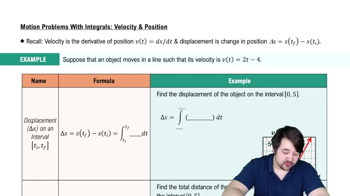
Using The Velocity Function

Integration

Integration is a fundamental concept in calculus that allows us to find the accumulated value of a function over an interval. To find the hiker's position at t=3, we need to compute the definite integral of the velocity function from 0 to 3. This process essentially sums up all the small changes in position over the specified time period.
Video consigliato:
Percorso guidato
06:18
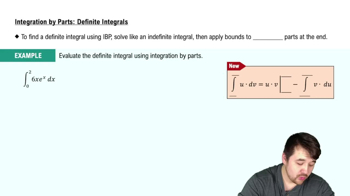
Integration by Parts for Definite Integrals

Definite Integral

A definite integral calculates the net area under a curve between two points on the x-axis. In this context, it represents the total distance traveled by the hiker from time t=0 to t=3. The result of the definite integral will give us the hiker's position at t=3, which is crucial for answering the question.
Video consigliato:
Percorso guidato
05:43
Definition of the Definite Integral
Pratica correlata
Domanda del libro di testo

Determine whether the following statements are true and give an explanation or counterexample. 


c. Let f(x)=12x^2. The area of the surface generated when the graph of f on [−4, 4] is revolved about the x-axis is twice the area of the surface generated when the graph of f on [0, 4] is revolved about the x-axis. 

65
views
Domanda del libro di testo

Probe speed A data collection probe is dropped from a stationary balloon, and it falls with a velocity (in m/s) given by v(t) = 9.8t, neglecting air resistance. After 10 s, a chute deploys and the probe immediately slows to a constant speed of 10 m/s, which it maintains until it enters the ocean.


c. If the probe was released from an altitude of 3 km, when does it enter the ocean?

46
views
Domanda del libro di testo

Cycling distance A cyclist rides down a long straight road with a velocity (in m/min) given by v(t) = 400−20t, for 0≤t≤10, where t is measured in minutes.


c. How far has the cyclist traveled when her velocity is 250 m/min?

49
views
Domanda del libro di testo

Flow rates in the Spokane River The daily discharge of the Spokane River as it flows through Spokane, Washington, in April and June is modeled by the functions

r1(t) = 0.25t²+37.46t+722.47 (April) and

r2(t) = 0.90t²−69.06t+2053.12 (June), where the discharge is measured in millions of cubic feet per day, and t=0 corresponds to the beginning of the first day of the month (see figure).

c. The Spokane River flows out of Lake Coeur d’Alene, which contains approximately 0.67mi³ of water. Determine the percentage of Lake Coeur d’Alene’s volume that flows through Spokane in April and June.

32
views
Domanda del libro di testo

Determine whether the following statements are true and give an explanation or counterexample.


c. ∫₀¹(x−x^2) dx=∫₀¹(√y−y) dy

54
views
Domanda del libro di testo

13–16. Displacement from velocity Consider an object moving along a line with the given velocity v. Assume time t is measured in seconds and velocities have units of m/s.


c. Find the distance traveled over the given interval.


v(t) = 3t²−6t on [0, 3]

85
views