
Ch. 6 - Applications of Integration
Briggs - Calculus: Early Transcendentals 3rd Edition
Briggs3rd EditionCalculus: Early TranscendentalsISBN: 9780136847243Non è quello che usi tu?Cambia libro di testo
Capitolo 6, Problema 6.1.59a

Explain why or why not Determine whether the following statements are true and give an explanation or counterexample.


a. The distance traveled by an object moving along a line is the same as the displacement of the object.

Guida verificata passo dopo passo
1
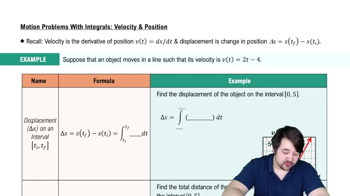
Recall the definitions: Displacement is the change in position of an object, calculated as the final position minus the initial position, and it is a vector quantity (it has direction). Distance traveled is the total length of the path taken by the object, which is a scalar quantity (only magnitude, no direction).
Understand that displacement can be zero if the object returns to its starting point, but the distance traveled will be the total length covered, which is generally not zero in this case.
Consider an example: if an object moves 5 meters to the right and then 5 meters back to the left, the displacement is zero (because the final position equals the initial position), but the distance traveled is 10 meters (5 + 5).
From this example, conclude that the distance traveled and displacement are not always the same; distance traveled is always greater than or equal to the magnitude of displacement.
Therefore, the statement 'The distance traveled by an object moving along a line is the same as the displacement of the object' is false, and the counterexample above demonstrates why.

Risposta video verificata per un problema simile:

Questa soluzione video è stata consigliata dai nostri tutor come utile per risolvere questo problema.
Durata del video:
2m

Concetti chiave

Ecco i concetti essenziali che devi comprendere per rispondere correttamente alla domanda.

Displacement

Displacement is a vector quantity that represents the change in position of an object from its starting point to its ending point, considering direction. It is calculated as the straight-line distance between the initial and final positions, regardless of the path taken.
Video consigliato:
Percorso guidato
10:17
Using The Velocity Function

Distance Traveled

Distance traveled is a scalar quantity that measures the total length of the path an object moves along, without considering direction. It accounts for all movement, including any backtracking or detours, and is always equal to or greater than the magnitude of displacement.
Video consigliato:
Percorso guidato
06:22
Introduction To Work

Difference Between Distance and Displacement

Distance and displacement differ because displacement only considers the net change in position, while distance sums the entire path length. For example, if an object moves forward and then back to the start, displacement is zero, but distance traveled is positive, showing they are not always equal.
Video consigliato:
02:59
Finding Area Between Curves that Cross on the Interval
Pratica correlata
Domanda del libro di testo

13–16. Displacement from velocity Consider an object moving along a line with the given velocity v. Assume time t is measured in seconds and velocities have units of m/s.


a. Determine when the motion is in the positive direction and when it is in the negative direction. 


v(t) = 50e^−2t on [0, 4]

35
views
Domanda del libro di testo

21–30. {Use of Tech} Arc length by calculator


a. Write and simplify the integral that gives the arc length of the following curves on the given interval. 

y = 1/x, for 1 ≤ x ≤ 10

59
views
Domanda del libro di testo

55–58. Marginal cost Consider the following marginal cost functions.


a. Find the additional cost incurred in dollars when production is increased from 100 units to 150 units.


C′(x)=200−0.05x

64
views
Domanda del libro di testo

Emptying a cylindrical tank A cylindrical water tank has height 8 m and radius 2m (see figure).

a. If the tank is full of water, how much work is required to pump the water to the level of the top of the tank and out of the tank?

98
views
Domanda del libro di testo

Let R be the region in the first quadrant bounded above by the curve y=2−x² and bounded below by the line y=x. Suppose the shell method is used to determine the volume of the solid generated by revolving R about the y-axis.

a. What is the radius of a cylindrical shell at a point x in [0, 2]?

70
views
Domanda del libro di testo

Region R is revolved about the line x=4 to form a solid of revolution.


a. What is the radius of a cross section of the solid at a point y in [1, 3]?

61
views