Ch. 10 - Infinite Sequences and Series
Hass - Thomas' Calculus 15th Edition
Hass15th EditionThomas' CalculusISBN: 9780137616077Non è quello che usi tu?Cambia libro di testo
Capitolo 10, Problema 10.7.28b

Intervals of Convergence
In Exercises 1–36, for what values of x does the series converge (b) absolutely?
∑ (from n = 0 to ∞) [ (−2)ⁿ (n + 1) (x − 1)ⁿ ]

Guida verificata passo dopo passo
1
Identify the given power series: \(\sum_{n=0}^{\infty} (-2)^n (n+1) (x-1)^n\).
To determine absolute convergence, consider the series formed by the absolute values of the terms: \(\sum_{n=0}^{\infty} |(-2)^n (n+1) (x-1)^n| = \sum_{n=0}^{\infty} (n+1) |2|^n |x-1|^n = \sum_{n=0}^{\infty} (n+1) (2|x-1|)^n\).
Recognize that this is a power series in terms of \(r = 2|x-1|\) with general term \((n+1) r^n\). To analyze convergence, use the root or ratio test, or recall the known result for the series \(\sum (n+1) r^n\).
Recall that the series \(\sum_{n=0}^{\infty} (n+1) r^n\) converges if and only if \(|r| < 1\). Therefore, set up the inequality \(2|x-1| < 1\) to find the interval where the series converges absolutely.
Solve the inequality \(2|x-1| < 1\) to find the values of \(x\) for which the original series converges absolutely. This will give the interval of absolute convergence.

Risposta video verificata per un problema simile:

Questa soluzione video è stata consigliata dai nostri tutor come utile per risolvere questo problema.
Durata del video:
12m

Concetti chiave

Ecco i concetti essenziali che devi comprendere per rispondere correttamente alla domanda.

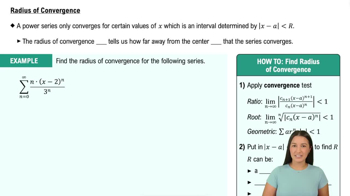
Radius and Interval of Convergence

The radius of convergence defines the distance from the center point within which a power series converges. The interval of convergence includes all x-values for which the series converges, possibly including endpoints. Finding this interval involves applying tests like the Ratio or Root Test to the general term.
Video consigliato:
07:36
Radius of Convergence

Absolute Convergence

A series converges absolutely if the series of absolute values converges. This is a stronger form of convergence ensuring the original series converges regardless of term signs. Testing absolute convergence often simplifies analysis by removing alternating signs.
Video consigliato:
Percorso guidato
07:51
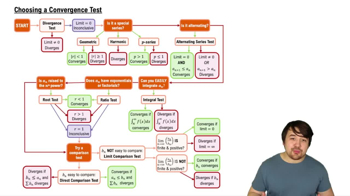
Choosing a Convergence Test

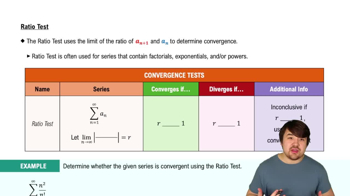
Ratio Test for Series Convergence

The Ratio Test evaluates the limit of the absolute value of the ratio of consecutive terms. If this limit is less than one, the series converges absolutely; if greater than one, it diverges. This test is especially useful for power series involving factorials or exponential terms.
Video consigliato:
Pratica correlata
Domanda del libro di testo

∑ (from n=1 to ∞) (1 / √(n + 1)) diverges

b. What should n be in order that the partial sum sₙ = ∑ (from i=1 to n) (1 / √(i + 1)) satisfies sₙ > 1000?

29
views

Domanda del libro di testo

b. From Example 5, Section 10.2, show that

S = 1 + ∑(from n=1 to ∞) [1 / (n²(n + 1))].

21
views
Domanda del libro di testo

A sequence of rational numbers is described as follows:

1/1,3/2,7/5,17/12,…,a/b,(a + 2b)/(a + b),…

Here the numerators form one sequence, the denominators form a second sequence, and their ratios form a third sequence. Let xₙ and yₙ be, respectively, the numerator and the denominator of the nᵗʰ fraction rₙ = xₙ / yₙ.

b. The fractions rₙ = xₙ / yₙ approach a limit as n increases. What is that limit? (Hint: Use part (a) to show that rₙ² − 2 = ±(1 / yₙ)² and that yₙ is not less than n.)

33
views
Domanda del libro di testo

Quadratic Approximations The Taylor polynomial of order 2 generated by a twice-differentiable function f(x) at x = a is called the quadratic approximation of f at x = a. In Exercises 41–46, find the (a) linearization (Taylor polynomial of order 1)

f(x) = ln(cos x)

26
views
Domanda del libro di testo

Intervals of Convergence

Intervals of Convergence

In Exercises 1–36, for what values of x does the series converge (b) absolutely?

∑ (from n = 1 to ∞) [ (3x + 1)^(n + 1) / (2n + 2) ]

29
views
Domanda del libro di testo

The series

eˣ = 1 + x + x²/2! + x³/3! + x⁴/4! + x⁵/5! + ⋯

converges to eˣ for all x.

a. Find a series for (d/dx)eˣ. Do you get the series for eˣ? Explain your answer.

5
views