
Ch. 4 - Applications of Derivatives
Hass - Thomas' Calculus 15th Edition
Hass15th EditionThomas' CalculusISBN: 9780137616077Non è quello che usi tu?Cambia libro di testo
Capitolo 4, Problema 23

The Mean Value Theorem                                                                                                                                                                  
                                                                                                                                                                                        
 a. Show that the equation 𝓍⁴ + 2𝓍² ― 2 = 0 has exactly one solution on [0,1] .
         
[Technology Exercises] b.Find the solution to as many decimal places as you can.  

Guida verificata passo dopo passo
1
Step 1: Define the function f(x) = x^4 + 2x^2 - 2. We need to show that this function has exactly one solution in the interval [0,1].
Step 2: Check the endpoints of the interval. Calculate f(0) and f(1). f(0) = 0^4 + 2*0^2 - 2 = -2 and f(1) = 1^4 + 2*1^2 - 2 = 1.
Step 3: Since f(0) < 0 and f(1) > 0, by the Intermediate Value Theorem, there is at least one root in the interval (0,1).
Step 4: To show that there is exactly one solution, check the derivative f'(x) = 4x^3 + 4x. Analyze the sign of f'(x) on the interval [0,1].
Step 5: Since f'(x) = 4x(x^2 + 1) is always positive for x in [0,1], f(x) is strictly increasing on this interval. Therefore, there is exactly one root in [0,1].

Risposta video verificata per un problema simile:

Questa soluzione video è stata consigliata dai nostri tutor come utile per risolvere questo problema.
Durata del video:
6m

Concetti chiave

Ecco i concetti essenziali che devi comprendere per rispondere correttamente alla domanda.

Mean Value Theorem

The Mean Value Theorem (MVT) states that if a function is continuous on a closed interval [a, b] and differentiable on the open interval (a, b), then there exists at least one point c in (a, b) such that the derivative at that point equals the average rate of change of the function over [a, b]. This theorem is fundamental in understanding the behavior of functions and can be used to prove the existence of solutions to equations.
Video consigliato:
Percorso guidato
06:11
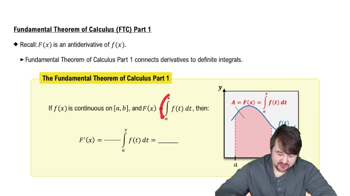
Fundamental Theorem of Calculus Part 1

Intermediate Value Theorem

The Intermediate Value Theorem (IVT) asserts that for any continuous function on a closed interval [a, b], if the function takes on two values f(a) and f(b), then it must also take on every value between f(a) and f(b) at least once. This theorem is crucial for establishing the existence of roots within an interval, which is essential for showing that the equation x⁴ + 2x² - 2 = 0 has a solution in [0, 1].
Video consigliato:
Percorso guidato
06:11
Fundamental Theorem of Calculus Part 1

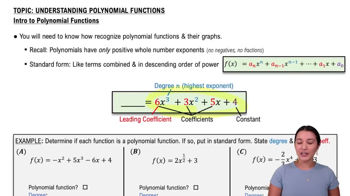
Finding Roots of Polynomials

Finding roots of polynomials involves determining the values of x for which the polynomial equals zero. Techniques such as factoring, synthetic division, and numerical methods (like the Newton-Raphson method) can be employed. In the context of the given equation, analyzing the polynomial's behavior on the interval [0, 1] can help confirm the existence and uniqueness of a root, as well as facilitate the approximation of its value.
Video consigliato:
6:04
Introduction to Polynomial Functions
Pratica correlata