Ch. 7 - Transcendental Functions
Hass - Thomas' Calculus 15th Edition
Hass15th EditionThomas' CalculusISBN: 9780137616077Non è quello che usi tu?Cambia libro di testo
Capitolo 7, Problema 7.1.50c

c. Find the slopes of the tangent lines to the graphs of h and k at (2, 2) and (−2, −2).

Guida verificata passo dopo passo
1
Identify the functions h and k whose tangent line slopes you need to find. Make sure you have their explicit formulas or expressions.
Recall that the slope of the tangent line to a function at a point is given by the derivative of the function evaluated at that point. So, find the derivatives \( h'(x) \) and \( k'(x) \).
Evaluate the derivative \( h'(x) \) at \( x = 2 \) and \( x = -2 \) to find the slopes of the tangent lines to \( h \) at the points \( (2, 2) \) and \( (-2, -2) \).
Similarly, evaluate the derivative \( k'(x) \) at \( x = 2 \) and \( x = -2 \) to find the slopes of the tangent lines to \( k \) at the points \( (2, 2) \) and \( (-2, -2) \).
Summarize the slopes found for each function at the given points, which represent the slopes of the tangent lines to the graphs at those points.

Risposta video verificata per un problema simile:

Questa soluzione video è stata consigliata dai nostri tutor come utile per risolvere questo problema.
Durata del video:
2m

Concetti chiave

Ecco i concetti essenziali che devi comprendere per rispondere correttamente alla domanda.

Derivative as the Slope of the Tangent Line

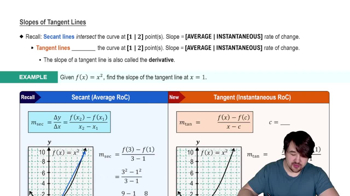
The derivative of a function at a given point represents the slope of the tangent line to the graph at that point. It measures the instantaneous rate of change of the function with respect to the independent variable.
Video consigliato:
Percorso guidato
05:13
Slopes of Tangent Lines

Evaluating the Derivative at Specific Points

To find the slope of the tangent line at a particular point, you first compute the derivative function and then substitute the x-coordinate of the point into this derivative. This yields the slope value at that point.
Video consigliato:

Understanding the Graphs of Functions h and k

Knowing the explicit forms or properties of the functions h and k is essential to differentiate them correctly. This understanding allows accurate calculation of their derivatives and evaluation at the given points (2, 2) and (−2, −2).
Video consigliato:
Percorso guidato
5:53
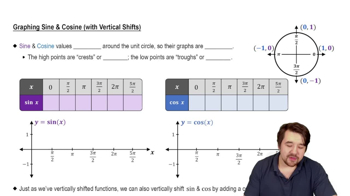
Graph of Sine and Cosine Function
Pratica correlata
Domanda del libro di testo

Use reference triangles in an appropriate quadrant to find the angles in Exercises 1–8.

1. c. tan^(-1)(1/√3)

20
views

Domanda del libro di testo

In Exercises 67–72, you will explore some functions and their inverses together with their derivatives and tangent line approximations at specified points. Perform the following steps using your CAS:


c. Find the equation for the tangent line to f at the specified point (x_0, f(x_0)).


70. y= x³/(x²+1), -1 ≤ x ≤ 1, x_0=1/2

16
views
Domanda del libro di testo

3. Which of the following functions grow faster than x² as x→∞? Which grow at the same rate as x²? Which grow slower?

c. √(x^4 + x^3)

20
views
Domanda del libro di testo

9. True, or false? As x→∞,

c. x = O(x+5)

29
views
Domanda del libro di testo

In Exercises 67–72, you will explore some functions and their inverses together with their derivatives and tangent line approximations at specified points. Perform the following steps using your CAS:


c. Find the equation for the tangent line to f at the specified point (x_0, f(x_0)).


72. y= 2-x-x³, -2 ≤ x ≤ 2, x_0 = 3/2


15
views
Domanda del libro di testo

23. Human evolution continues The analysis of tooth shrinkage by C. Loring Brace and colleagues at the University of Michigan’s Museum of Anthropology indicates that human tooth size is continuing to decrease and that the evolutionary process has not yet come to a halt. In northern Europeans, for example, tooth size reduction now has a rate of 1% per 1000 years.

c. What will be our descendants’ tooth size 20,000 years from now (as a percentage of our present tooth size)?

6
views