37. Plutonium-239 The half-life of the plutonium isotope is 24,360 years. If 10 g of plutonium is released into the atmosphere by a nuclear accident, how many years will it take for 80% of the isotope to decay?
Ch. 7 - Transcendental Functions
Capitolo 7, Problema 7.3.23
In Exercises 7–26, find the derivative of y with respect to x, t, or θ, as appropriate.
y = e^(cost+lnt)
Guida verificata passo dopo passo1
Identify the variable with respect to which you need to differentiate. Since the function is given as \(y = e^{\cos t + \ln t}\), and the expression involves \(t\), we will differentiate with respect to \(t\).
Recall the chain rule for differentiation: if \(y = e^{u(t)}\), then \(\frac{dy}{dt} = e^{u(t)} \cdot \frac{du}{dt}\), where \(u(t) = \cos t + \ln t\) in this case.
Find the derivative of the exponent function \(u(t) = \cos t + \ln t\). Differentiate each term separately: \(\frac{d}{dt}(\cos t) = -\sin t\) and \(\frac{d}{dt}(\ln t) = \frac{1}{t}\).
Combine the derivatives of the terms to get \(\frac{du}{dt} = -\sin t + \frac{1}{t}\).
Write the final expression for the derivative using the chain rule: \(\frac{dy}{dt} = e^{\cos t + \ln t} \cdot \left(-\sin t + \frac{1}{t}\right)\).

Risposta video verificata per un problema simile:
Questa soluzione video è stata consigliata dai nostri tutor come utile per risolvere questo problema.
Durata del video:
4mConcetti chiave
Ecco i concetti essenziali che devi comprendere per rispondere correttamente alla domanda.
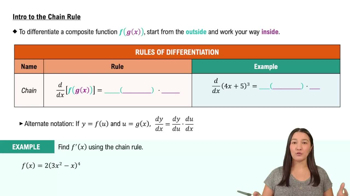
Chain Rule
The chain rule is used to differentiate composite functions. It states that the derivative of a function composed of another function is the derivative of the outer function evaluated at the inner function times the derivative of the inner function. This is essential when differentiating expressions like e^(cos t + ln t).
Video consigliato:
Intro to the Chain Rule
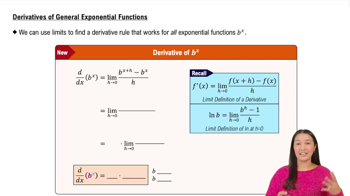
Derivatives of Exponential Functions
The derivative of an exponential function e^u, where u is a function of the variable, is e^u multiplied by the derivative of u. Recognizing this helps in differentiating y = e^(cos t + ln t) by first identifying the exponent as a function and then applying the chain rule.
Video consigliato:
Derivatives of General Exponential Functions
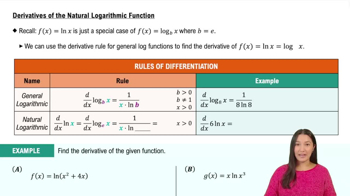
Derivatives of Trigonometric and Logarithmic Functions
Knowing the derivatives of cos t and ln t is crucial. The derivative of cos t with respect to t is -sin t, and the derivative of ln t is 1/t. These derivatives are used when applying the chain rule to find the derivative of the exponent in the given function.
Video consigliato:
Derivative of the Natural Logarithmic Function
Pratica correlata
Domanda del libro di testo
4
views
Domanda del libro di testo
Indeterminate Powers and Products
Find the limits in Exercises 53–68.
63. lim (x → ∞) ((x + 2)/(x - 1))^x
18
views
Domanda del libro di testo
In Exercises 115–126, use logarithmic differentiation or the method in Example 6 to find the derivative of y with respect to the given independent variable.
124. x^(sin y) = ln y
35
views
Domanda del libro di testo
132. What is special about the functions
f(x) = arcsin((1/√(x²+1)) and g(x)=arctan(1/x)?
Explain.
26
views
Domanda del libro di testo
Use l’Hôpital’s rule to find the limits in Exercises 7–52.
35. lim (x → 0⁺) ln(x² + 2x) / ln x
52
views
Domanda del libro di testo
135. Find the area of the “triangular” region in the first quadrant that is bounded above by the curve y = e^(2x), below by the curve y = e^x, and on the right by the line x = ln(3).
23
views