Ch. 8 - Techniques of Integration
Hass - Thomas' Calculus 15th Edition
Hass15th EditionThomas' CalculusISBN: 9780137616077Non è quello che usi tu?Cambia libro di testo
Capitolo 8, Problema 8.PE.135

135. Evaluate ∫₀^(π/2) (sin x) / (sin x + cos x) dx in two ways:
(a) By evaluating ∫ (sin x) / (sin x + cos x) dx, then using the Evaluation Theorem.

Guida verificata passo dopo passo
1
Start by defining the integral: \(I = \int_0^{\frac{\pi}{2}} \frac{\sin x}{\sin x + \cos x} \, dx\).
To evaluate the integral directly, consider the integrand \(f(x) = \frac{\sin x}{\sin x + \cos x}\). Find its antiderivative \(F(x)\) by using algebraic manipulation or substitution techniques.
One useful approach is to rewrite the integrand as \(\frac{\sin x}{\sin x + \cos x} = 1 - \frac{\cos x}{\sin x + \cos x}\), which might simplify the integration process.
Integrate each term separately: \(\int 1 \, dx\) and \(\int \frac{\cos x}{\sin x + \cos x} \, dx\). For the second integral, consider the substitution \(u = \sin x + \cos x\), then find \(du\) and express the integral in terms of \(u\).
After finding the antiderivative \(F(x)\), apply the Evaluation Theorem (Fundamental Theorem of Calculus) by computing \(F\left(\frac{\pi}{2}\right) - F(0)\) to get the value of the definite integral.

Risposta video verificata per un problema simile:

Questa soluzione video è stata consigliata dai nostri tutor come utile per risolvere questo problema.
Durata del video:
6m

Concetti chiave

Ecco i concetti essenziali che devi comprendere per rispondere correttamente alla domanda.

Definite Integral and Evaluation Theorem

A definite integral calculates the net area under a curve between two limits. The Evaluation Theorem states that if F is an antiderivative of f, then ∫_a^b f(x) dx = F(b) - F(a). This allows us to find the exact value of the integral by evaluating the antiderivative at the boundaries.
Video consigliato:
Percorso guidato
05:43
Definition of the Definite Integral

Integration Techniques for Rational Trigonometric Functions

Integrating expressions like (sin x) / (sin x + cos x) often requires algebraic manipulation or substitution to simplify the integrand. Recognizing patterns or using substitutions such as t = tan x or rewriting numerator and denominator can make the integral more manageable.
Video consigliato:
Percorso guidato
6:04
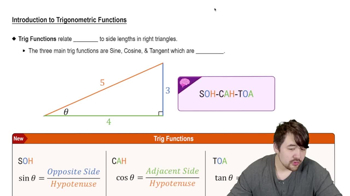
Introduction to Trigonometric Functions

Symmetry and Complementary Angle Properties in Definite Integrals

For integrals over [0, π/2], using symmetry or the property f(π/2 - x) can simplify evaluation. This approach exploits complementary angles in sine and cosine to relate integrals and sometimes find values without direct integration.
Video consigliato:
Percorso guidato
05:43
Definition of the Definite Integral
Pratica correlata
Domanda del libro di testo

4. What substitutions are made to evaluate integrals of sin(mx)sin(nx), sin(mx)cos(nx), and cos(mx)cos(nx)? Give an example of each case.

17
views

Domanda del libro di testo

Heat capacity of a gas

Heat capacity 

C_v

is the amount of heat required to raise the temperature of a given mass of gas with constant volume by 1°C, measured in units of cal/deg-mol (calories per degree gram molecular weight).

The heat capacity of oxygen depends on its temperature T and satisfies the formula

C_v = 8.27 + 10^(-5) * (26T − 1.87T²)

Use Simpson’s Rule to find the average value of C_v and the temperature at which it is attained for

20°C ≤ T ≤ 675°C.

20
views
Domanda del libro di testo

Evaluate the integrals in Exercises 29–32 (b) using a trigonometric substitution.

∫ [x / √(4 − x²)] dx

28
views
Domanda del libro di testo

Evaluate the integrals in Exercises 69–134. The integrals are listed in random order so you need to decide which integration technique to use.

129. ∫ (x^(ln x) * ln x) / x dx

18
views
Domanda del libro di testo

Evaluate the integrals in Exercises 69–134. The integrals are listed in random order so you need to decide which integration technique to use.

∫ (2 − cosx + sinx) / sin²x dx

30
views
Domanda del libro di testo

In Exercises 11–22, estimate the minimum number of subintervals needed to approximate the integrals with an error of magnitude less than 10^-4 by (a) the Trapezoidal Rule (The integrals in Exercises 11–18 are the integrals from Exercises 1–8.)

∫ from -1 to 1 of (x² + 1) dx

30
views