2. When applying the formula for integration by parts, how do you choose the u and dv? How can you apply integration by parts to an integral of the form ∫ f(x) dx?
Ch. 8 - Techniques of Integration
Capitolo 8, Problema 8.AAE.18a
18. Finding volume (Continuation of Exercise 17.) Find the volume of the solid generated by revolving the region R about:
a. the y-axis.
Guida verificata passo dopo passo1
Identify the region R from Exercise 17. Typically, this region is bounded by given curves or lines. Make sure you clearly understand the boundaries of R before proceeding.
Since the solid is generated by revolving the region R about the y-axis, decide on the method to use for finding the volume. The common methods are the Disk/Washer method or the Shell method. For revolution around the y-axis, the Shell method is often convenient.
Set up the integral using the Shell method. The formula for the volume using cylindrical shells when revolving around the y-axis is:
\[ V = \int_{a}^{b} 2\pi \cdot (\text{radius}) \cdot (\text{height}) \, dx \]
Here, the radius is the distance from the y-axis (which is simply \(x\)), and the height is the vertical length of the region at each \(x\).
Determine the limits of integration \(a\) and \(b\) from the domain of the region R along the x-axis. Also, express the height of the shell as a function of \(x\) by subtracting the lower curve from the upper curve within the region.
Write the integral explicitly by substituting the radius and height expressions, then prepare to evaluate the integral to find the volume. Remember, do not compute the final value yet—just set up the integral correctly.

Risposta video verificata per un problema simile:
Questa soluzione video è stata consigliata dai nostri tutor come utile per risolvere questo problema.
Durata del video:
5mConcetti chiave
Ecco i concetti essenziali che devi comprendere per rispondere correttamente alla domanda.
Volume of Solids of Revolution
This concept involves calculating the volume of a 3D solid formed by rotating a 2D region around an axis. The volume is typically found using integral calculus methods such as the disk, washer, or shell methods, depending on the axis of rotation and the shape of the region.
Video consigliato:
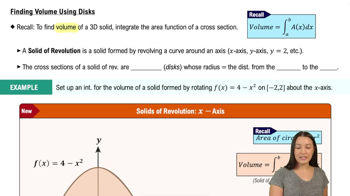
Finding Volume Using Disks
Shell Method
The shell method calculates volume by integrating cylindrical shells formed by revolving vertical or horizontal slices of the region around an axis. It is especially useful when revolving around the y-axis and when the region is described in terms of x.
Video consigliato:
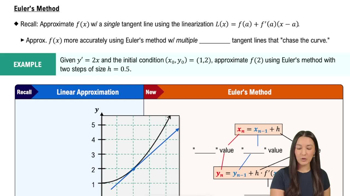
Euler's Method
Axis of Rotation (y-axis)
The axis of rotation determines how the region is revolved to form the solid. Revolving around the y-axis means the solid is generated by rotating the region horizontally, which affects the choice of method and the limits of integration.
Video consigliato:
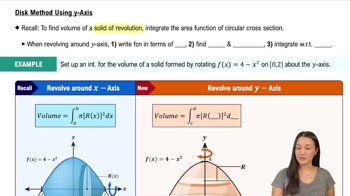
Disk Method Using y-Axis
Pratica correlata
Domanda del libro di testo
23
views
Domanda del libro di testo
Evaluate the limits in Exercise 9 and 10 by identifying them with definite integrals and evaluating the integrals.
lim (n → ∞) Σ (from k=1 to n) ln √(1 + k/n)
30
views
Domanda del libro di testo
Finding arc length
Find the length of the curve
y = ∫ from 0 to x of √(cos(2t)) dt, 0 ≤ x ≤ π/4.
42
views
Domanda del libro di testo
Evaluate the integrals in Exercises 1–6.
∫ dt / (t - √(1 - t²))
30
views
Domanda del libro di testo
Use the substitution z = tan(θ/2) to evaluate the integrals in Exercises 41 and 42.
∫ csc θ dθ
27
views
Domanda del libro di testo
Use the substitutions in Equations (1)–(4) to evaluate the integrals in Exercises 33–40. Integrals like these arise in calculating the average angular velocity of the output shaft of a universal joint when the input and output shafts are not aligned.
∫(from π/2 to 2π/3) cos θ dθ / (sin θ cos θ + sin θ)
36
views