
Ch. 8 - Techniques of Integration
Hass - Thomas' Calculus 15th Edition
Hass15th EditionThomas' CalculusISBN: 9780137616077Non è quello che usi tu?Cambia libro di testo
Capitolo 8, Problema 8.2.60a

Finding volume: Find the volume of the solid generated by revolving the region in the first quadrant bounded by the coordinate axes, the curve y = e^(-x), and the line x = 1.
a. About the y-axis.

Guida verificata passo dopo passo
1
Identify the region to be revolved: it is bounded by the x-axis (y=0), y-axis (x=0), the curve \(y = e^{-x}\), and the vertical line \(x = 1\) in the first quadrant.
Since the solid is generated by revolving the region about the y-axis, consider using the method of cylindrical shells. The formula for the volume using shells is \(V = \int_a^b 2\pi \cdot (\text{radius}) \cdot (\text{height}) \, dx\).
Determine the radius and height of a typical shell: the radius is the distance from the y-axis, which is \(x\), and the height is the value of the function \(y = e^{-x}\).
Set up the integral for the volume: \(V = \int_0^1 2\pi x e^{-x} \, dx\).
Evaluate the integral using integration by parts or an appropriate method to find the volume (do not compute the final value here).

Risposta video verificata per un problema simile:

Questa soluzione video è stata consigliata dai nostri tutor come utile per risolvere questo problema.
Durata del video:
10m

Concetti chiave

Ecco i concetti essenziali che devi comprendere per rispondere correttamente alla domanda.

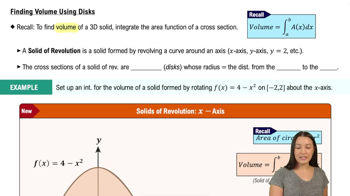
Volume of Solids of Revolution

This concept involves finding the volume of a 3D solid formed by rotating a 2D region around an axis. The volume can be computed using integral methods such as the disk/washer or shell method, depending on the axis of rotation and the shape of the region.
Video consigliato:
04:48
Finding Volume Using Disks

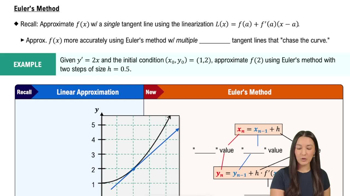
Shell Method

The shell method calculates volume by integrating cylindrical shells formed by revolving vertical slices around a vertical axis. It is especially useful when rotating around the y-axis and when the function is given in terms of x, simplifying the integral setup.
Video consigliato:
07:33
Euler's Method

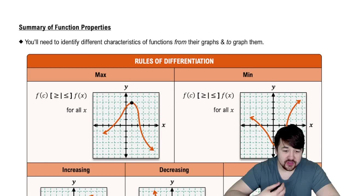
Exponential Functions and Their Properties

Understanding the behavior of the function y = e^(-x) is crucial, as it defines the boundary of the region. Knowing its decay and how to integrate expressions involving e^(-x) helps in setting up and evaluating the integral for volume.
Video consigliato:
Percorso guidato
06:21
Properties of Functions
Pratica correlata
Domanda del libro di testo

In Exercises 11–22, estimate the minimum number of subintervals needed to approximate the integrals with an error of magnitude less than 10^-4 by (a) the Trapezoidal Rule (The integrals in Exercises 11–18 are the integrals from Exercises 1–8.)

∫ from 2 to 4 of 1/(s - 1)² ds

30
views
Domanda del libro di testo

In Exercises 11–22, estimate the minimum number of subintervals needed to approximate the integrals with an error of magnitude less than 10^-4 by (a) the Trapezoidal Rule (The integrals in Exercises 11–18 are the integrals from Exercises 1–8.)

∫ from 1 to 3 of (2x - 1) dx

27
views
Domanda del libro di testo

In Exercises 11–22, estimate the minimum number of subintervals needed to approximate the integrals with an error of magnitude less than 10^-4 by (a) the Trapezoidal Rule (The integrals in Exercises 11–18 are the integrals from Exercises 1–8.)

∫ from -1 to 1 of (t³ + 1) dt

30
views
Domanda del libro di testo

In Exercises 11–22, estimate the minimum number of subintervals needed to approximate the integrals with an error of magnitude less than 10^-4 by (a) the Trapezoidal Rule (The integrals in Exercises 11–18 are the integrals from Exercises 1–8.)

∫ from -2 to 0 of (x² - 1) dx

30
views
Domanda del libro di testo

Finding area

Find the area of the region enclosed by the curve y = x cos(x) and the x-axis (see the accompanying figure) for:

a. π/2 ≤ x ≤ 3π/2.

58
views
Domanda del libro di testo

Finding volume: Find the volume of the solid generated by revolving the region bounded by the x-axis and the curve y = x sin(x), 0 ≤ x ≤ π, about

a. The y-axis.

(See Exercise 57 for a graph.)

52
views