Skip to main content
Cell Biology
Il mio corso
Impara
Preparazione agli esami
AI Tutor
Guide di studio
Flashcard
Esplora
Prova l'app
Il mio corso
Impara
Preparazione agli esami
AI Tutor
Guide di studio
Flashcard
Esplora
Prova l'app
Indietro
Cell Biology - Chapter 4 Campbell Biology 9th Edition
Puoi toccare per girare la carta.
What is the basic unit of life?
Puoi toccare per girare la carta.
👆
What is the basic unit of life?
The
cell
is the basic unit of life in all living organisms.
Avanzamenti del tracciato
I pulsanti di controllo sono stati cambiati in modalità "navigazione".
1/28
Video consigliati
VideoThumbView.guidedCourse
02:26
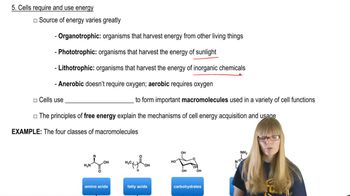
Cells and Energy
845
views
20
rank
VideoThumbView.guidedCourse
02:23
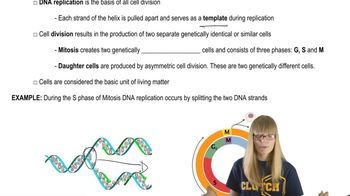
Cell Replication
1069
views
14
rank
VideoThumbView.guidedCourse
02:53
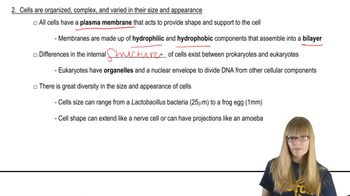
Cell Organization
1311
views
33
rank
Termini in questo insieme (28)
Nascondere definizioni
What is the basic unit of life?
The
cell
is the basic unit of life in all living organisms.
What are the two main types of cells?
Prokaryotic
and
eukaryotic
cells.
What distinguishes prokaryotic cells from eukaryotic cells?
Prokaryotic cells lack a
nucleus
and membrane-bound organelles, while eukaryotic cells have both.
What is the function of the plasma membrane?
The
plasma membrane
regulates the passage of molecules in and out of the cell.
What is the role of the nucleus in a eukaryotic cell?
The
nucleus
stores genetic material (DNA) and controls cell activities.
What is the function of ribosomes?
Ribosomes
synthesize proteins by translating mRNA.
What is the endoplasmic reticulum (ER)?
The
ER
is a network of membranes involved in protein and lipid synthesis; rough ER has ribosomes, smooth ER does not.
What is the Golgi apparatus responsible for?
The
Golgi apparatus
modifies, sorts, and packages proteins and lipids for transport.
What are lysosomes and their function?
Lysosomes
contain digestive enzymes to break down macromolecules and old organelles.
What is the function of mitochondria?
Mitochondria
generate ATP through cellular respiration, supplying energy to the cell.
What is the cytoskeleton?
The
cytoskeleton
is a network of protein fibers that maintain cell shape and enable movement.
What are the three main types of cytoskeletal fibers?
Microtubules
,
microfilaments
, and
intermediate filaments
.
What is the function of microtubules?
Microtubules provide structural support and act as tracks for organelle movement.
What is the role of microfilaments?
Microfilaments support cell shape and are involved in cell movement and division.
What is the extracellular matrix (ECM)?
The
ECM
is a network of proteins and carbohydrates outside animal cells that provides structural support.
What are cell junctions?
Structures that connect cells, including tight junctions, desmosomes, and gap junctions.
What is the function of tight junctions?
Tight junctions create a seal preventing leakage between cells.
What do desmosomes do?
Desmosomes anchor cells together, providing mechanical stability.
What is the role of gap junctions?
Gap junctions allow direct communication and molecule exchange between adjacent cells.
What is the fluid mosaic model?
A model describing the plasma membrane as a fluid bilayer of lipids with embedded proteins.
What are the main components of the plasma membrane?
Phospholipids, proteins, cholesterol, and carbohydrates.
How do phospholipids arrange themselves in the membrane?
In a bilayer with hydrophobic tails inward and hydrophilic heads outward.
What is the function of membrane proteins?
They assist in transport, signal transduction, and cell recognition.
What is passive transport?
Movement of molecules across membranes without energy input, down their concentration gradient.
What is active transport?
Movement of molecules against their concentration gradient using energy, usually ATP.
What is osmosis?
The diffusion of water across a selectively permeable membrane.
What is endocytosis?
The process by which cells engulf external substances by forming vesicles.
What is exocytosis?
The process of vesicles fusing with the plasma membrane to release contents outside the cell.
 IndietroIndietro
 02:26