 Indietro
Cell Biology Transport and Membrane Concepts
 04:10

Termini in questo insieme (18)
A hypertonic solution has a higher concentration of solutes compared to another solution, causing water to move out of a cell.
A hypotonic solution has a lower concentration of solutes compared to another solution, causing water to move into a cell.
An isotonic solution has equal solute concentrations on both sides, resulting in no net movement of water across the membrane.
Diffusion is the movement of molecules from an area of high concentration to an area of low concentration.
A solution is a mixture of a solute dissolved in a solvent, often water in biological systems.
A solute is the substance that is dissolved in a solvent.
A solvent is the substance in which the solute is dissolved, usually water in biological contexts.
A semipermeable membrane allows certain molecules or ions to pass through by diffusion while blocking others.
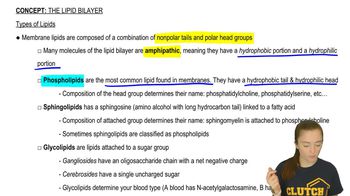
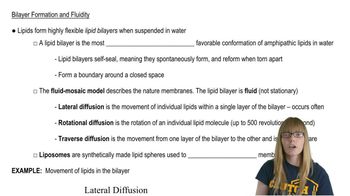
The phospholipid bilayer is the fundamental structure of cell membranes, made of two layers of phospholipids with hydrophilic heads and hydrophobic tails.
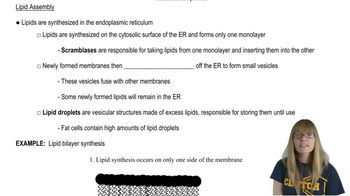
A vesicle is a small membrane-bound sac used to transport materials within cells.
Endocytosis is the process where cells engulf materials by forming a vesicle to bring substances into the cell.
Exocytosis is the process where cells release materials by fusing a vesicle with the plasma membrane.
Osmosis is the diffusion of water across a semipermeable membrane from low to high solute concentration.
Active transport moves molecules against their concentration gradient and requires energy, usually from ATP.
Passive transport moves molecules down their concentration gradient without using energy.
Facilitated diffusion is passive transport of molecules across membranes via specific protein channels.
Homeostasis is the maintenance of stable internal conditions within a cell or organism.
A protein pump is a membrane protein that uses energy to move substances across the membrane against their gradient.