In Exercises 1–68, factor completely, or state that the polynomial is prime.
a²(x − y) + 4(y − x)
Guida verificata passo dopo passo
1
Step 1: Observe the given expression: \(a^2(x - y) + 4(y - x)\). Notice that \((y - x)\) can be rewritten as \(-(x - y)\).
Step 2: Rewrite the expression using the observation: \(a^2(x - y) - 4(x - y)\).
Step 3: Factor out the common factor \((x - y)\) from both terms: \((x - y)(a^2 - 4)\).
Step 4: Recognize that \(a^2 - 4\) is a difference of squares, which can be factored further.
Step 5: Factor \(a^2 - 4\) as \((a - 2)(a + 2)\), resulting in the fully factored expression: \((x - y)(a - 2)(a + 2)\).
Risposta video verificata per un problema simile:
Questa soluzione video è stata consigliata dai nostri tutor come utile per risolvere questo problema.
Durata del video:
3m
Guarda un video:
0 Commenti
Concetti chiave
Ecco i concetti essenziali che devi comprendere per rispondere correttamente alla domanda.
Factoring Polynomials
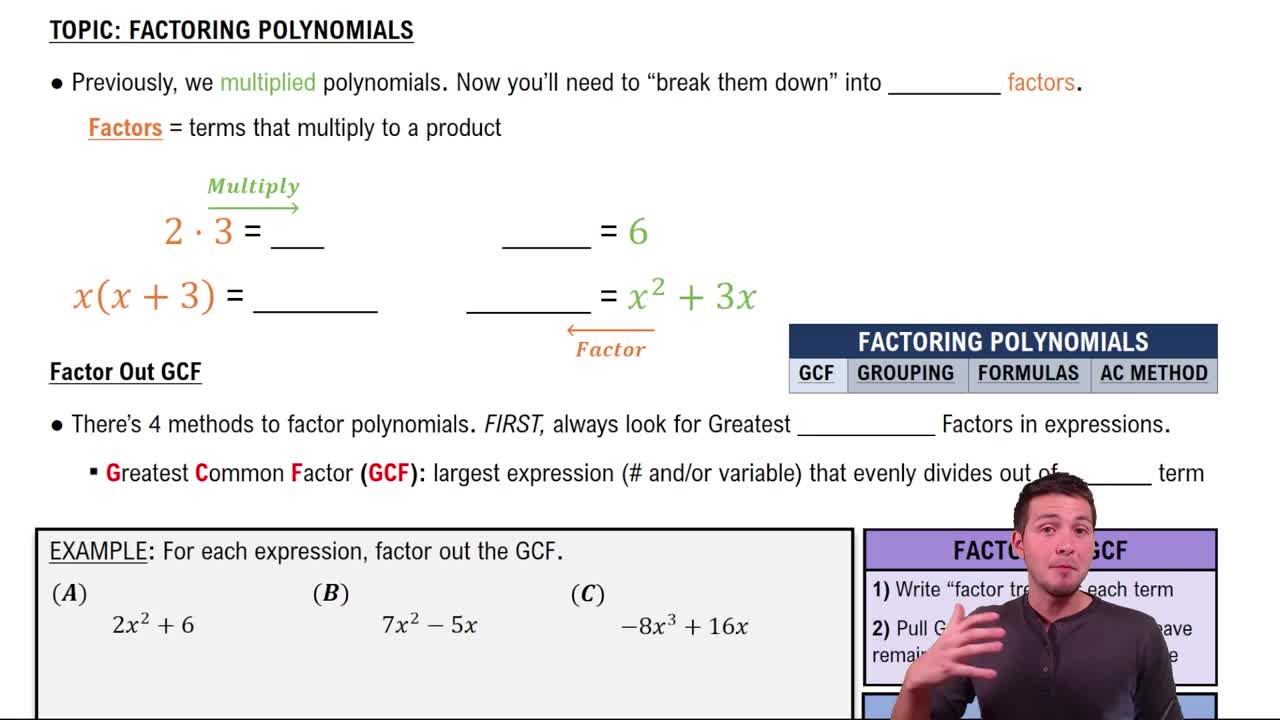
Factoring polynomials involves rewriting a polynomial expression as a product of simpler polynomials or factors. This process is essential for simplifying expressions, solving equations, and analyzing polynomial behavior. Common techniques include factoring out the greatest common factor, using special products like the difference of squares, and applying the grouping method.
The greatest common factor (GCF) is the largest factor that divides two or more numbers or expressions without leaving a remainder. Identifying the GCF is a crucial first step in factoring polynomials, as it allows for simplification by factoring out the GCF from each term. This can make the remaining polynomial easier to work with and factor further.
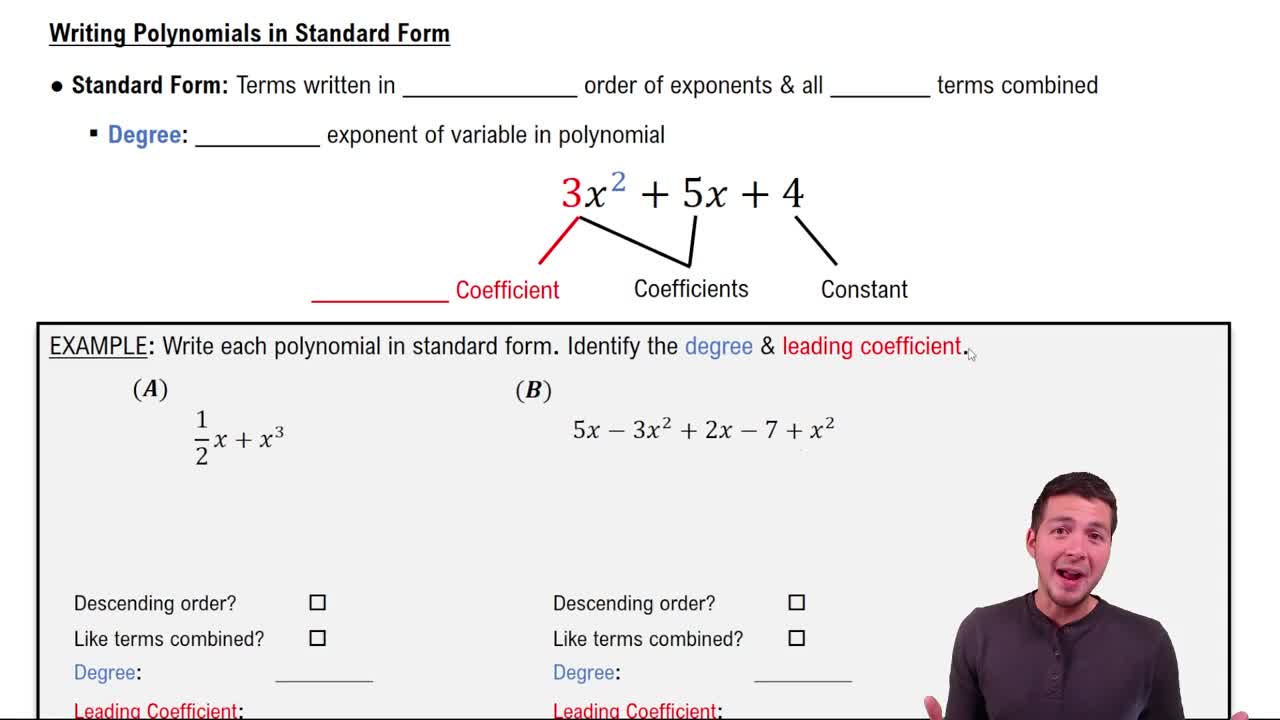
The degree of a polynomial is the highest power of the variable in the expression, which determines its behavior and the number of roots it can have. Understanding the structure of polynomial terms, including coefficients and variables, is vital for effective factoring. Recognizing how to manipulate these terms can lead to successful factorization or identification of prime polynomials.

 3:19 minuti
 Guida verificata passo dopo passo
 07:30
07:30