In Exercises 1–68, factor completely, or state that the polynomial is prime.
x² + 10x − y² + 25
Guida verificata passo dopo passo
1
Identify the polynomial: \(x^2 + 10x - y^2 + 25\).
Rearrange the terms to group them: \((x^2 + 10x + 25) - y^2\).
Recognize that \(x^2 + 10x + 25\) is a perfect square trinomial, which can be factored as \((x + 5)^2\).
Rewrite the expression using the difference of squares formula: \((x + 5)^2 - y^2\).
Apply the difference of squares formula: \((a^2 - b^2) = (a - b)(a + b)\), where \(a = (x + 5)\) and \(b = y\), resulting in \((x + 5 - y)(x + 5 + y)\).
Risposta video verificata per un problema simile:
Questa soluzione video è stata consigliata dai nostri tutor come utile per risolvere questo problema.
Durata del video:
1m
Guarda un video:
0 Commenti
Concetti chiave
Ecco i concetti essenziali che devi comprendere per rispondere correttamente alla domanda.
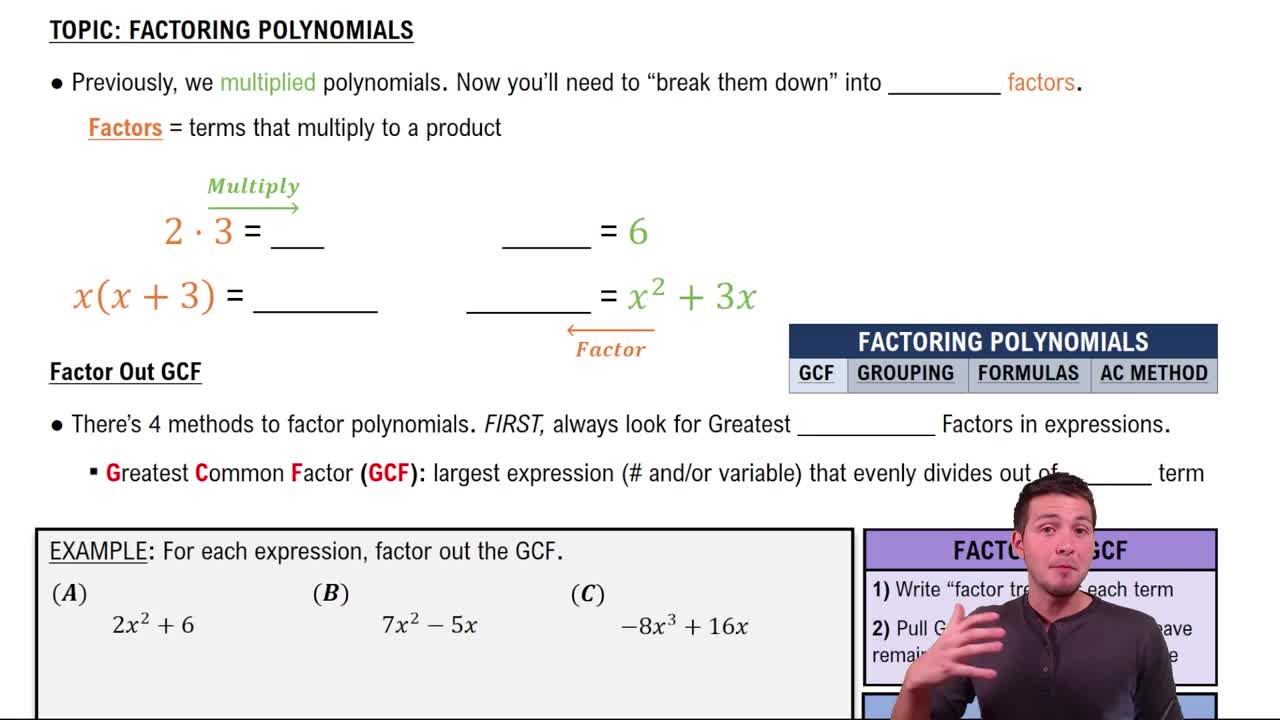
Factoring Polynomials
Factoring polynomials involves rewriting a polynomial expression as a product of simpler polynomials. This process is essential for simplifying expressions and solving equations. Common techniques include factoring out the greatest common factor, using special products like the difference of squares, and applying the quadratic formula when necessary.
The difference of squares is a specific factoring pattern that applies to expressions of the form a² - b², which can be factored into (a + b)(a - b). In the given polynomial, recognizing the presence of a difference of squares can simplify the factoring process, especially when combined with other terms.
Solving Quadratic Equations by Completing the Square
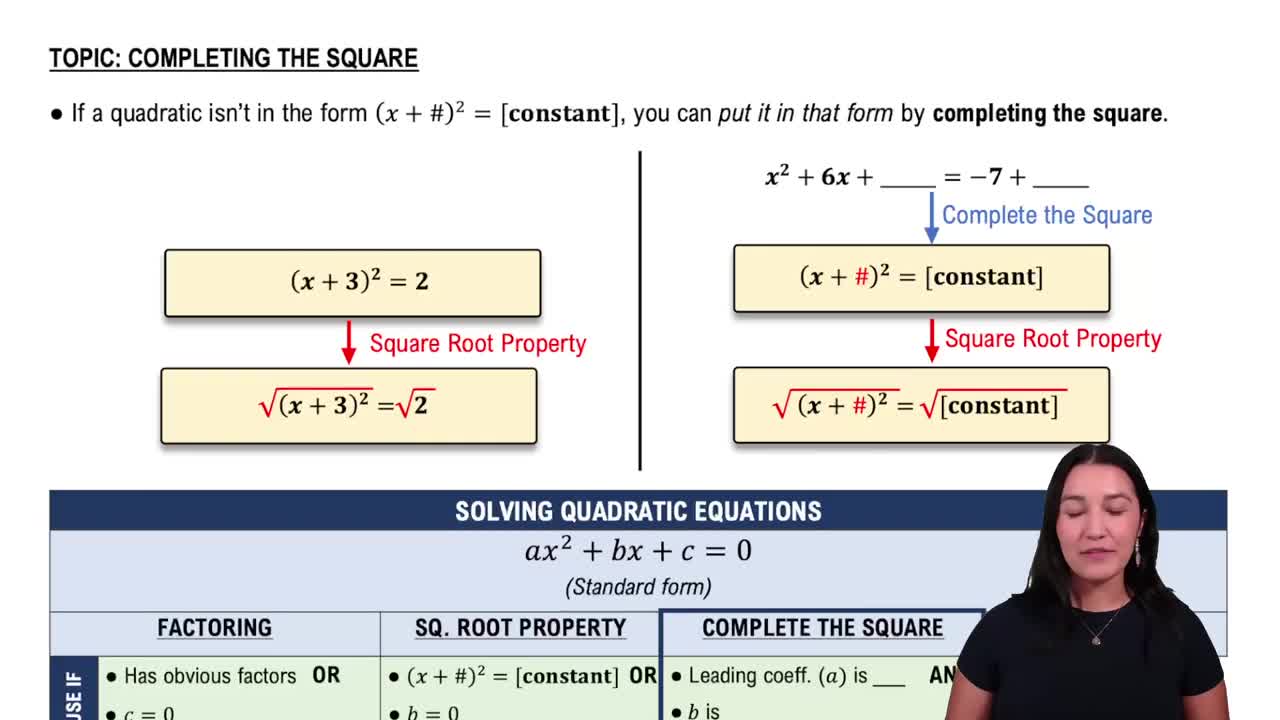
Completing the Square
Completing the square is a method used to transform a quadratic expression into a perfect square trinomial. This technique is useful for factoring and solving quadratic equations. In the context of the given polynomial, it can help identify the structure of the expression and facilitate the factoring process.

 1:17 minuti
 Guida verificata passo dopo passo
 07:30
07:30