Skip to main content
College Algebra
Il mio corso
Impara
Preparazione agli esami
AI Tutor
Guide di studio
Soluzioni per libri di testo
Flashcard
Esplora
Prova l'app
Il mio corso
Impara
Preparazione agli esami
AI Tutor
Guide di studio
Soluzioni per libri di testo
Flashcard
Esplora
Prova l'app
Indietro
College Algebra Midterm Key Concepts and Problems
Puoi toccare per girare la carta.
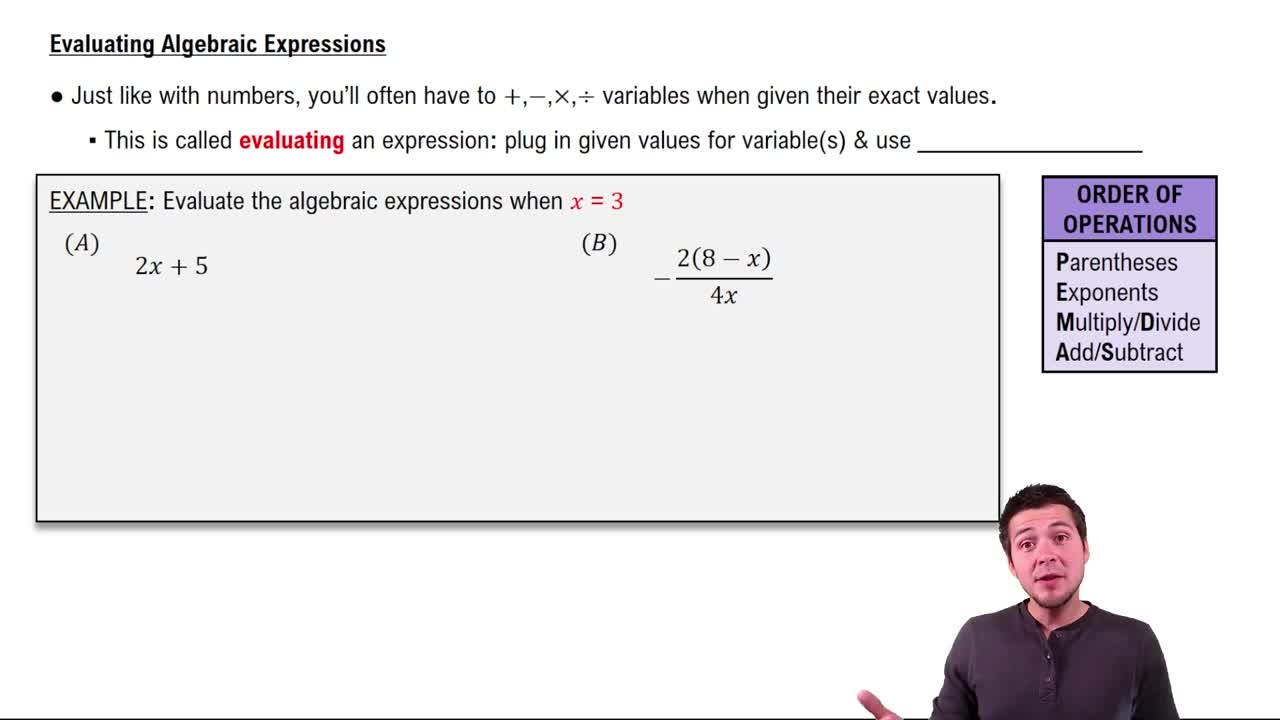
Evaluate 2(x + 3) − 12 when x = −4
Puoi toccare per girare la carta.
👆
Evaluate 2(x + 3) − 12 when x = −4
Substitute x = −4: 2(−4 + 3) − 12 = 2(−1) − 12 = −2 − 12 = −14.
Avanzamenti del tracciato
I pulsanti di controllo sono stati cambiati in modalità "navigazione".
1/24
Video consigliati
VideoThumbView.guidedCourse
03:11
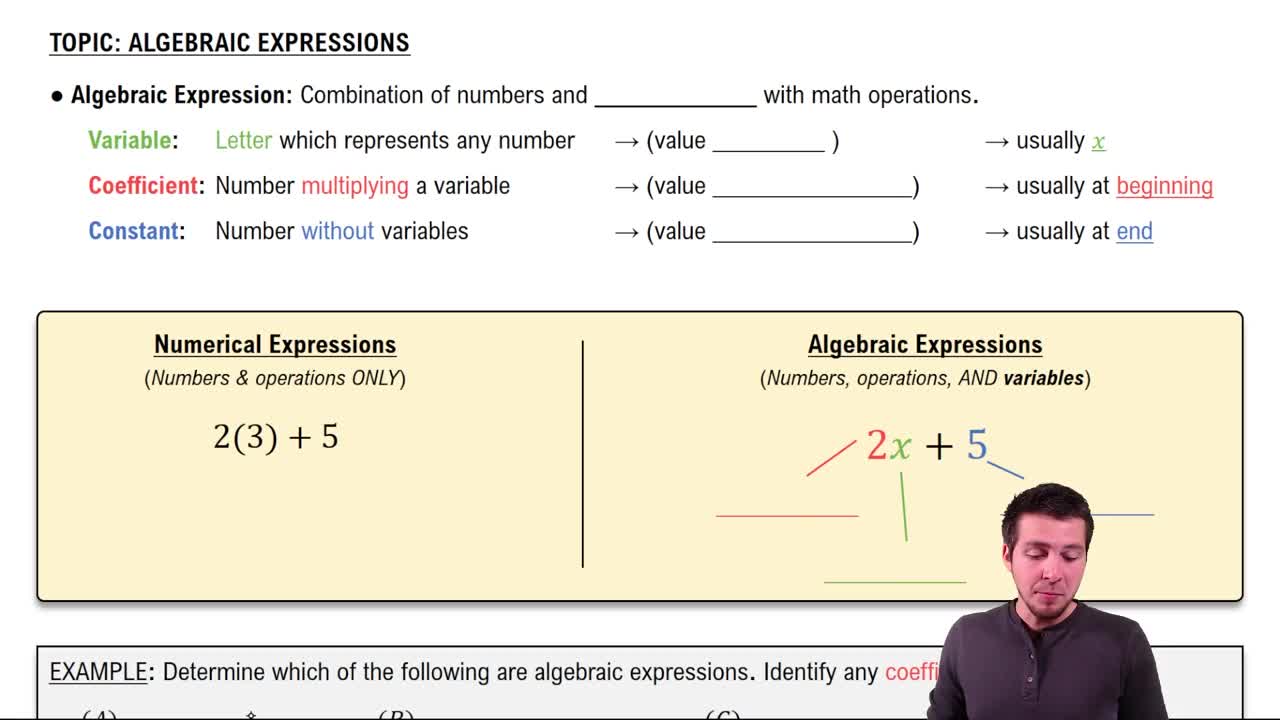
Evaluating Algebraic Expressions
14922
views
778
rank
10
comments
VideoThumbView.guidedCourse
05:09
Introduction to Algebraic Expressions
26250
views
1172
rank
8
comments
VideoThumbView.guidedCourse
1:51
Introduction to College Algebra Channel
21022
views
687
rank
1
comments
Termini in questo insieme (24)
Nascondere definizioni
Evaluate 2(x + 3) − 12 when x = −4
Substitute x = −4: 2(−4 + 3) − 12 = 2(−1) − 12 = −2 − 12 = −14.
Write 3.1642 × 10^6 in standard notation
Move decimal 6 places right: 3,164,200.
Simplify 8x^3 / (2x)^2
Rewrite denominator: (2x)^2 = 4x^2. Then 8x^3 / 4x^2 = 2x.
Subtract (13w³ + 2w² − 3) − (6w² + 5w − 3)
Result: 13w³ + 2w² − 3 − 6w² − 5w + 3 = 13w³ − 4w² − 5w.
Multiply (b − 2)(b² − 4b + 4)
Use distributive property: b³ − 4b² + 4b − 2b² + 8b − 8 = b³ − 6b² + 12b − 8.
Factor 16x² − 81
Difference of squares: (4x − 9)(4x + 9).
Factor y² + 12y + 36
Perfect square trinomial: (y + 6)².
Find the y-intercept for 2x − 5y = 6
Set x=0: −5y=6 → y=−6/5.
Distance between (5, −3) and (−2, 8)
Distance = √[(−2−5)² + (8+3)²] = √[49 + 121] = √170.
Midpoint between (5, −3) and (−2, 8)
Midpoint = ((5−2)/2, (−3+8)/2) = (1.5, 2.5).
Interval notation for {x | x ≤ 10}
Interval: (−∞, 10].
Solve |3x − 2| ≥ 4
3x − 2 ≥ 4 or 3x − 2 ≤ −4 → x ≥ 2 or x ≤ −2/3.
Equation of line through (−4, 2) and (5, −3)
Slope m = (−3−2)/(5+4) = −5/9; equation: y − 2 = (−5/9)(x + 4).
Add (3 − 2i) + (4 − i)
Sum: (3+4) + (−2i − i) = 7 − 3i.
Multiply (14 − 3i)(8 + 5i)
Product: 14×8 + 14×5i − 3i×8 − 3i×5i = 112 + 70i − 24i − 15i² = 112 + 46i + 15 = 127 + 46i.
Solve 4x² − 4x = 1
Rewrite: 4x² − 4x − 1 = 0; use quadratic formula.
Find domain of g(x) = 8 − x
Domain: all real numbers (−∞, ∞).
Compute (f ○ g)(4) for f(x) = 3x² − 10, g(x) = 2x + 5
g(4) = 2(4) + 5 = 13; f(13) = 3(13)² − 10 = 3(169) − 10 = 497.
Find inverse of f(x) = 0.5√(x − 3)
Swap x and y: x = 0.5√(y − 3); solve for y: y = 4x² + 3.
Determine if f(x) = −3x² + 4 is one-to-one
No, because it is a quadratic (parabola) failing the horizontal line test.
Write quadratic function in standard form: y = x² + 2x − 8
Complete the square: y = (x + 1)² − 9.
Use Rational Root Theorem on f(x) = 4x⁴ + 8x³ + 21x² + 17x + 4
Possible rational roots are ± factors of 4 over factors of 4: ±1, ±2, ±4, ±1/2, ±3/4, etc.
Find vertical asymptote(s) of f(x) = (x + 4) / (x² − 2x − 3)
Denominator zeroes: x² − 2x − 3 = (x − 3)(x + 1) = 0 → x = 3, −1 vertical asymptotes.
Find slant asymptote of g(x) = (x² + 3x − 3) / (x − 1)
Divide numerator by denominator: quotient is x + 4; slant asymptote y = x + 4.
 IndietroIndietro
 03:11