Skip to main content
College Algebra
Il mio corso
Impara
Preparazione agli esami
AI Tutor
Guide di studio
Soluzioni per libri di testo
Flashcard
Esplora
Prova l'app
Il mio corso
Impara
Preparazione agli esami
AI Tutor
Guide di studio
Soluzioni per libri di testo
Flashcard
Esplora
Prova l'app
Indietro
College Algebra: Solving Quadratic and Rational Equations
Puoi toccare per girare la carta.
What is the standard form of a quadratic equation?
Puoi toccare per girare la carta.
👆
What is the standard form of a quadratic equation?
A quadratic equation is in standard form when written as \(ax^2 + bx + c = 0\), where
a
,
b
, and
c
are constants and
a ≠ 0
.
Avanzamenti del tracciato
I pulsanti di controllo sono stati cambiati in modalità "navigazione".
1/20
Video consigliati
05:35
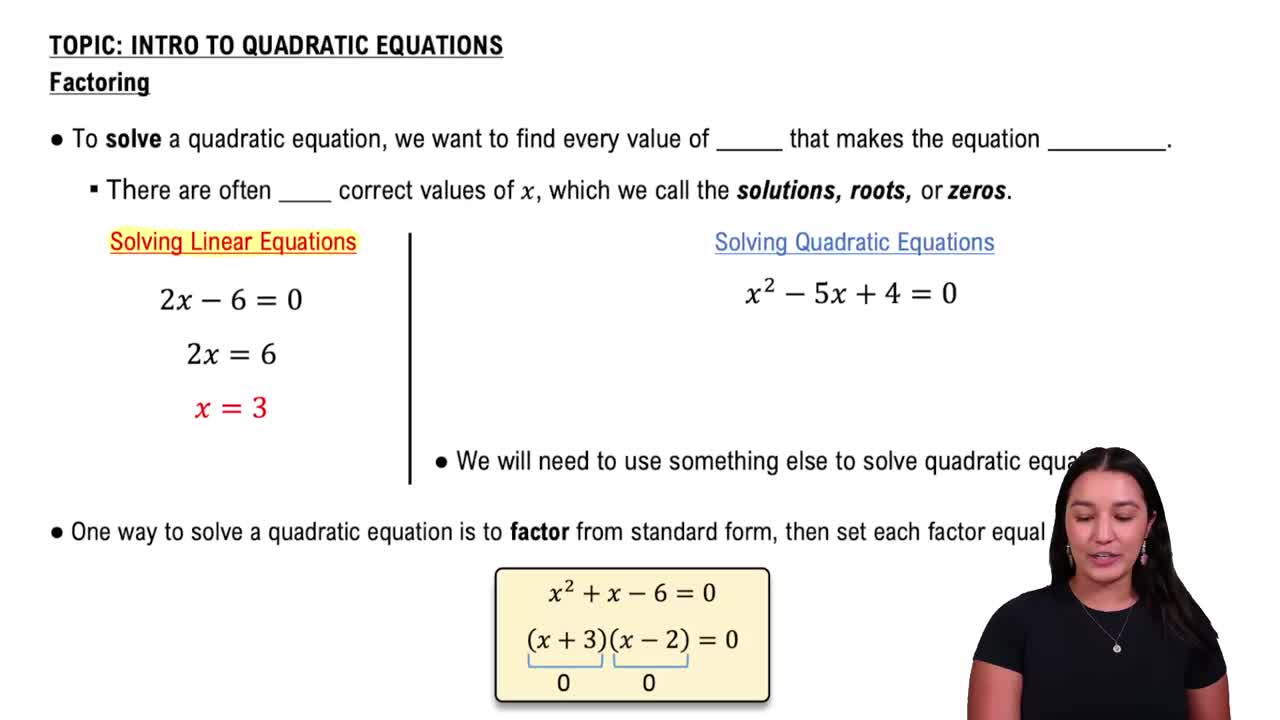
Introduction to Quadratic Equations
6038
views
187
rank
3
comments
06:08
Solving Quadratic Equations by Factoring
4424
views
129
rank
2
comments
Termini in questo insieme (20)
Nascondere definizioni
What is the standard form of a quadratic equation?
A quadratic equation is in standard form when written as \(ax^2 + bx + c = 0\), where
a
,
b
, and
c
are constants and
a ≠ 0
.
Name the methods to solve quadratic equations.
Quadratic equations can be solved by
factoring
,
completing the square
,
using the quadratic formula
, or
graphing
.
What is the quadratic formula?
The quadratic formula is \(x = \frac{-b \pm \sqrt{b^2 - 4ac}}{2a}\), used to find roots of \(ax^2 + bx + c = 0\).
How do you solve a quadratic equation by factoring?
Rewrite the equation in standard form, factor the quadratic expression, set each factor equal to zero, then solve for
x
.
What does the discriminant tell you about the roots of a quadratic?
The discriminant is \(b^2 - 4ac\). If > 0, two real roots; = 0, one real root; < 0, two complex roots.
What is a rational equation?
A rational equation is an equation that contains one or more rational expressions, which are fractions with polynomials in numerator and denominator.
What is the first step in solving a rational equation?
Identify the least common denominator (LCD) of all rational expressions and multiply both sides of the equation by the LCD to clear denominators.
Why must you check for extraneous solutions when solving rational equations?
Multiplying by the LCD can introduce solutions that make denominators zero, which are not valid; these must be excluded.
How do you solve a rational equation after clearing denominators?
After multiplying by the LCD, solve the resulting polynomial or linear equation, then check for extraneous solutions.
What is the method to solve quadratic equations by completing the square?
Rewrite the equation so the quadratic and linear terms are on one side, add a constant to complete the square, then solve by taking square roots.
How do you find the roots of a quadratic equation graphically?
Plot the quadratic function and identify the x-intercepts; these points correspond to the roots of the equation.
What is the importance of setting the equation to zero when solving quadratics?
Setting the equation to zero allows factoring or applying the quadratic formula to find values of
x
that satisfy the equation.
What does it mean if a quadratic equation cannot be factored easily?
Use the quadratic formula or complete the square to find the roots when factoring is difficult or impossible.
How do you handle restrictions on the variable in rational equations?
Determine values that make any denominator zero and exclude them from the solution set.
What is the role of the LCD in solving rational equations?
The LCD allows you to eliminate denominators by multiplying both sides, simplifying the equation to a polynomial form.
How do you verify solutions to rational equations?
Substitute each solution back into the original equation to ensure no denominator is zero and the equation holds true.
What is the difference between solving quadratic and rational equations?
Quadratic equations involve polynomials of degree two, while rational equations involve fractions with polynomials; rational equations require checking for excluded values.
What is the zero-product property used in solving quadratics?
If \(ab=0\), then either \(a=0\) or \(b=0\). This helps find roots after factoring.
How do you rewrite a quadratic equation to complete the square?
Isolate the quadratic and linear terms, divide the linear coefficient by 2, square it, and add to both sides to form a perfect square trinomial.
What is an extraneous solution in rational equations?
A solution that emerges from the algebraic process but does not satisfy the original equation, often due to division by zero.
 IndietroIndietro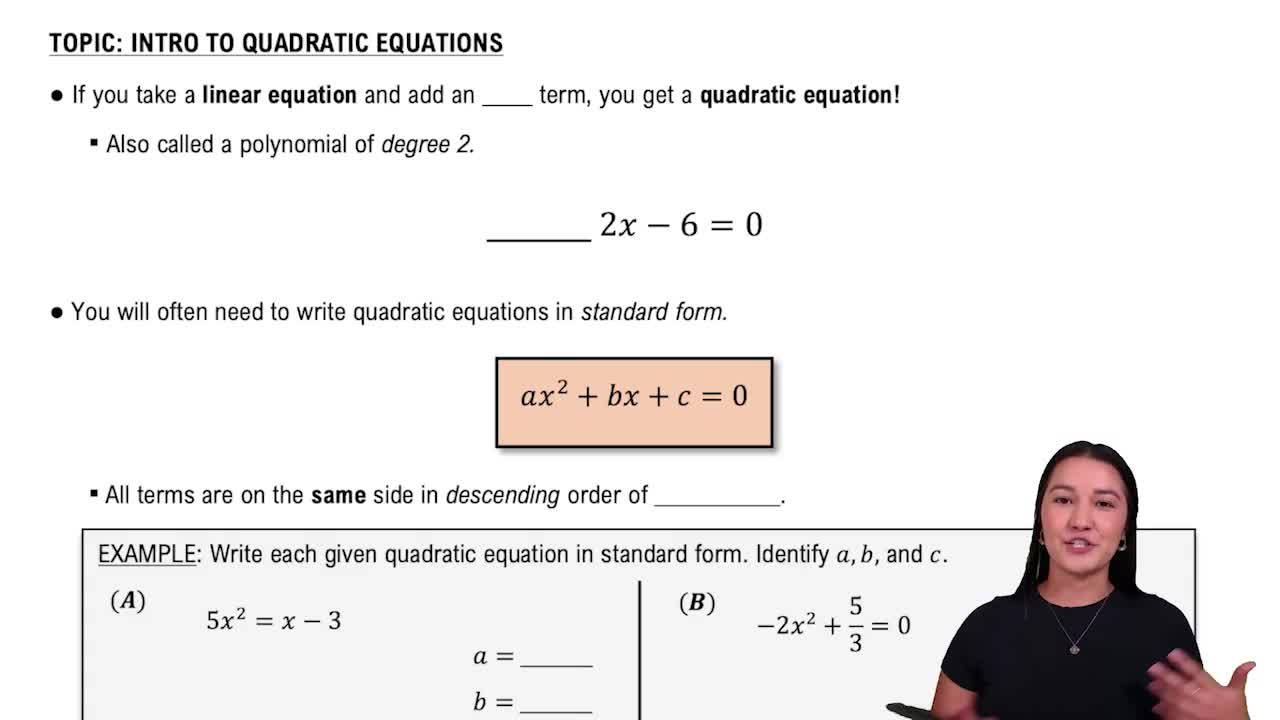
 05:35
05:35