Skip to main content
College Algebra
Il mio corso
Impara
Preparazione agli esami
AI Tutor
Guide di studio
Soluzioni per libri di testo
Flashcard
Esplora
Prova l'app
Il mio corso
Impara
Preparazione agli esami
AI Tutor
Guide di studio
Soluzioni per libri di testo
Flashcard
Esplora
Prova l'app
Indietro
College Algebra: Systems, Inequalities, and Logarithms
Puoi toccare per girare la carta.
What defines a system of linear equations in two variables?
Puoi toccare per girare la carta.
👆
What defines a system of linear equations in two variables?
A system where each equation is linear, meaning variables appear only to the first power and are not multiplied together.
Avanzamenti del tracciato
I pulsanti di controllo sono stati cambiati in modalità "navigazione".
1/20
Video consigliati
VideoThumbView.guidedCourse
3:09
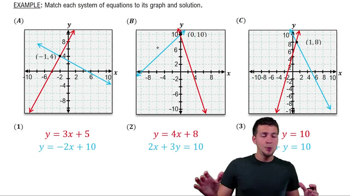
Example 1
2388
views
62
rank
VideoThumbView.guidedCourse
6:48
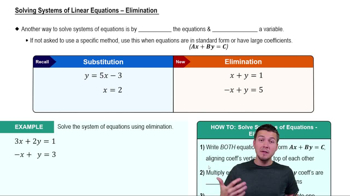
Solving Systems of Equations - Elimination
2575
views
37
rank
VideoThumbView.guidedCourse
3:31
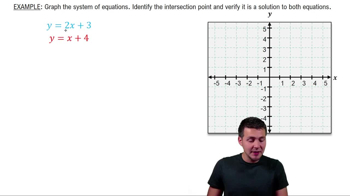
Example 2
2124
views
40
rank
Termini in questo insieme (20)
Nascondere definizioni
What defines a system of linear equations in two variables?
A system where each equation is linear, meaning variables appear only to the first power and are not multiplied together.
How can you identify a system of nonlinear equations in two variables?
At least one equation contains variables with exponents other than one, variables multiplied together, or other nonlinear terms.
What is a system of inequalities in two variables?
A set of two or more inequalities involving two variables, representing regions on the coordinate plane.
How do you graph a system of linear inequalities?
Graph each inequality's boundary line, then shade the region that satisfies the inequality; the solution is the intersection of shaded regions.
What is a logarithmic function?
A function defined as the inverse of an exponential function, typically written as \(f(x)=\log_b(x)\) where
b
is the base.
What is the domain of a logarithmic function \(\log_b(x)\)?
All positive real numbers, since the argument
x
must be greater than zero.
State the product property of logarithms.
\(\log_b(MN)=\log_b(M)+\log_b(N)\) for positive
M
and
N
.
State the quotient property of logarithms.
\(\log_b\left(\frac{M}{N}\right)=\log_b(M)-\log_b(N)\) for positive
M
and
N
.
State the power property of logarithms.
\(\log_b(M^p)=p\log_b(M)\) for positive
M
and any real
p
.
How do you distinguish between linear and nonlinear systems by their graphs?
Linear systems graph as straight lines; nonlinear systems graph as curves like circles, parabolas, or other shapes.
What does the solution to a system of linear equations represent graphically?
The point(s) where the lines intersect.
What does the solution to a system of inequalities represent graphically?
The overlapping shaded region that satisfies all inequalities.
How can you tell if a system of equations has no solution?
If the lines are parallel and distinct, meaning they never intersect.
How can you tell if a system of equations has infinitely many solutions?
If the equations represent the same line, so all points on the line satisfy both equations.
What is the inverse relationship between exponential and logarithmic functions?
Logarithms undo exponentials: \(b^{\log_b(x)}=x\) and \(\log_b(b^x)=x\).
What is the base of the natural logarithm?
The constant
e
(approximately 2.718), written as \(\ln(x)=\log_e(x)\).
How do you solve a logarithmic equation?
Rewrite the logarithmic equation in exponential form and solve for the variable.
What restrictions apply when solving logarithmic equations?
Arguments of all logarithms must be positive; solutions that make arguments non-positive are extraneous.
How do you solve a system of nonlinear equations?
Use substitution or elimination, often involving algebraic manipulation or graphing to find intersection points.
What is the key difference between systems of equations and systems of inequalities?
Systems of equations seek exact points of intersection; systems of inequalities seek regions satisfying all inequalities.
 IndietroIndietro
 3:09