Exercises 41–60 contain rational equations with variables in denominators. For each equation, a. write the value or values of the variable that make a denominator zero. These are the restrictions on the variable. b. Keeping the restrictions in mind, solve the equation. 3/(2x - 2) + 1/2 = 2/(x - 1)
Ch. 1 - Equations and Inequalities

Capitolo 2, Problema 55
In Exercises 48–57, perform the indicated operations and write the result in standard form. √ (-32) - √ (-18)
Guida verificata passo dopo passo1
Recognize that the square root of a negative number involves imaginary numbers. Recall that √(-a) = i√(a), where 'i' is the imaginary unit (i.e., i² = -1).
Rewrite each square root in terms of 'i': √(-32) = i√(32) and √(-18) = i√(18).
Simplify the square roots of the positive numbers under the radicals. For example, √(32) can be simplified as √(16 × 2) = √(16)√(2) = 4√(2). Similarly, √(18) can be simplified as √(9 × 2) = √(9)√(2) = 3√(2).
Substitute the simplified forms back into the expression: i√(32) - i√(18) becomes 4i√(2) - 3i√(2).
Combine like terms (terms with 'i√(2)') to simplify the expression further: (4i√(2) - 3i√(2)) = (4 - 3)i√(2).

Risposta video verificata per un problema simile:
Questa soluzione video è stata consigliata dai nostri tutor come utile per risolvere questo problema.
Durata del video:
4mConcetti chiave
Ecco i concetti essenziali che devi comprendere per rispondere correttamente alla domanda.
Complex Numbers
Complex numbers are numbers that have a real part and an imaginary part, expressed in the form a + bi, where 'a' is the real part and 'b' is the coefficient of the imaginary unit 'i', which is defined as the square root of -1. Understanding complex numbers is essential for performing operations involving square roots of negative numbers, as they allow us to express these roots in a meaningful way.
Video consigliato:
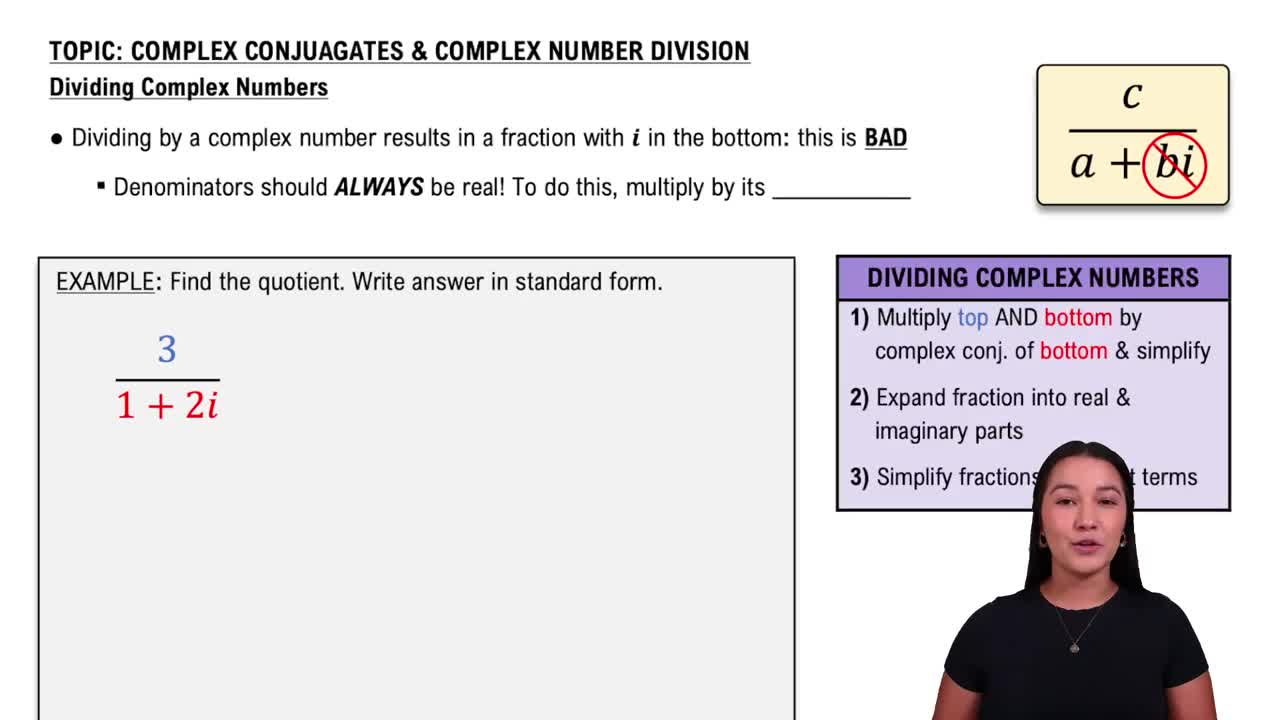
Dividing Complex Numbers
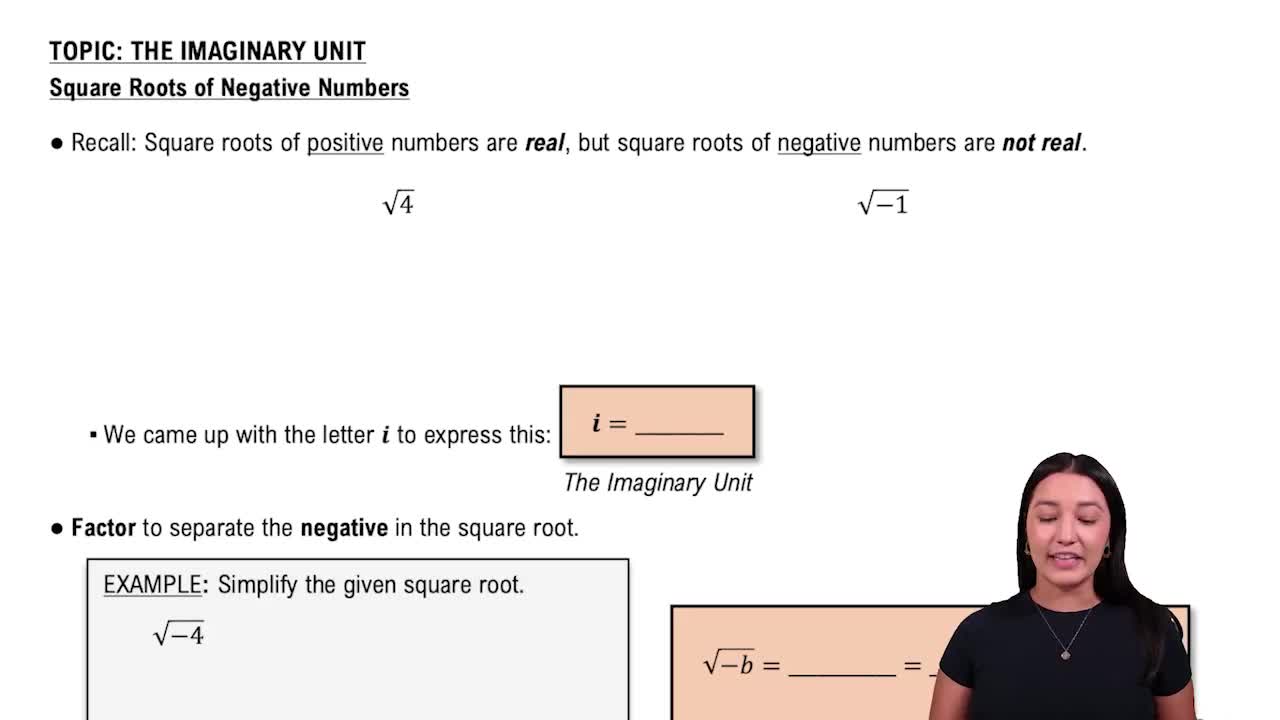
Square Roots of Negative Numbers
The square root of a negative number is not defined within the set of real numbers, but it can be expressed using imaginary numbers. For example, √(-n) can be rewritten as i√n, where 'i' is the imaginary unit. This concept is crucial for solving problems that involve square roots of negative values, as seen in the given expression.
Video consigliato:
Square Roots of Negative Numbers
Standard Form of Complex Numbers
The standard form of a complex number is typically written as a + bi, where 'a' and 'b' are real numbers. When performing operations with complex numbers, such as addition or subtraction, it is important to combine like terms (real with real and imaginary with imaginary) to express the result in this standard form. This ensures clarity and consistency in mathematical communication.
Video consigliato:
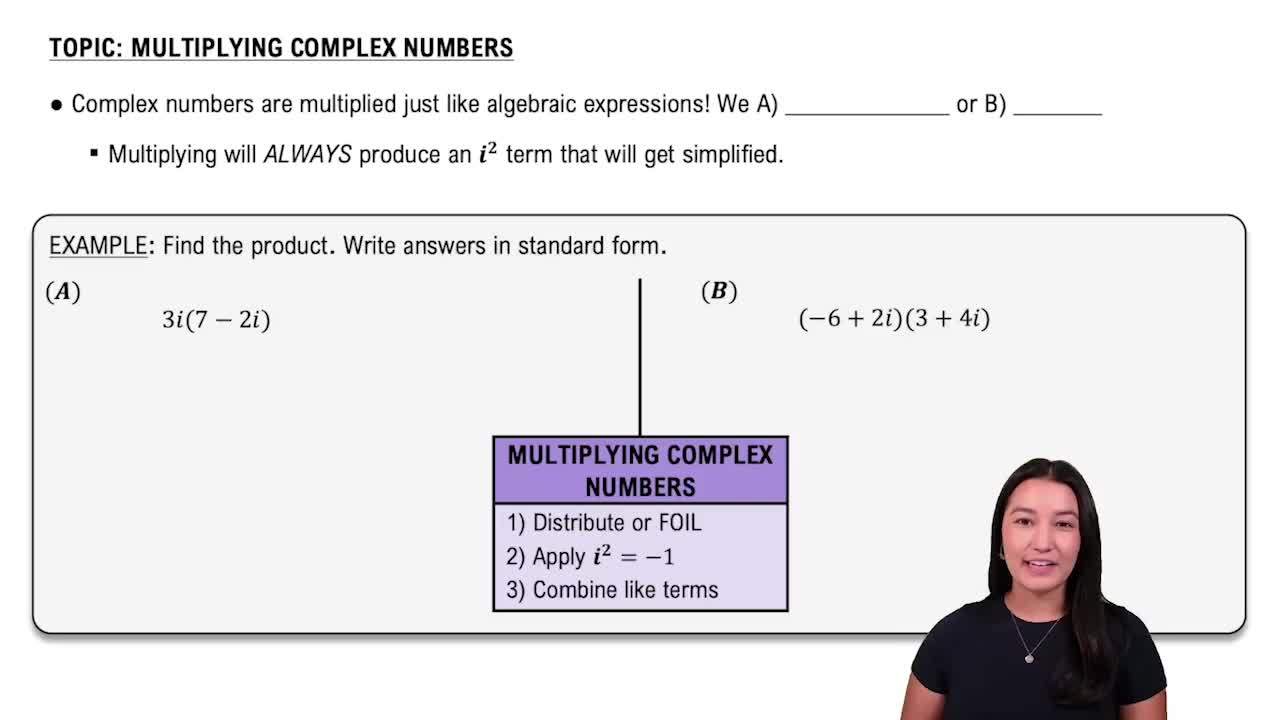
Multiplying Complex Numbers
Pratica correlata
Domanda del libro di testo
1074
views
Domanda del libro di testo
Exercises 41–60 contain rational equations with variables in denominators. For each equation, a. write the value or values of the variable that make a denominator zero. These are the restrictions on the variable. b. Keeping the restrictions in mind, solve the equation. 3/(x + 2) + 2/(x - 2) = 8/(x + 2)(x - 2)
1168
views
Domanda del libro di testo
Solve each equation in Exercises 47–64 by completing the square.
801
views
Domanda del libro di testo
Solve each equation in Exercises 41–60 by making an appropriate substitution. (x - 5)2 - 4(x - 5) - 21 = 0
639
views
Domanda del libro di testo
Solve each formula for the specified variable. Do you recognize the formula? If so, what does it describe? 1/R = 1/R1 + 1/R2 for R1
617
views
Domanda del libro di testo
In Exercises 51–58, solve each compound inequality. - 11 < 2x - 1 ≤ - 5
903
views
