Solve each equation. Then state whether the equation is an identity, a conditional equation, or an inconsistent equation. (3x+1)/3 - 13/2 = (1-x)/4
Ch. 1 - Equations and Inequalities

Capitolo 2, Problema 27
Solve each radical equation in Exercises 11–30. Check all proposed solutions. √(2x + 3) + √(x - 2) = 2
Guida verificata passo dopo passo1
Identify the equation: \(\sqrt{2x + 3} + \sqrt{x - 2} = 2\). Our goal is to solve for \(x\).
Isolate one of the square root terms. For example, subtract \(\sqrt{x - 2}\) from both sides to get: \(\sqrt{2x + 3} = 2 - \sqrt{x - 2}\).
Square both sides of the equation to eliminate the square root on the left. This gives: \(\left(\sqrt{2x + 3}\right)^2 = \left(2 - \sqrt{x - 2}\right)^2\).
Simplify both sides: the left side becomes \(2x + 3\), and the right side expands using the formula \((a - b)^2 = a^2 - 2ab + b^2\) to \(4 - 4\sqrt{x - 2} + (x - 2)\).
Rearrange the equation to isolate the remaining square root term, then square both sides again to eliminate it. After that, solve the resulting polynomial equation for \(x\). Finally, check all proposed solutions in the original equation to discard any extraneous roots.

Risposta video verificata per un problema simile:
Questa soluzione video è stata consigliata dai nostri tutor come utile per risolvere questo problema.
Durata del video:
14mConcetti chiave
Ecco i concetti essenziali che devi comprendere per rispondere correttamente alla domanda.
Radical Equations
Radical equations involve variables within a root, typically a square root. Solving them requires isolating the radical expression and then eliminating the root by raising both sides of the equation to the appropriate power, often squaring. This process can introduce extraneous solutions, so checking all proposed solutions is essential.
Video consigliato:
Percorso guidato
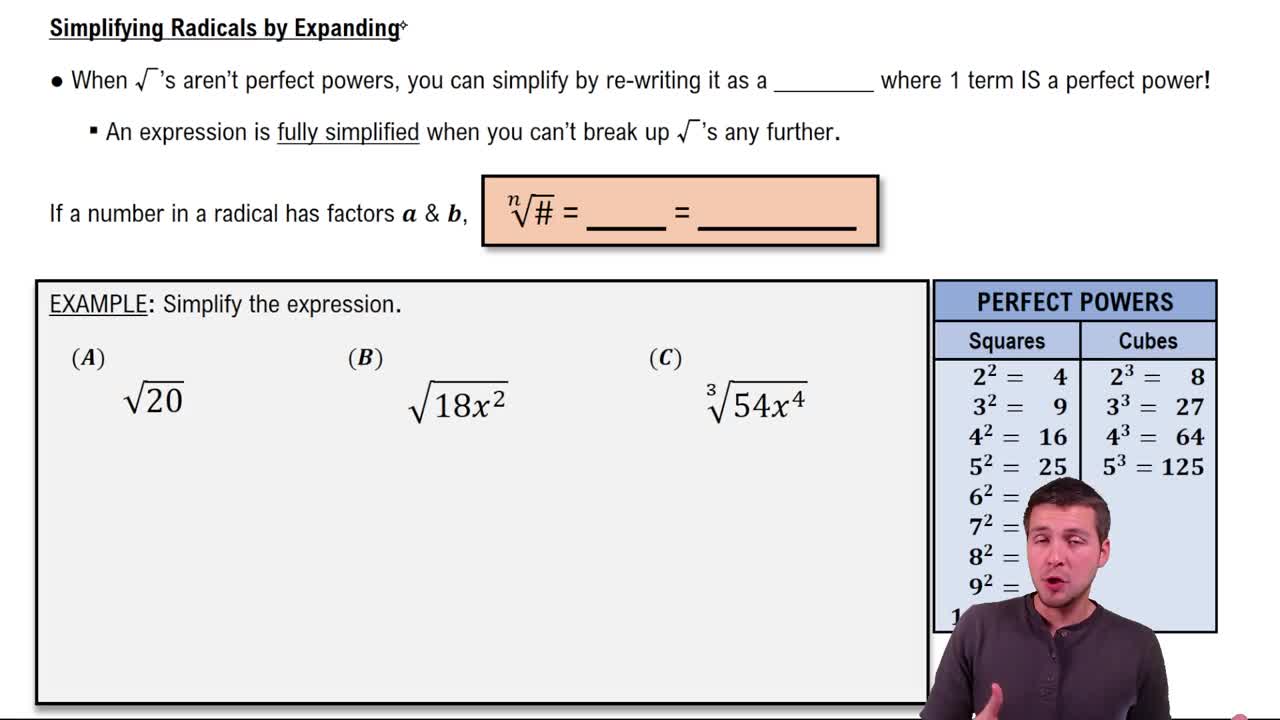
Expanding Radicals
Domain Restrictions
The domain of a radical equation is limited by the requirement that the expression inside the square root must be non-negative. For example, in √(2x + 3), the expression 2x + 3 must be ≥ 0. Identifying these restrictions helps determine valid solutions and avoid invalid or extraneous answers.
Video consigliato:
Percorso guidato
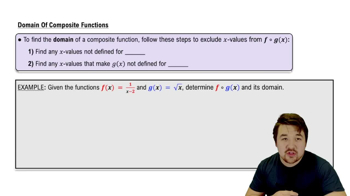
Domain Restrictions of Composed Functions
Checking Solutions
After solving a radical equation, substituting the solutions back into the original equation is crucial to verify their validity. Squaring both sides can introduce extraneous solutions that do not satisfy the original equation. Checking ensures only true solutions are accepted.
Video consigliato:
Percorso guidato
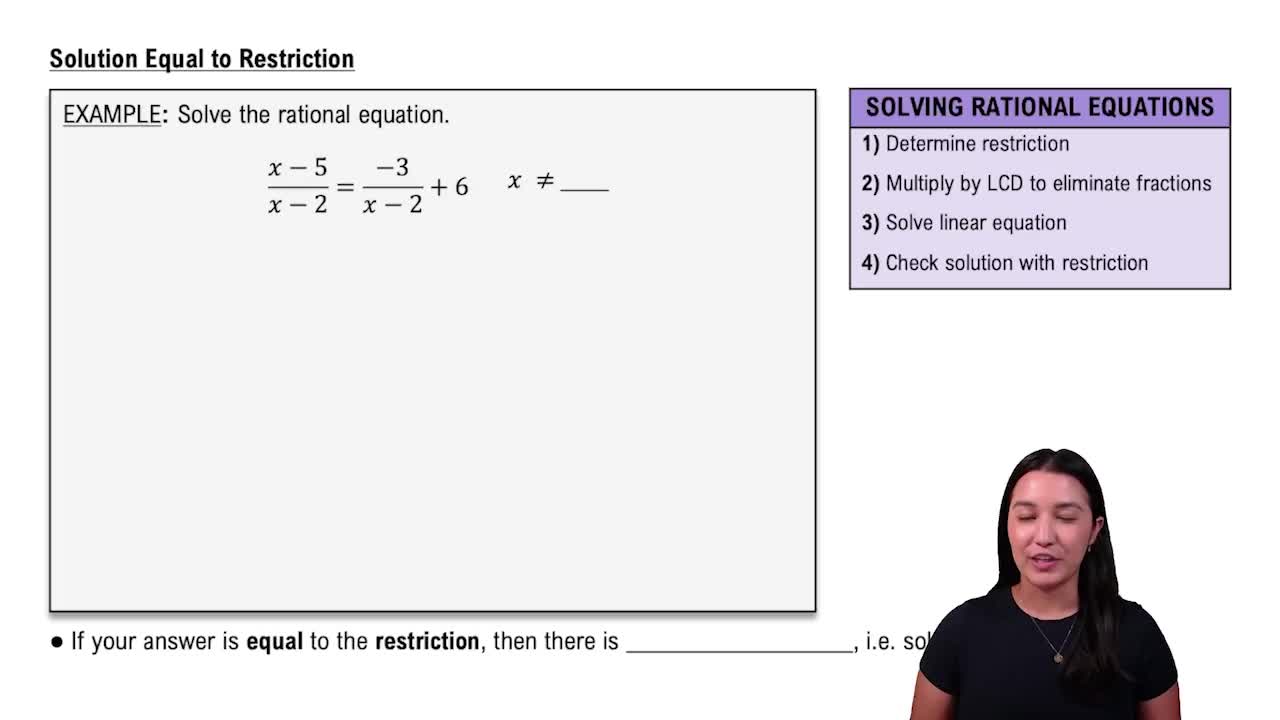
Restrictions on Rational Equations
Pratica correlata
Domanda del libro di testo
1008
views
Domanda del libro di testo
In Exercises 21–28, divide and express the result in standard form. (2 + 3i)/(2 + i)
118
views
Domanda del libro di testo
The length of the rectangular tennis court at Wimbledon is 6 feet longer than twice the width. If the court's perimeter is 228 feet, what are the court's dimensions?
680
views
Domanda del libro di testo
Graph each equation in Exercises 13 - 28. Let x = - 3, - 2, - 1, 0, 1, 2, 3
y = x3
228
views
Domanda del libro di testo
In all exercises, other than exercises with no solution, use interval notation to express solution sets and graph each solution set on a number line. In Exercises 27–50, solve each linear inequality. 5x + 11 < 26
757
views
Domanda del libro di testo
Exercises 27–40 contain linear equations with constants in denominators. Solve each equation. x/3 = x/2 - 2
944
views