Find f(g(x)) and g (f(x)) and determine whether each pair of functions ƒ and g are inverses of each other. f(x) = = -x and g(x) = -x
Ch. 2 - Functions and Graphs

Capitolo 3, Problema 7a
Find the domain of each function. g(x) = 3/(x2-2x-15)
Guida verificata passo dopo passo1
Step 1: Recall that the domain of a function is the set of all possible input values (x-values) for which the function is defined. For rational functions like g(x) = 3/(x^2 - 2x - 15), the function is undefined when the denominator equals zero.
Step 2: Set the denominator equal to zero to find the x-values that make the function undefined. Solve the equation x^2 - 2x - 15 = 0.
Step 3: Factor the quadratic expression x^2 - 2x - 15. Look for two numbers that multiply to -15 and add to -2. These numbers are -5 and 3, so the factorization is (x - 5)(x + 3).
Step 4: Solve the factored equation (x - 5)(x + 3) = 0. Set each factor equal to zero: x - 5 = 0 and x + 3 = 0. Solve for x to find x = 5 and x = -3.
Step 5: Exclude the values x = 5 and x = -3 from the domain, as these make the denominator zero. The domain of g(x) is all real numbers except x = 5 and x = -3, which can be written in interval notation as (-∞, -3) ∪ (-3, 5) ∪ (5, ∞).

Risposta video verificata per un problema simile:
Questa soluzione video è stata consigliata dai nostri tutor come utile per risolvere questo problema.
Durata del video:
3mConcetti chiave
Ecco i concetti essenziali che devi comprendere per rispondere correttamente alla domanda.
Domain of a Function
The domain of a function refers to the set of all possible input values (x-values) for which the function is defined. For rational functions, the domain is typically restricted by values that would make the denominator zero, as division by zero is undefined.
Video consigliato:
Percorso guidato
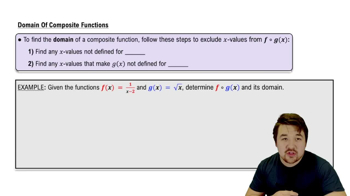
Domain Restrictions of Composed Functions
Factoring Quadratic Expressions
Factoring quadratic expressions involves rewriting them as a product of their linear factors. This is essential for identifying the values that make the denominator zero. In the case of g(x) = 3/(x^2-2x-15), factoring the quadratic will help determine the critical points that affect the domain.
Video consigliato:
Percorso guidato
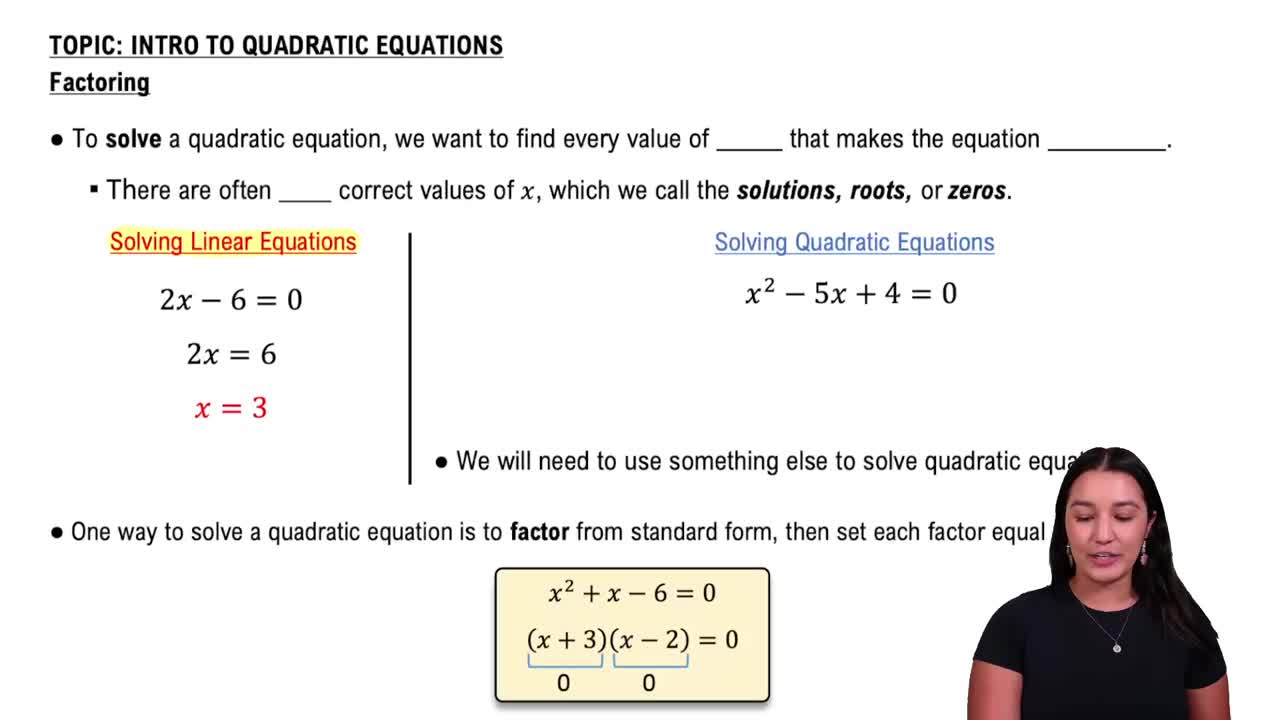
Solving Quadratic Equations by Factoring
Finding Asymptotes
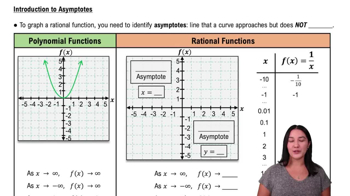
Asymptotes are lines that a graph approaches but never touches. For rational functions, vertical asymptotes occur at the x-values that make the denominator zero. Understanding asymptotes is crucial for determining the domain, as these points indicate where the function is undefined.
Video consigliato:
Percorso guidato
Introduction to Asymptotes
Pratica correlata
Domanda del libro di testo
633
views
Domanda del libro di testo
Use the given conditions to write an equation for each line in point-slope form and slope-intercept form. Passing through (2, −3) and perpendicular to the line whose equation is y = (1/5)x + 6
81
views
Domanda del libro di testo
In Exercises 1–10, determine whether each relation is a function. Give the domain and range for each relation. {(1, 4), (1, 5), (1, 6)}
142
views
Domanda del libro di testo
Find f(g(x)) and g (f(x)) and determine whether each pair of functions ƒ and g are inverses of each other. f(x) = 3/(x-4) and g(x) = (3/x) + 4
680
views
Domanda del libro di testo
Evaluate each function at the given values of the independent variable and simplify. g(x) = 3x^2 - 5x + 2 (a) g(0), (b) g(-2), (c) g(x-1), (d) g(-x)
207
views
Domanda del libro di testo
Use the graph of y = f(x) to graph each function g.
g(x) = f(-x)
899
views