In Exercises 77–92, use the graph to determine a. the function's domain; b. the function's range; c. the x-intercepts, if any; d. the y-intercept, if any; and e. the missing function values, indicated by question marks, below each graph.
Ch. 2 - Functions and Graphs

Capitolo 3, Problema 87
Find a. (f ○ g)(x); b. the domain of (f ○ g). f(x) = (x + 1)/(x - 2), g(x) = 1/x
Guida verificata passo dopo passo1
Step 1: Understand that the composition (f \(\circ\) g)(x) means f(g(x)), which is the function f applied to the output of g(x). So, first substitute g(x) into f(x).
Step 2: Write the expression for (f \(\circ\) g)(x) by replacing every x in f(x) with g(x). Since f(x) = \(\frac{x + 1}{x - 2}\) and g(x) = \(\frac{1}{x}\), we have (f \(\circ\) g)(x) = f\(\left\)(\(\frac{1}{x}\)\(\right\)) = \(\frac{\frac{1}{x}\) + 1}{\(\frac{1}{x}\) - 2}.
Step 3: Simplify the complex fraction by finding a common denominator for the numerator and denominator separately, then simplify the overall expression.
Step 4: Determine the domain of (f \(\circ\) g)(x) by considering the domain restrictions of both g(x) and f(g(x)). First, find where g(x) is defined (denominator \(\neq\) 0), then find where f is defined when its input is g(x) (denominator of f(g(x)) \(\neq\) 0).
Step 5: Combine the domain restrictions from both functions to write the domain of (f \(\circ\) g)(x) in interval or set notation, excluding values that make any denominator zero or cause undefined expressions.

Risposta video verificata per un problema simile:
Questa soluzione video è stata consigliata dai nostri tutor come utile per risolvere questo problema.
Durata del video:
3mConcetti chiave
Ecco i concetti essenziali che devi comprendere per rispondere correttamente alla domanda.
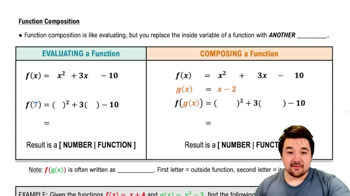
Function Composition
Function composition involves applying one function to the result of another, denoted as (f ○ g)(x) = f(g(x)). It requires substituting the entire output of g(x) into the function f. Understanding this process is essential to correctly find (f ○ g)(x).
Video consigliato:
Percorso guidato
Function Composition
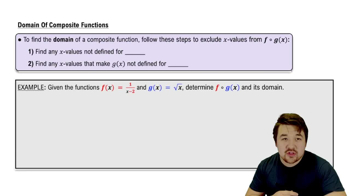
Domain of a Function
The domain of a function is the set of all input values (x) for which the function is defined. When composing functions, the domain of (f ○ g) includes all x-values in the domain of g for which g(x) is in the domain of f. Identifying restrictions like division by zero is crucial.
Video consigliato:
Percorso guidato
Domain Restrictions of Composed Functions
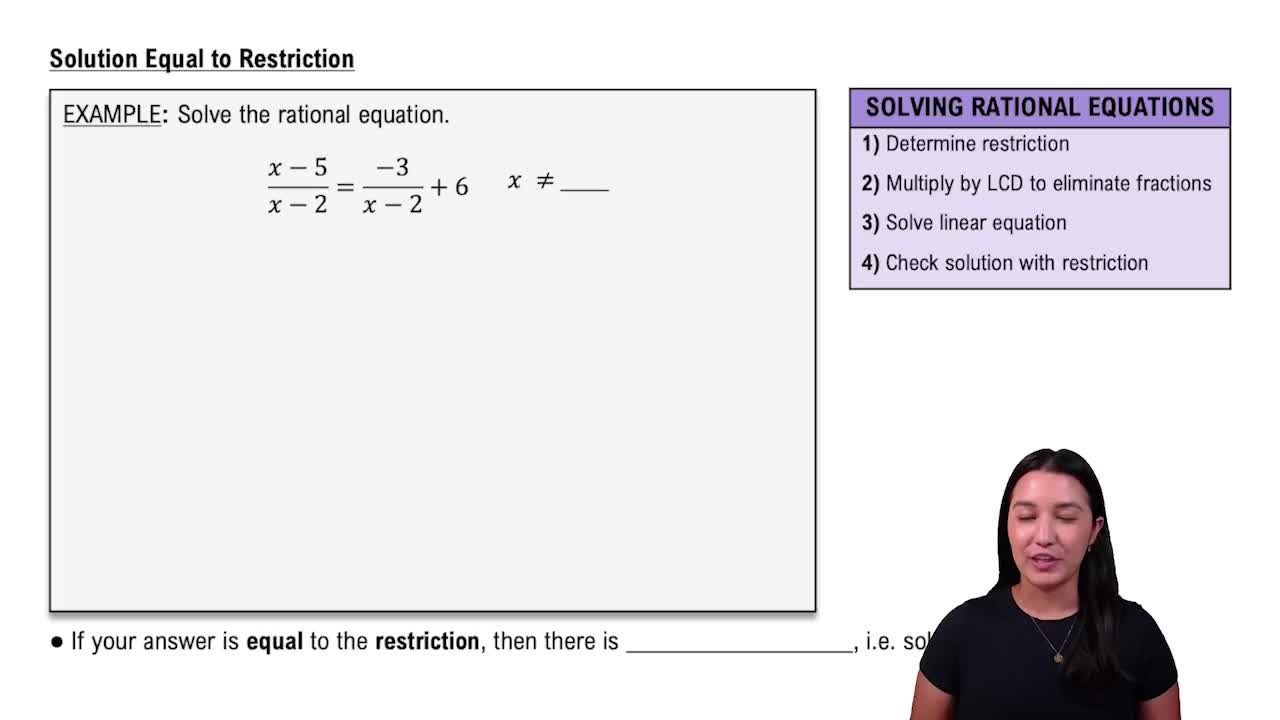
Rational Functions and Restrictions
Rational functions are ratios of polynomials, which can have restrictions where the denominator equals zero. For f(x) = (x + 1)/(x - 2) and g(x) = 1/x, values that make denominators zero must be excluded from the domain to avoid undefined expressions.
Video consigliato:
Percorso guidato
Restrictions on Rational Equations
Pratica correlata
Domanda del libro di testo
130
views
Domanda del libro di testo
Use the graphs of f and g to solve Exercises 83–90.
Find the domain of ƒ + g.
1268
views
Domanda del libro di testo
Begin by graphing the absolute value function, f(x) = |x|. Then use transformations of this graph to graph the given function. h(x) = |x + 3| - 2
791
views
Domanda del libro di testo
Begin by graphing the absolute value function, f(x) = |x|. Then use transformations of this graph to graph the given function. h(x) = -|x+3|
1612
views
Domanda del libro di testo
Use the graphs of f and g to solve Exercises 83–90.
Find(g/f)(3)
1295
views
Domanda del libro di testo
In Exercises 77–92, use the graph to determine a. the function's domain; b. the function's range; c. the x-intercepts, if any; d. the y-intercept, if any; and e. the missing function values, indicated by question marks, below each graph.
107
views
