Find the coordinates of the vertex for the parabola defined by the given quadratic function. f(x)=−2(x+1)2+5
Ch. 3 - Polynomial and Rational Functions

Capitolo 4, Problema 11
Use the Leading Coefficient Test to determine the end behavior of the graph of the given polynomial function. Then use this end behavior to match the polynomial function with its graph. [The graphs are labeled (a) through (d).]
Guida verificata passo dopo passo1
Identify the leading term of the polynomial function. For the given function \(f(x) = x^6 - 6x^4 + 9x^2\), the leading term is \(x^6\) because it has the highest power of \(x\).
Determine the degree of the polynomial, which is the exponent of the leading term. Here, the degree is 6, an even number.
Look at the leading coefficient, which is the coefficient of the leading term. In this case, it is 1 (positive).
Apply the Leading Coefficient Test: For an even degree polynomial with a positive leading coefficient, the end behavior is such that as \(x \to \infty\), \(f(x) \to \infty\), and as \(x \to -\infty\), \(f(x) \to \infty\).
Use this end behavior information to match the polynomial function with the graph that shows both ends of the graph rising upwards.

Risposta video verificata per un problema simile:
Questa soluzione video è stata consigliata dai nostri tutor come utile per risolvere questo problema.
Durata del video:
4mConcetti chiave
Ecco i concetti essenziali che devi comprendere per rispondere correttamente alla domanda.
Leading Coefficient Test
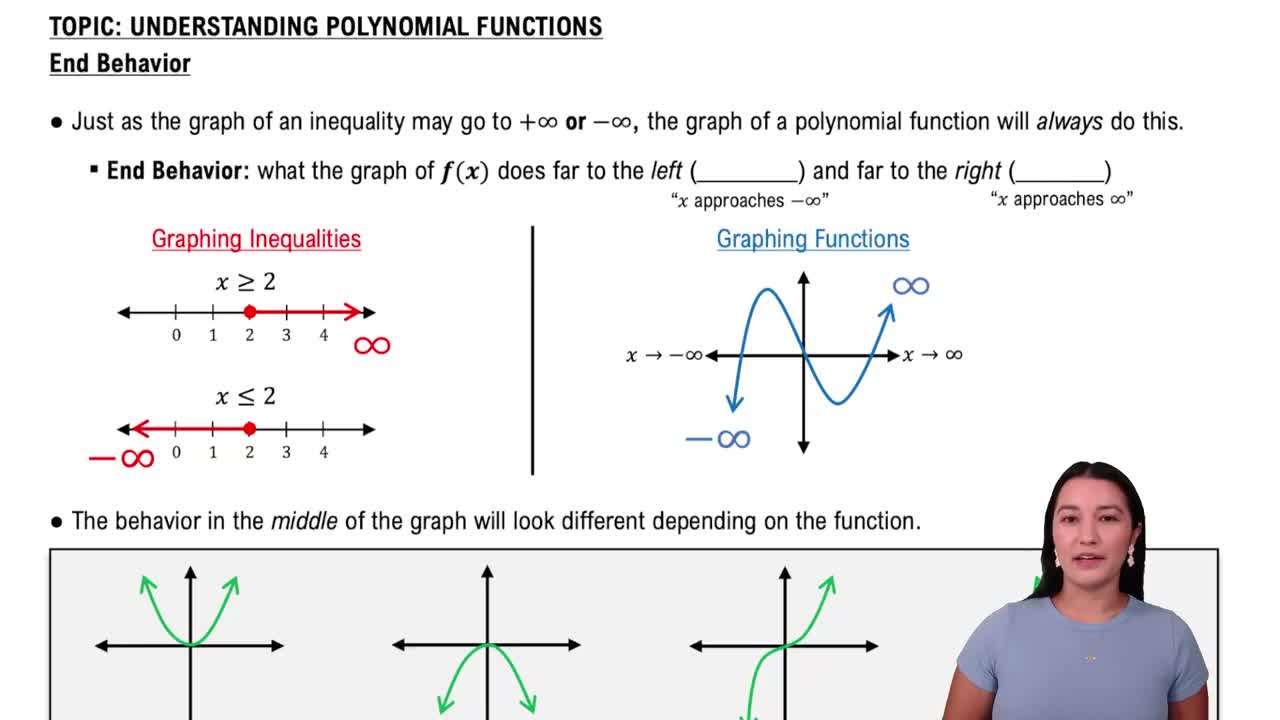
The Leading Coefficient Test helps determine the end behavior of a polynomial function by examining the degree and the leading coefficient. For even-degree polynomials with a positive leading coefficient, both ends of the graph rise; if negative, both fall. For odd-degree polynomials, the ends go in opposite directions depending on the sign of the leading coefficient.
Video consigliato:
Percorso guidato
End Behavior of Polynomial Functions
Degree of a Polynomial
The degree of a polynomial is the highest power of the variable in the expression. It influences the shape and end behavior of the graph. In this problem, the polynomial degree is 6, an even number, which affects how the graph behaves as x approaches positive or negative infinity.
Video consigliato:
Percorso guidato
Standard Form of Polynomials
End Behavior of Polynomial Functions
End behavior describes how the values of a polynomial function behave as x approaches positive or negative infinity. It is determined by the leading term and helps match the polynomial to its graph by predicting whether the graph rises or falls on each end.
Video consigliato:
Percorso guidato
End Behavior of Polynomial Functions
Pratica correlata
Domanda del libro di testo
1106
views
Domanda del libro di testo
In Exercises 9–16, a) List all possible rational zeros. b) Use synthetic division to test the possible rational zeros and find an actual zero. c) Use the quotient from part (b) to find the remaining zeros of the polynomial function. f(x)=2x3−3x2−11x+6
449
views
Domanda del libro di testo
Write an equation that expresses each relationship. Then solve the equation for y. x varies jointly as y and z.
534
views
Domanda del libro di testo
Identify which graphs are not those of polynomial functions.
1037
views
Domanda del libro di testo
Solve each polynomial inequality in Exercises 1–42 and graph the solution set on a real number line. Express each solution set in interval notation. 3x2+10x−8≤0
499
views
Domanda del libro di testo
Divide using long division. State the quotient, and the remainder, r(x). (4x4−4x2+6x)/(x−4)
692
views