In Exercises 25–26, graph each polynomial function.
Ch. 3 - Polynomial and Rational Functions

Capitolo 4, Problema 25
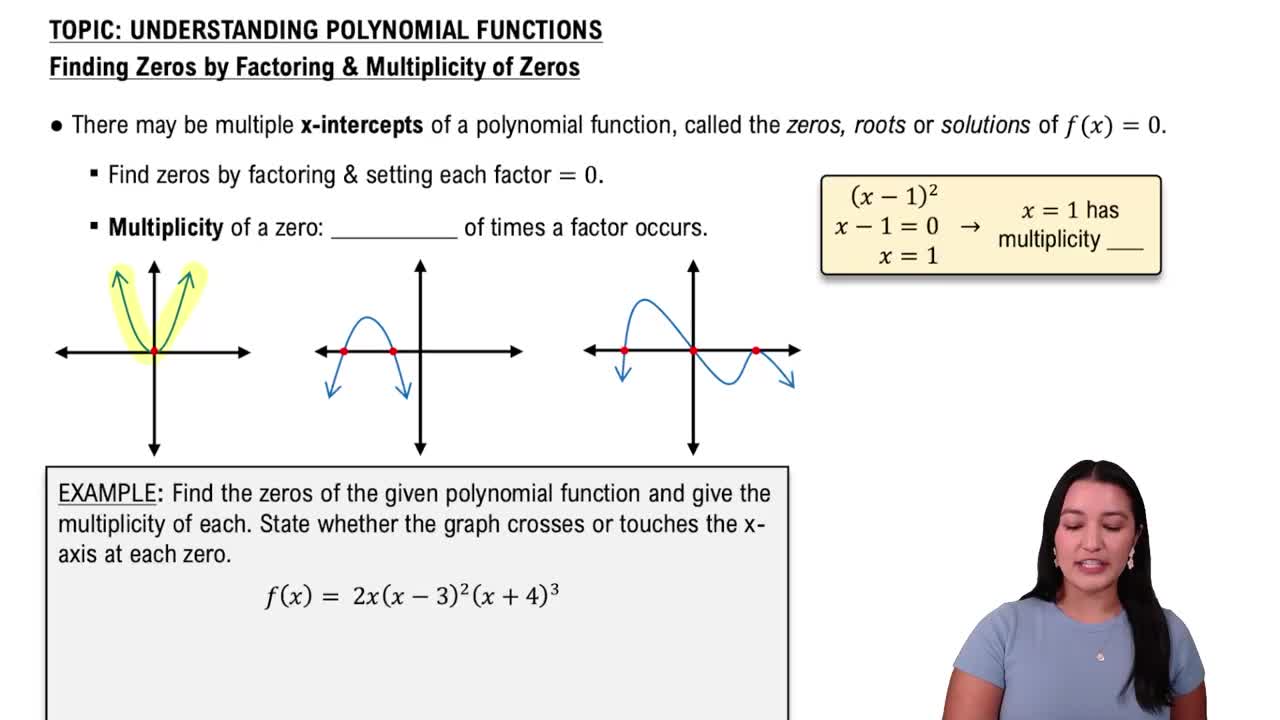
Find the zeros for each polynomial function and give the multiplicity for each zero. State whether the graph crosses the x-axis, or touches the x-axis and turns around, at each zero. f(x)=2(x−5)(x+4)2
Guida verificata passo dopo passo1
Identify the zeros of the polynomial by setting each factor equal to zero: solve \(2(x-5)(x+4)^2 = 0\) by setting \(x-5=0\) and \(x+4=0\).
From \(x-5=0\), find the zero \(x=5\). From \(x+4=0\), find the zero \(x=-4\).
Determine the multiplicity of each zero by looking at the exponents of the factors: the factor \((x-5)\) has an exponent of 1, so the zero \(x=5\) has multiplicity 1; the factor \((x+4)^2\) has an exponent of 2, so the zero \(x=-4\) has multiplicity 2.
Interpret the multiplicity to describe the graph behavior at each zero: if the multiplicity is odd (like 1), the graph crosses the x-axis at that zero; if the multiplicity is even (like 2), the graph touches the x-axis and turns around at that zero.
Summarize the results: zero at \(x=5\) with multiplicity 1 (graph crosses the x-axis), and zero at \(x=-4\) with multiplicity 2 (graph touches and turns around at the x-axis).

Risposta video verificata per un problema simile:
Questa soluzione video è stata consigliata dai nostri tutor come utile per risolvere questo problema.
Durata del video:
3mConcetti chiave
Ecco i concetti essenziali che devi comprendere per rispondere correttamente alla domanda.
Zeros of a Polynomial Function
Zeros of a polynomial function are the values of x that make the function equal to zero. They correspond to the x-intercepts of the graph. Finding zeros involves setting the function equal to zero and solving for x, often by factoring or using other algebraic methods.
Video consigliato:
Percorso guidato
Finding Zeros & Their Multiplicity
Multiplicity of Zeros
Multiplicity refers to the number of times a particular zero appears as a factor in the polynomial. A zero with multiplicity 1 is called a simple zero, while higher multiplicities indicate repeated roots. The multiplicity affects the behavior of the graph at that zero.
Video consigliato:
Percorso guidato
Finding Zeros & Their Multiplicity
Graph Behavior at Zeros Based on Multiplicity
The graph crosses the x-axis at zeros with odd multiplicity and touches the x-axis and turns around at zeros with even multiplicity. This means the shape of the graph near each zero depends on whether the multiplicity is odd or even, influencing how the function behaves visually.
Video consigliato:
Percorso guidato
Finding Zeros & Their Multiplicity
Pratica correlata
Domanda del libro di testo
990
views
Domanda del libro di testo
Find the zeros for each polynomial function and give the multiplicity for each zero. State whether the graph crosses the x-axis, or touches the x-axis and turns around, at each zero. f(x)=3(x+5)(x+2)2
1238
views
Domanda del libro di testo
Find an nth-degree polynomial function with real coefficients satisfying the given conditions. If you are using a graphing utility, use it to graph the function and verify the real zeros and the given function value. n=3; 1 and 5i are zeros; f(-1) = -104
760
views
Domanda del libro di testo
Divide using synthetic division. (x2−5x−5x3+x4)÷(5+x)
504
views
Domanda del libro di testo
Solve each polynomial inequality in Exercises 1–42 and graph the solution set on a real number line. Express each solution set in interval notation. x2 ≤ 4x − 2
520
views
Domanda del libro di testo
In Exercises 25–26, graph each polynomial function.
1037
views