In Exercises 39–52, find all zeros of the polynomial function or solve the given polynomial equation. Use the Rational Zero Theorem, Descartes's Rule of Signs, and possibly the graph of the polynomial function shown by a graphing utility as an aid in obtaining the first zero or the first root. f(x)=x4−2x3+x2+12x+8
Ch. 3 - Polynomial and Rational Functions

Capitolo 4, Problema 43
Find the horizontal asymptote, if there is one, of the graph of each rational function. f(x)=(−2x+1)/(3x+5)
Guida verificata passo dopo passo1
Identify the degrees of the numerator and denominator polynomials in the rational function \(f(x) = \frac{-2x + 1}{3x + 5}\). Here, both the numerator and denominator are first-degree polynomials (degree 1).
Recall the rule for horizontal asymptotes of rational functions:
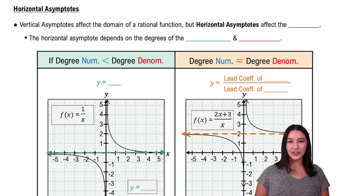
- If the degree of the numerator is less than the degree of the denominator, the horizontal asymptote is \(y = 0\).
- If the degrees are equal, the horizontal asymptote is \(y = \frac{\text{leading coefficient of numerator}}{\text{leading coefficient of denominator}}\).
- If the degree of the numerator is greater than the degree of the denominator, there is no horizontal asymptote (there may be an oblique asymptote instead).
Since the degrees of numerator and denominator are equal (both 1), find the leading coefficients: numerator's leading coefficient is \(-2\), denominator's leading coefficient is \(3\).
Write the horizontal asymptote as \(y = \frac{-2}{3}\) by dividing the leading coefficients.
Conclude that the horizontal asymptote of the function \(f(x) = \frac{-2x + 1}{3x + 5}\) is the horizontal line \(y = \frac{-2}{3}\).

Risposta video verificata per un problema simile:
Questa soluzione video è stata consigliata dai nostri tutor come utile per risolvere questo problema.
Durata del video:
1mConcetti chiave
Ecco i concetti essenziali che devi comprendere per rispondere correttamente alla domanda.
Rational Functions
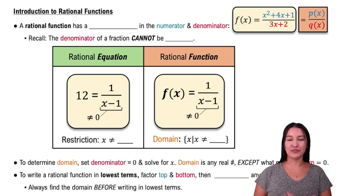
A rational function is a ratio of two polynomials, expressed as f(x) = P(x)/Q(x). Understanding the behavior of rational functions, especially their graphs, is essential for analyzing asymptotes and limits.
Video consigliato:
Intro to Rational Functions
Horizontal Asymptotes
A horizontal asymptote describes the behavior of a function as x approaches infinity or negative infinity. It is a horizontal line y = L that the graph approaches but does not necessarily touch, indicating the end behavior of the function.
Video consigliato:
Determining Horizontal Asymptotes
Degree of Polynomials in Numerator and Denominator
The degrees of the numerator and denominator polynomials determine the horizontal asymptote of a rational function. If degrees are equal, the asymptote is the ratio of leading coefficients; if numerator degree is less, asymptote is y=0; if greater, no horizontal asymptote.
Video consigliato:
Rationalizing Denominators
Pratica correlata
Domanda del libro di testo
568
views
Domanda del libro di testo
Solve the equation 12x3+16x2−5x−3=0 given that -3/2 is a root.
1216
views
Domanda del libro di testo
Solve each rational inequality in Exercises 43–60 and graph the solution set on a real number line. Express each solution set in interval notation. (x+3)/(x+4)<0
554
views
Domanda del libro di testo
An equation of a quadratic function is given. a) Determine, without graphing, whether the function has a minimum value or a maximum value. b) Find the minimum or maximum value and determine where it occurs. c) Identify the function's domain and its range. f(x)=5x2−5x
969
views
Domanda del libro di testo
Solve the equation 2x3−3x2−11x+6=0 given that -2 is a zero of f(x)=2x3−3x2−11x+6.
1079
views
Domanda del libro di testo
Solve each rational inequality in Exercises 43–60 and graph the solution set on a real number line. Express each solution set in interval notation. (x−4)/(x+3) > 0
578
views
