Use long division to rewrite the equation for g in the form quotient + remainder/divisor. Then use this form of the function's equation and transformations of f(x) = 1/x to graph g. g(x) = (2x+7)/(x+3)
Ch. 3 - Polynomial and Rational Functions

Capitolo 4, Problema 93
In Exercises 89–94, the equation for f is given by the simplified expression that results after performing the indicated operation. Write the equation for f and then graph the function. (1 − 3/(x+2)) / (1 + 1/(x−2))
Guida verificata passo dopo passo1
Start by rewriting the given expression clearly: . This helps visualize the numerator and denominator separately.
Find a common denominator for the numerator: rewrite as . Simplify the numerator inside the fraction.
Similarly, find a common denominator for the denominator: rewrite as . Simplify the numerator inside this fraction.
Now, the entire expression is a complex fraction: . To simplify, multiply the numerator by the reciprocal of the denominator.
Perform the multiplication: multiply the numerators together and the denominators together, then simplify the resulting expression by combining like terms and factoring if possible. This will give the simplified expression for .

Risposta video verificata per un problema simile:
Questa soluzione video è stata consigliata dai nostri tutor come utile per risolvere questo problema.
Durata del video:
14mConcetti chiave
Ecco i concetti essenziali che devi comprendere per rispondere correttamente alla domanda.
Simplifying Complex Rational Expressions
This involves rewriting expressions that contain fractions within fractions into a simpler, single rational expression. The process typically includes finding common denominators, combining terms, and simplifying numerators and denominators separately to make the expression easier to work with.
Video consigliato:
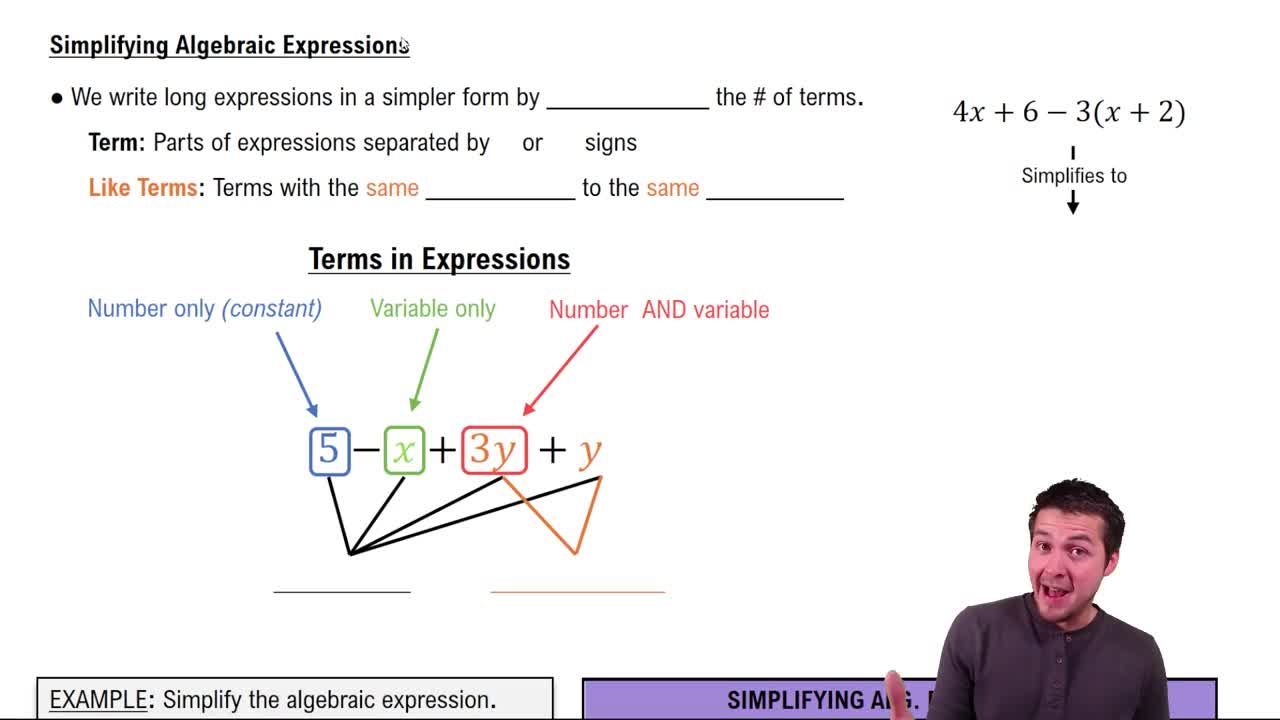
Simplifying Algebraic Expressions
Domain of a Function
The domain is the set of all input values (x-values) for which the function is defined. When simplifying rational expressions, it is important to identify values that make any denominator zero, as these values are excluded from the domain to avoid undefined expressions.
Video consigliato:
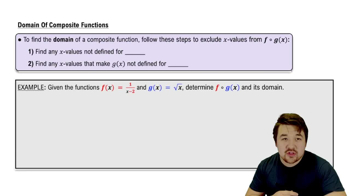
Domain Restrictions of Composed Functions
Graphing Rational Functions
Graphing involves plotting the function on a coordinate plane, considering key features such as intercepts, asymptotes, and behavior near undefined points. Understanding how to interpret the simplified function helps in sketching its graph accurately.
Video consigliato:
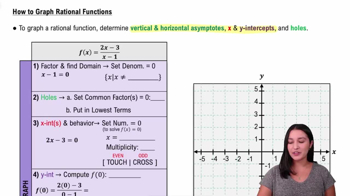
How to Graph Rational Functions
Pratica correlata
Domanda del libro di testo
1110
views
Domanda del libro di testo
Solve each inequality in Exercises 86–91 using a graphing utility. (x - 4)/(x - 1) ≤ 0
495
views
Domanda del libro di testo
Use long division to rewrite the equation for g in the form quotient + remainder/divisor. Then use this form of the function's equation and transformations of f(x) = 1/x to graph g. g(x)=(3x−7)/(x−2)
638
views
Domanda del libro di testo
In Exercises 97–98, write the equation of each parabola in vertex form. Vertex: (-3,-4) The graph passes through the point (1,4).
1135
views
Domanda del libro di testo
Solve each inequality in Exercises 86–91 using a graphing utility. 1/(x + 1) ≤ 2/(x + 4)
527
views
Domanda del libro di testo
In Exercises 89–94, the equation for f is given by the simplified expression that results after performing the indicated operation. Write the equation for f and then graph the function. x/(2x+6) − 9/(x2−9)
833
views