Write each equation in its equivalent logarithmic form. 2-4 = 1/16
Ch. 4 - Exponential and Logarithmic Functions

Capitolo 5, Problema 13
In Exercises 13–15, write each equation in its equivalent exponential form. 1/2 = log49 7
Guida verificata passo dopo passo1
Understand that the equation \( \frac{1}{2} = \log_{49} 7 \) is in logarithmic form, where \( \log_b a = c \) means \( b^c = a \).
Identify the base \( b \), the result \( a \), and the exponent \( c \) from the logarithmic equation. Here, \( b = 49 \), \( a = 7 \), and \( c = \frac{1}{2} \).
Rewrite the equation in exponential form using the identified components: \( 49^{\frac{1}{2}} = 7 \).
Recognize that rewriting in exponential form involves expressing the base raised to the power of the exponent equals the result.
Verify the conversion by checking if the exponential form correctly represents the original logarithmic equation.

Risposta video verificata per un problema simile:
Questa soluzione video è stata consigliata dai nostri tutor come utile per risolvere questo problema.
Durata del video:
1mConcetti chiave
Ecco i concetti essenziali che devi comprendere per rispondere correttamente alla domanda.
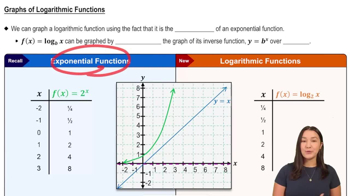
Logarithmic Functions
Logarithmic functions are the inverse of exponential functions. They express the power to which a base must be raised to obtain a certain number. For example, in the equation log_b(a) = c, b is the base, a is the result, and c is the exponent. Understanding this relationship is crucial for converting between logarithmic and exponential forms.
Video consigliato:
Graphs of Logarithmic Functions
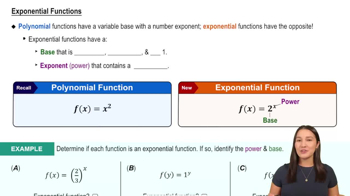
Exponential Form
Exponential form refers to expressing a number as a base raised to a power. For instance, the equation a = b^c indicates that b is raised to the power of c to yield a. In the context of logarithms, converting a logarithmic equation to exponential form allows us to solve for unknown variables by rewriting the equation in a more straightforward manner.
Video consigliato:
Exponential Functions
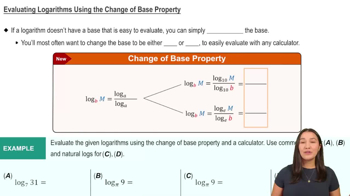
Change of Base Formula
The change of base formula is a method used to convert logarithms from one base to another, which can simplify calculations. It states that log_b(a) can be expressed as log_k(a) / log_k(b) for any positive k. This concept is particularly useful when dealing with logarithms that do not have a readily available base, allowing for easier computation and understanding of logarithmic relationships.
Video consigliato:
Change of Base Property
Pratica correlata
Domanda del libro di testo
858
views
1
rank
Domanda del libro di testo
Write each equation in its equivalent logarithmic form. ∛8 = 2
895
views
Domanda del libro di testo
Use properties of logarithms to expand each logarithmic expression as much as possible. Where possible, evaluate logarithmic expressions without using a calculator. ln(e2/5)
1188
views
Domanda del libro di testo
Graph each function by making a table of coordinates. If applicable, use a graphing utility to confirm your hand-drawn graph. g(x) = (3/2)x
965
views
Domanda del libro di testo
Solve each exponential equation in Exercises 1–22 by expressing each side as a power of the same base and then equating exponents. 31-x=1/27
986
views
Domanda del libro di testo
Use properties of logarithms to expand each logarithmic expression as much as possible. Where possible, evaluate logarithmic expressions without using a calculator. log4 (64/y)
904
views