Solve each exponential equation in Exercises 1–22 by expressing each side as a power of the same base and then equating exponents. 9x=27
Ch. 4 - Exponential and Logarithmic Functions

Capitolo 5, Problema 10
Use the compound interest formulas to solve Exercises 10–11. Suppose that you have \$5000 to invest. Which investment yields the greater return over 5 years: 1.5% compounded semiannually or 1.45% compounded monthly?
Guida verificata passo dopo passo1
Identify the compound interest formula: \(A = P \left(1 + \frac{r}{n}\right)^{nt}\), where \(A\) is the amount after \(t\) years, \(P\) is the principal, \(r\) is the annual interest rate (in decimal), \(n\) is the number of compounding periods per year, and \(t\) is the time in years.
For the first investment (1.5% compounded semiannually): set \(P = 5000\), \(r = 0.015\), \(n = 2\), and \(t = 5\). Substitute these values into the formula to express the amount \(A_1\).
For the second investment (1.45% compounded monthly): set \(P = 5000\), \(r = 0.0145\), \(n = 12\), and \(t = 5\). Substitute these values into the formula to express the amount \(A_2\).
Calculate the expressions for \(A_1\) and \(A_2\) separately by evaluating the powers and multiplications (do not compute the final numerical values here, just set up the expressions).
Compare the two amounts \(A_1\) and \(A_2\) to determine which investment yields the greater return over 5 years.

Risposta video verificata per un problema simile:
Questa soluzione video è stata consigliata dai nostri tutor come utile per risolvere questo problema.
Durata del video:
7mConcetti chiave
Ecco i concetti essenziali che devi comprendere per rispondere correttamente alla domanda.
Compound Interest Formula
The compound interest formula calculates the amount of money accumulated over time with interest added periodically. It is given by A = P(1 + r/n)^(nt), where P is the principal, r is the annual interest rate, n is the number of compounding periods per year, and t is the time in years.
Video consigliato:
Percorso guidato
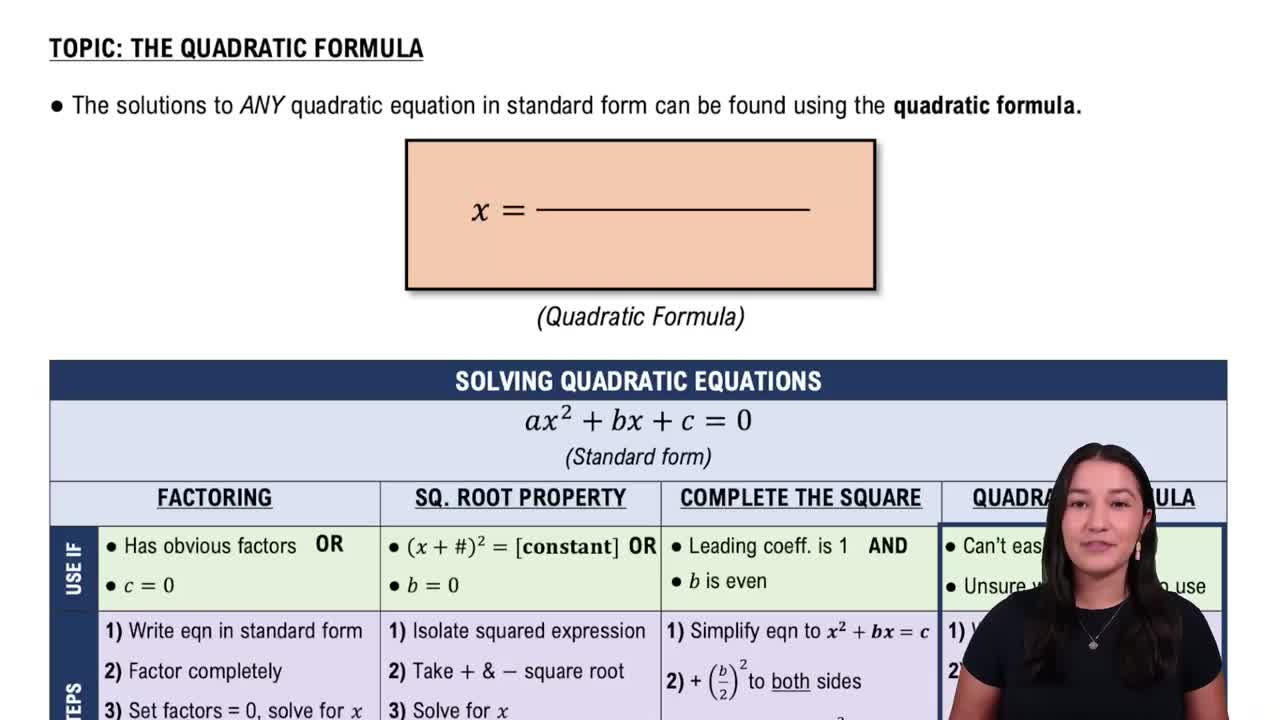
Solving Quadratic Equations Using The Quadratic Formula
Compounding Frequency
Compounding frequency refers to how often interest is added to the principal balance within a year. Common frequencies include annually, semiannually, quarterly, and monthly. More frequent compounding results in interest being calculated on previously earned interest more often, increasing the total return.
Video consigliato:
Percorso guidato
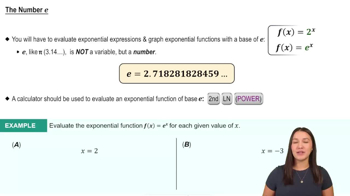
The Number e
Comparing Investment Returns
To determine which investment yields a greater return, calculate the final amount for each option using their respective interest rates and compounding frequencies. Comparing these amounts after the same time period shows which investment is more profitable.
Video consigliato:
Percorso guidato
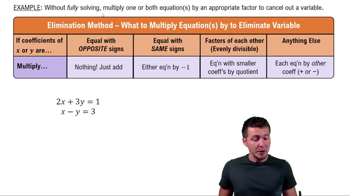
Example 3
Pratica correlata
Domanda del libro di testo
666
views
Domanda del libro di testo
Use properties of logarithms to expand each logarithmic expression as much as possible. Where possible, evaluate logarithmic expressions without using a calculator. log(x/100)
1085
views
Domanda del libro di testo
Solve each exponential equation in Exercises 1–22 by expressing each side as a power of the same base and then equating exponents. 32x=8
697
views
Domanda del libro di testo
In Exercises 11–18, graph each function by making a table of coordinates. If applicable, use a graphing utility to confirm your hand-drawn graph. f(x) = 4x
1165
views
Domanda del libro di testo
In Exercises 1–10, approximate each number using a calculator. Round your answer to three decimal places. e-0.95
882
views
Domanda del libro di testo
Write each equation in its equivalent logarithmic form. 54 = 625
801
views