 Indietro
Chem Ch4
 01:32
01:32
Termini in questo insieme (20)
A chemical reaction is a process where one or more substances are converted into different substances, involving chemical changes that produce new chemical substances.
A combustion reaction involves a substance combining with oxygen to form oxygen-containing compounds and emits heat.
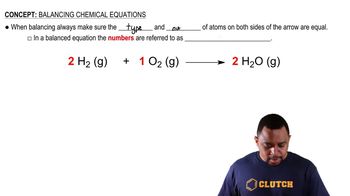
A chemical equation shows the formulas and states of reactants and products, and the relative numbers of molecules involved, which helps determine reactant and product quantities.
(g) gas, (l) liquid, (s) solid, (aq) aqueous (water solution).
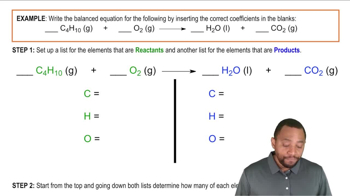
To obey the Law of Conservation of Mass, equations must have equal numbers of atoms of each element on both sides by adjusting coefficients, not subscripts.
Stoichiometry is the study of numerical relationships between chemical quantities in a reaction, based on balanced equations and conservation of mass.
Coefficients specify the relative amounts in moles of each substance involved in the reaction.
Use the ratio of coefficients from the balanced equation as conversion factors between moles of reactants and products.
The limiting reactant is the reactant completely consumed first, limiting the amount of product formed.
Excess reactants are reactants present in quantities greater than needed to react with the limiting reactant.
Theoretical yield is the maximum amount of product that can be formed from the limiting reactant in a chemical reaction.
Actual yield is the amount of product actually obtained; percent yield = (actual yield / theoretical yield) × 100%.
Convert reactant masses to moles, use stoichiometric ratios to find product amounts, and the reactant producing the least product is limiting.
\(CH_4 + 2 O_2 \rightarrow CO_2 + 2 H_2O\)
Using the ratio 2 mol C8H18 : 16 mol CO2, 22.0 mol C8H18 produces 176 mol CO2.
Molar mass converts between mass and moles, enabling calculation of product mass from reactant mass using stoichiometric ratios.
Greenhouse gases allow sunlight in, warm Earth's surface, and trap some heat, balancing incoming and outgoing solar energy to determine Earth's average temperature.
Increased CO2 from fossil fuel combustion and volcanic activity correlates with a 0.7°C rise in atmospheric temperature since 1860.
Alkali metals react vigorously with water to form dissolved metal ions, hydroxide ions, and hydrogen gas, with reactivity increasing down the group.
Halogens react with metals to form metal halides, with hydrogen to form hydrogen halides, and with each other to form interhalogen compounds.