 Indietro
Chem Ch6
 01:15
01:15
Termini in questo insieme (21)
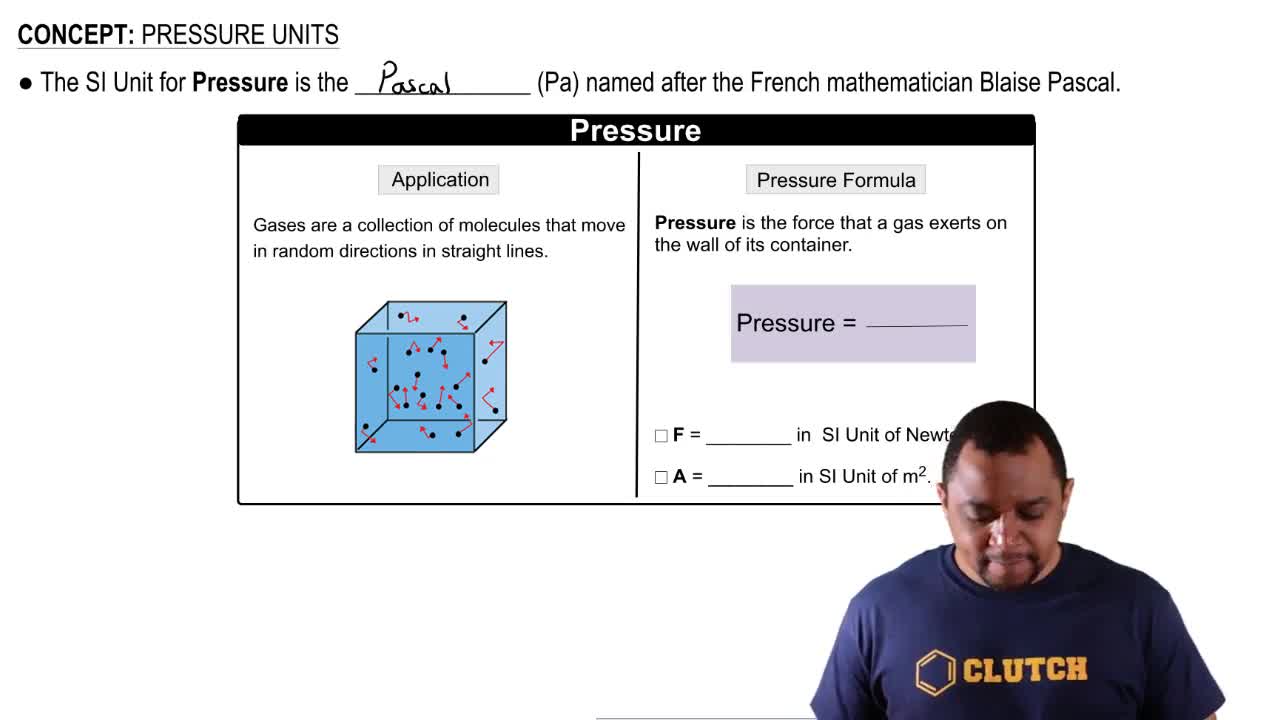
Gas pressure is the force exerted per unit area by gas molecules as they collide with surfaces around them.
Atmospheric pressure decreases with increasing altitude because the number of gas particles in a given volume decreases.
Gas pressure depends on the number of gas particles, the volume of the container, and the average speed of the gas particles.
At constant temperature and amount, the pressure of a gas is inversely proportional to its volume: \(P \times V = \text{constant}\).
Decreasing the volume increases the frequency of molecular collisions with container walls, increasing pressure.
At constant pressure and amount, the volume of a gas is directly proportional to its temperature in kelvins: \(\frac{V}{T} = \text{constant}\).
Absolute zero is the temperature at which the volume of a gas extrapolates to zero, 0 K or -273.15 °C.
At constant temperature and pressure, the volume of a gas is directly proportional to the number of moles: \(\frac{V}{n} = \text{constant}\).
The combined gas law: \(PV = nRT\), relating pressure, volume, temperature, and moles.
Standard temperature is 273 K (0 °C) and standard pressure is 1 atm.
One mole of an ideal gas occupies 22.4 liters at STP.
Density = molar mass / molar volume; gases with higher molar mass have higher density.
The total pressure of a gas mixture equals the sum of the partial pressures of each component: \(P_{total} = P_a + P_b + P_c + \cdots\).
Mole fraction is the ratio of moles of a component to total moles: \(\chi_a = \frac{n_a}{n_{total}}\).
Partial pressure of a gas = mole fraction × total pressure: \(P_a = \chi_a P_{total}\).
Gas particles are in constant motion, have negligible size, no intermolecular attractions, and collisions are elastic.
Average kinetic energy is directly proportional to temperature in kelvins.
\(u_{rms} = \sqrt{\frac{3RT}{M}}\), where M is molar mass in kg/mol.
The rate of effusion of a gas is inversely proportional to the square root of its molar mass: \(\frac{rate_A}{rate_B} = \sqrt{\frac{M_B}{M_A}}\).
Real gases have intermolecular attractions and finite molecular volume, especially at high pressure and low temperature.
Modified ideal gas law accounting for molecular volume and attractions: \(\left(P + \frac{a n^2}{V^2}\right)(V - nb) = nRT\).