 Indietro
Electronic Structure of Atoms - General Chemistry
 2:58
2:58
Termini in questo insieme (28)
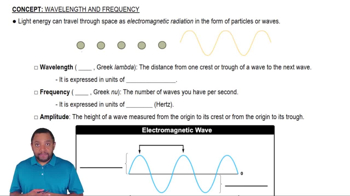
Wavelength (λ) is the distance between corresponding points on adjacent waves.
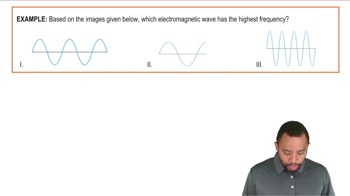
Frequency (ν) is the number of complete waves passing a given point per unit time.
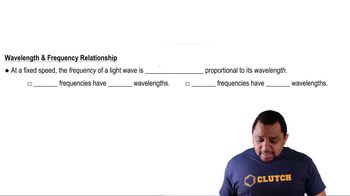
For waves traveling at the same velocity, the longer the wavelength, the smaller the frequency.
The speed of light is \(3.00 \times 10^{8} \text{ m/s}\). It relates to wavelength and frequency by \(c = \lambda \nu\).
Quanta are packets of energy; energy is not continuous but comes in discrete amounts.
Energy of a photon is proportional to frequency: \(E = h \nu\), where h is Planck's constant.
A line spectrum consists of discrete wavelengths emitted by atoms, unique to each element.
Electrons orbit the nucleus in specific allowed orbits with quantized energies; energy is emitted or absorbed when electrons change orbits.
The ground state is the lowest energy state of an electron; any higher energy state is an excited state.
Positive ΔE means energy absorbed (photon absorbed), negative ΔE means energy released (photon emitted).
It only accurately describes hydrogen; it assumes electrons do not spiral into the nucleus without explaining why.
Matter exhibits wave properties; wavelength is related to momentum by \(\lambda = \frac{h}{mv}\).
The more precisely the momentum of a particle is known, the less precisely its position is known: \(\Delta x \Delta p \geq \frac{h}{4\pi}\).
It treats electrons as wave functions, giving probabilities of electron locations rather than fixed orbits.
Quantum numbers describe the energy, shape, and orientation of atomic orbitals.
n describes the energy level of an orbital; it is an integer ≥ 1.
l defines the shape of the orbital; allowed values are integers from 0 to n-1, corresponding to s, p, d, f orbitals.
ml describes the orientation of the orbital; values range from -l to +l.
s orbitals are spherical; p orbitals have two lobes; d orbitals have four lobes or a doughnut shape; f orbitals are more complex.
ms describes electron spin; allowed values are +1/2 or -1/2.
No two electrons in the same atom can have the same set of four quantum numbers.
Electron configuration is the arrangement of electrons in an atom's orbitals in the ground state.
Electrons fill degenerate orbitals singly first, with parallel spins, to minimize energy.
Valence electrons are in the outermost shell; core electrons are in filled inner shells.
Using noble gas symbols in brackets to represent core electrons, followed by valence electron configuration.
4s orbitals fill before 3d orbitals; transition metals fill 3d after 4s.
Lanthanides fill 4f orbitals; actinides fill 5f orbitals; both are inner transition metals.
Close energy levels cause electrons to half-fill or fully fill d or f orbitals for extra stability.