 Indietro
General Chemistry: Atomic Structure and Light
 03:32
03:32
Termini in questo insieme (26)
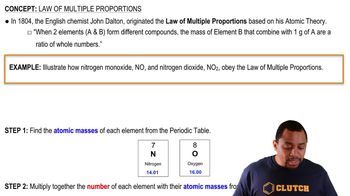
When two elements form different compounds, the masses of one element that combine with a fixed mass of the other are in a whole number ratio.
Carbon monoxide and carbon dioxide both contain C and O. The mass ratio of oxygen to carbon in CO2 is 2.67:1, and in CO it is 1.33:1, a simple whole number ratio.
Discovered cathode rays are negatively charged particles (electrons) that travel in straight lines and are independent of the cathode.
1. Elements are made of atoms.
2. Atoms of an element are identical.
3. Atoms combine in whole number ratios.
4. Atoms cannot change into other elements.
1. Most mass and positive charge are in the nucleus.
2. Most volume is empty space with electrons.
3. In neutral atoms, positive and negative charges are equal.
Neutral particles in the nucleus with mass similar to protons; explain atomic mass differences in isotopes.
The number of protons in the nucleus; defines the element.
The total number of protons and neutrons in an atom's nucleus.
Atoms of the same element with different numbers of neutrons but the same number of protons.
Charged atoms formed by losing or gaining electrons; cations are positive, anions are negative.
Weighted average mass of an element's naturally occurring isotopes.
Mass of one mole of a substance, equal to the atomic or molecular mass in grams per mole.
Number of particles in one mole: \(6.022 \times 10^{23}\).
Electrons and light exhibit both wave and particle properties.
Constant speed of light: \(3.00 \times 10^{8} \text{ m/s}\).
Distance between successive crests or troughs of a wave; determines light color.
Number of waves passing a point per second; unit is hertz (Hz).
Wavelength and frequency are inversely proportional for waves traveling at constant speed.
Emission of electrons from a metal surface when light shines on it, explained by photons with energy \(E=hv\).
Light consists of photons; energy of a photon is \(E=hv\), where h is Planck's constant.
Electrons orbit the nucleus in fixed energy levels; emit photons when jumping to lower energy orbits.
Particles like electrons have wave properties; wave nature is significant for very small particles.
It is impossible to know both the exact position and velocity of an electron simultaneously.
Classical physics predicts definite paths (determinacy), but electron paths are probabilistic (indeterminacy).
Calculates the probability of finding an electron with a certain energy at a specific location in an atom.
Set of integers (n, l, ml, ms) that describe electron energy, orbital shape, orientation, and spin.