 Indietro
General Chemistry: Atoms and Elements
 02:53
02:53
Termini in questo insieme (24)
An atom is the smallest particle of matter that retains all the properties of an element.
An element is a fundamental form of matter composed of one kind of atom.
Matter is neither created nor destroyed in a chemical reaction.
All samples of a given compound have the same proportions of their constituent elements.
When two elements form different compounds, the masses of one element that combine with a fixed mass of the other are in ratios of small whole numbers.
- Matter is composed of indivisible atoms.
- Atoms of an element are identical.
- Atoms of different elements differ.
- Atoms combine in whole-number ratios.
- Atoms are rearranged in reactions, not created or destroyed.
Cathode rays are composed of negatively charged particles called electrons that travel in straight lines and are independent of the cathode material.
A model where electrons are embedded in a positively charged spherical cloud.
The charge of a single electron.
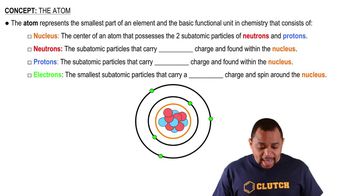
Atoms have a small, dense, positively charged nucleus and are mostly empty space.
- Proton: positive charge (+1)
- Neutron: neutral (0)
- Electron: negative charge (-1)
The number of protons in its nucleus, called the atomic number (Z).
Atoms of the same element with the same number of protons but different numbers of neutrons.
It is the weighted average mass of an element's isotopes based on their natural abundance.
When elements are arranged by increasing atomic mass, certain properties recur periodically.
He arranged elements by increasing mass and grouped elements with similar properties, predicting undiscovered elements.
Groups are vertical columns with similar properties; periods are horizontal rows.
Highly reactive metals in Group 1A, good conductors, malleable, ductile, and tend to lose electrons.
Very reactive nonmetals in Group 7A, including fluorine, chlorine, bromine, iodine, and astatine.
Inert, chemically stable gases in Group 8A that rarely form compounds.
A unit representing Avogadro's number of particles, equal to the number of atoms in exactly 12 grams of carbon-12.
The mass in grams of one mole of atoms of an element, numerically equal to its atomic mass in amu.
Use Avogadro's number as a conversion factor: 1 mole = 6.022 x 10\(^{23}\) particles.
Use the molar mass as a conversion factor: mass (g) = moles × molar mass (g/mol).