 Indietro
General Chemistry Core Concepts
 2:58
2:58
Termini in questo insieme (29)
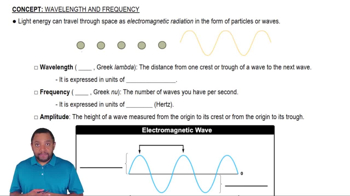
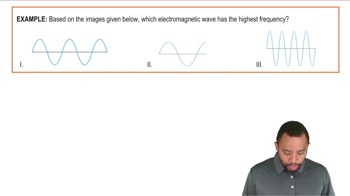
Wavelength is the distance between two peaks (meters). Frequency is cycles per second (Hz). Amplitude is wave height. Velocity (v) = wavelength (λ) × frequency (ν) = speed of light (c = 3.0 × 10\(8\) m/s).
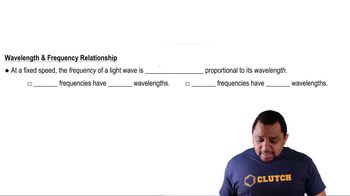
Wavelength and frequency are inversely related: \(c=\lambda \nu\). Longer wavelength means lower frequency.
Energy is quantized and exchanged in multiples of \(hv\), where h is Planck's constant (6.63 × 10\(-34\) J·s) and v is frequency.
Light ejects electrons from metal only if frequency exceeds a threshold. Energy of photon: \(E_{photon}=hv=\frac{hc}{\lambda}\). Proves light has particle properties.
Particles have wave properties. Wavelength of particle: \(\lambda=\frac{h}{mv}\), where m is mass and v velocity.
Energy of electron in hydrogen atom: \(E=-2.178 \times 10^{-18} J \left( \frac{1}{n_f^2} - \frac{1}{n_i^2} \right)\). Electrons occupy quantized orbits with integer n.
It is impossible to know both position and momentum of an electron precisely: \(\Delta x \Delta (mv) \geq \frac{h}{4\pi}\).
n: principal quantum number (orbital size, energy), integers > 0.
l: angular momentum (orbital shape), 0 to n-1.
m: magnetic (orientation), -l to +l.
ms: spin, +1/2 or -1/2.
Electrons fill orbitals starting from lowest energy to higher energy levels.
No two electrons in an atom can have the same set of four quantum numbers.
Electrons fill degenerate orbitals singly first with parallel spins before pairing.
Energy required to remove an electron. Decreases down a group (due to shielding and distance), increases across a period (due to increasing nuclear charge).
Energy change when an electron is added. Generally becomes more negative (exothermic) across a period.
Decreases across a period (more protons pull electrons closer), increases down a group (more shells).
Ability of an atom to attract electrons in a bond. Trends similar to ionization energy.
1 mole = 6.022 × 10\(23\) particles (Avogadro's number). Used to convert between particles, moles, and mass.
Mass in grams of one mole of a substance (element, molecule, or formula unit).
Percentage by mass of each element in a compound:
\(\% = \frac{mass\ of\ element}{total\ mass} \times 100\)
Empirical formula shows simplest whole-number ratio of atoms. Molecular formula is a whole-number multiple of empirical formula.
Conservation of matter requires equal atoms on both sides. Balance elements except O and H first, then O, then H.
Reactant completely consumed first, limiting the amount of product formed.
1. Write balanced equation.
2. Convert known quantities to moles.
3. Use mole ratios.
4. Convert to desired units.
5. Identify limiting reagent if needed.
Concentration defined as moles of solute per liter of solution: \(M=\frac{moles}{L}\).
\(M_1 V_1 = M_2 V_2\), where M is molarity and V is volume before and after dilution.
Arrhenius: acids produce H+, bases produce OH-.
Bronsted-Lowry: acids donate protons, bases accept protons.
Technique to determine concentration by reacting a known volume of titrant with analyte until equivalence point is reached.
Oxidation: loss of electrons (increase in oxidation state).
Reduction: gain of electrons (decrease in oxidation state).
OIL RIG mnemonic: Oxidation Is Loss, Reduction Is Gain.
Balance atoms except O and H, add H2O for O, add H+ for H, balance electrons, combine half-reactions.
Balance as in acid, then add OH- to neutralize H+ forming water, cancel waters.