 Indietro
General Chemistry Exam 1 Concept Review
 03:32
03:32
Termini in questo insieme (29)
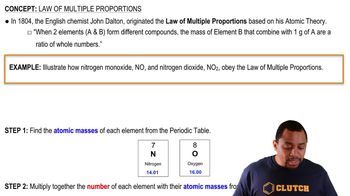
When two elements form more than one compound, the ratios of the masses of the second element combined with a fixed mass of the first are simple whole numbers.
A chemical compound always contains the same elements in exactly the same proportions by mass.
Mass is neither created nor destroyed in a chemical reaction; total mass of reactants equals total mass of products.
Observation, hypothesis, experiment, analysis, and conclusion.
A way to express very large or very small numbers as a product of a number between 1 and 10 and a power of 10.
The digits in a number that are known with certainty plus one estimated digit.
Result should have the same number of significant figures as the factor with the fewest sig figs.
Result should have the same number of decimal places as the number with the fewest decimal places.
Length (m), Mass (g), Time (s), Temperature (K or °C), Amount (mol), Volume (L), Density (g/mL or g/cm³).
Mega (10⁶), Kilo (10³), Deci (10⁻¹), Centi (10⁻²), Milli (10⁻³), Micro (10⁻⁶), Nano (10⁻⁹), Pico (10⁻¹²).
2.54 cm = 1 in; 1 mL = 1 cc = 1 cm³.
Method to convert units using conversion factors to cancel units and solve problems.
Density = mass / volume; can solve for mass or volume if density and one variable are known.
Convert °F to °C, °C to °F, and °C to K using standard formulas.
Solid, liquid, and gas; differ in shape and volume properties.
Pure substances have fixed composition; mixtures contain two or more substances physically combined.
Elements: single type of atom; Compounds: chemically combined elements; Homogeneous: uniform composition; Heterogeneous: non-uniform.
Decanting, distillation, and filtration are physical methods to separate mixtures.
Physical changes do not alter composition; chemical changes produce new substances.
Extensive depend on amount (mass, volume); intensive do not (density, color).
Protons and neutrons in nucleus; electrons in electron cloud.
Protons = atomic number; Neutrons = mass number - atomic number; Electrons = protons ± charge.
Cations are positively charged ions; anions are negatively charged ions.
Notation showing element symbol with mass number as superscript and atomic number as subscript.
Sum of atomic masses of all atoms in a compound's formula, expressed in g/mol.
Mass of element in compound divided by total mass of compound, multiplied by 100%.
Energy: capacity to do work; Thermal energy: total kinetic energy of particles; Kinetic energy: energy of motion; Potential energy: stored energy.
Precision: reproducibility of measurements; Accuracy: closeness to true value.
Random error: unpredictable fluctuations; Systematic error: consistent bias in measurement.