 Indietro
General Chemistry Test 2 Study Guide
 01:34
01:34

Termini in questo insieme (25)
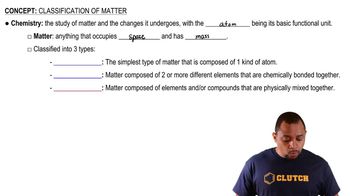
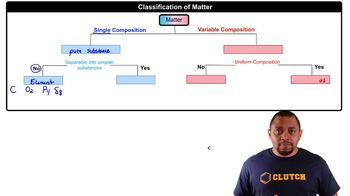
Matter is anything that has mass and occupies space. It is classified into pure substances and mixtures.
Pure substances have a fixed composition and include elements (e.g., oxygen) and compounds (e.g., water).
Mixtures contain two or more substances physically combined. Homogeneous mixtures are uniform (e.g., salt water), heterogeneous mixtures are not (e.g., salad).
Physical changes alter appearance but not composition (e.g., melting ice). Chemical changes alter composition (e.g., rusting iron).
Physical properties can be observed without changing composition (e.g., color). Chemical properties describe reactivity (e.g., flammability).
Intensive properties do not depend on amount (e.g., density). Extensive properties depend on amount (e.g., mass).
Meter (length), Kilogram (mass), Second (time), Ampere (electric current), Kelvin (temperature), Mole (amount of substance), Candela (luminous intensity).
Use formulas: °F = (°C × 9/5) + 32, K = °C + 273.15, and reverse accordingly.
The Factor Label method uses conversion factors as fractions to cancel units and convert quantities.
Density is mass per unit volume, calculated as \(\rho=\frac{m}{V}\).
Significant figures indicate the precision of a measurement and affect calculation accuracy.
Scientific notation expresses very large or small numbers as a product of a number between 1 and 10 and a power of 10.
Elements are arranged by increasing atomic number and grouped by similar properties into families.
Alkali metals: very reactive metals; Alkaline earth metals: reactive metals; Halogens: reactive nonmetals; Noble gases: inert gases; Transition metals: variable properties.
Metals are conductive and malleable, nonmetals are insulators and brittle, metalloids have mixed properties.
Ionic compounds combine metals and nonmetals with charges balanced; molecular compounds combine nonmetals with prefixes indicating atom counts.
Binary compounds contain two elements; tertiary compounds contain three or more elements.
Polyatomic ions are charged groups of atoms; their charges must be balanced in formulas.
Percent composition = (mass of element / total formula mass) × 100%.
A hydrate is a compound with water molecules attached; named by adding prefixes to indicate water molecules (e.g., copper(II) sulfate pentahydrate).
Multiply the subscript of each element by the number of formula units present.
GFM/MM is the sum of atomic masses of all atoms in a formula, expressed in grams per mole.
A mole is 6.02 × 10\(^{23}\) particles; it relates grams, particles, and volume (22.4 L at STP).
Use mole ratios from formulas to convert between amounts of substances; convert masses to moles first for mass-to-mass calculations.
Empirical formula shows simplest whole-number ratio; molecular formula shows actual number of atoms.