 Indietro
General Chemistry: Units, Measurements, and Problem Solving
 02:13
02:13
Termini in questo insieme (37)
Scientific notation expresses very large or small numbers as a coefficient between 1 and 10 multiplied by 10 raised to a power (positive or negative).
The power of 10 indicates the number of zeros following the digit 1 for positive powers, or the number of decimal places to the right of the digit 1 for negative powers.
Qualitative measurements are descriptive (e.g., color changes), while quantitative measurements are numerical values obtained from instruments or counting.
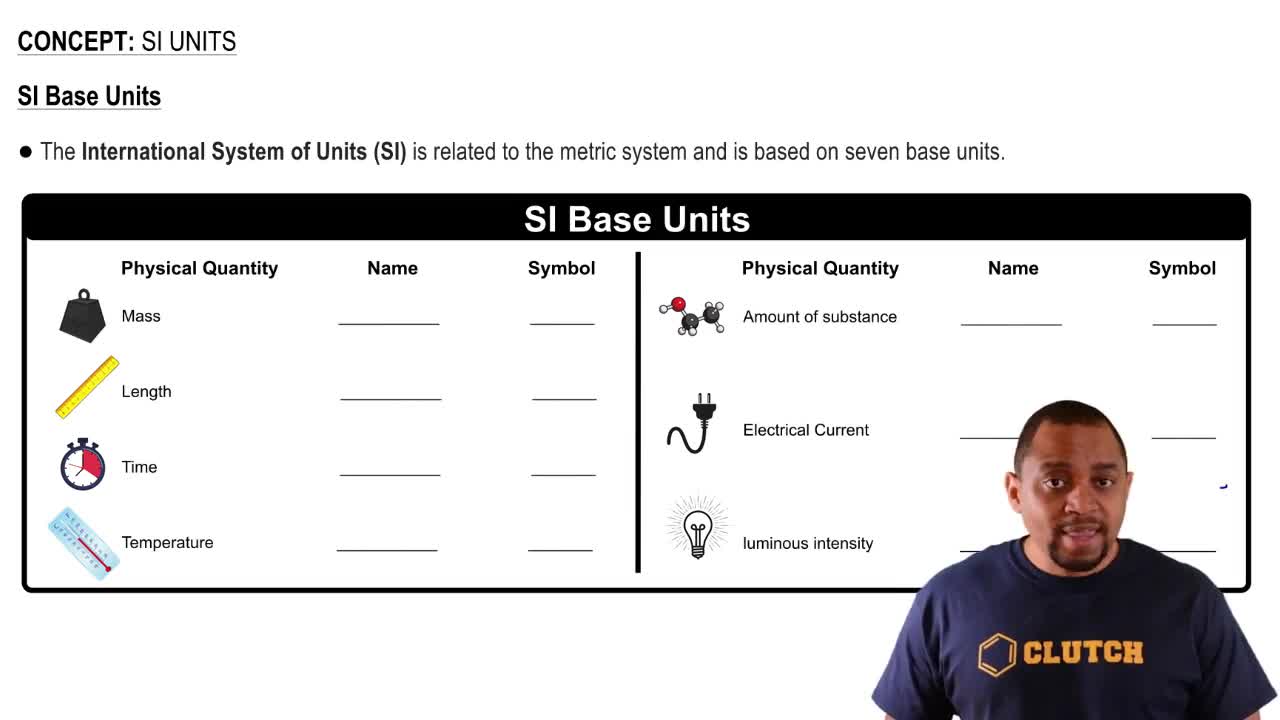
Length (meter, m), Mass (kilogram, kg), Time (second, s), Temperature (kelvin, K), Amount of substance (mole, mol), Electric current (ampere, A), Luminous intensity (candela, cd).
The meter is defined as the distance light travels in a vacuum in 1/299,792,458 of a second.
Mass measures the amount of matter; weight measures the gravitational force on that matter.
Prefixes like mega (M, 106), kilo (k, 103), milli (m, 10-3), micro (μ, 10-6), nano (n, 10-9), pico (p, 10-12) scale units up or down.
Use the formula \(K = ^\circ C + 273.15\).
Use the formula \(^\circ F = 1.8 \times ^\circ C + 32\).
Precision is how close repeated measurements are to each other; accuracy is how close a measurement is to the true value.
Systematic error consistently skews results in one direction; random error causes unpredictable variations around the true value.
Percent error = (|calculated value – true value| / true value) × 100%
Digits in a number that carry meaning about precision, including all nonzero digits, captive zeros, and trailing zeros after a decimal point.
Captive zeros (between nonzero digits) and trailing zeros after a decimal point are significant; leading zeros are not.
The result should have the same number of significant figures as the least precise measurement used in the calculation.
The result should have the same number of decimal places as the measurement with the fewest decimal places.
Density is an intensive property defined as mass divided by volume: \(\text{Density} = \frac{\text{Mass}}{\text{Volume}}\).
As volume increases, density decreases
Energy is the capacity to do work, which is a force applied over a distance.
Kinetic energy is energy of motion; potential energy is energy due to position or composition.
Thermal energy is a form of kinetic energy associated with the temperature of matter.
Energy of the universe is conserved; it can neither be created nor destroyed.
-energy can be transferred
A problem-solving method that uses conversion factors to cancel units and convert quantities from one unit to another.
Cube or square the conversion factor as appropriate when converting cubic or square units.
Density relates mass and volume, allowing conversion between these units when one is known.
chemical potential energy
molecule composition
System decreasing in energy
Change= negative -> exothermic
System increasing in energy
Change= positive -> endothermic
Matter is particulate
composed of particles
structure of particles
Determines properties of matter
Structure matters!
Matter
anything that occupies space + has mass
atoms
basic particles that compose ordinary matter; atoms composed of smaller particles
molecules
atoms that bind together
Classifying matter
Exists in 3 different states
-solid
-liquid
-gas
solid
atoms/ mol next to each other
particles do not move around
fixed volume + shape
Liquid
pack close
move around
fixed volume, but not shape
gas
space between
move around
compressible
Composition
Pure substance
Element
Compound