Ch.1 - Introduction: Matter, Energy, and Measurement
Brown - Chemistry: The Central Science 14th Edition
Brown14th EditionChemistry: The Central ScienceISBN: 9780134414232Non è quello che usi tu?Cambia libro di testo
Capitolo 1, Problema 42b

A watt is a measure of power (the rate of energy change) equal to 1 J/s. (b) An adult person radiates heat to the surroundings at about the same rate as a 100-watt electric incandescent light bulb. What is the total amount of energy in kcal radiated to the surroundings by an adult over a 24 h period?

Guida verificata passo dopo passo
1
Understand that power is the rate of energy transfer, and 1 watt is equal to 1 joule per second (1 W = 1 J/s).
Calculate the total energy in joules radiated by the person over 24 hours. Since the person radiates energy at a rate of 100 watts, multiply 100 J/s by the total number of seconds in 24 hours (24 hours * 60 minutes/hour * 60 seconds/minute).
Convert the total energy from joules to kilocalories. Use the conversion factor: 1 kcal = 4184 J.
Perform the conversion by dividing the total energy in joules by 4184 J/kcal to find the energy in kilocalories.
Summarize the process: You have calculated the total energy radiated by an adult over 24 hours in kilocalories by first finding the energy in joules and then converting it to kilocalories.

Risposta video verificata per un problema simile:

Questa soluzione video è stata consigliata dai nostri tutor come utile per risolvere questo problema.
Durata del video:
3m

Concetti chiave

Ecco i concetti essenziali che devi comprendere per rispondere correttamente alla domanda.

Power and Energy Conversion

Power is defined as the rate at which energy is transferred or converted, measured in watts (W), where 1 W equals 1 joule per second (J/s). To find the total energy produced over time, one can multiply power by time. In this case, the energy radiated by the adult can be calculated by converting the power output (100 W) into energy over a 24-hour period.
Video consigliato:
Percorso guidato
01:56
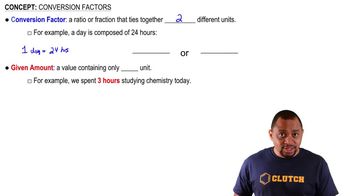
Conversion Factors

Time Conversion

To calculate energy over a specific time frame, it is essential to convert the time into seconds, as power is measured in joules per second. For 24 hours, this conversion involves multiplying 24 hours by 3600 seconds per hour, resulting in a total of 86,400 seconds. This total time will be used in the energy calculation.
Video consigliato:
Percorso guidato
01:56
Conversion Factors

Energy Units and Conversion to kcal

Energy can be expressed in various units, including joules (J) and kilocalories (kcal). To convert joules to kilocalories, one must use the conversion factor where 1 kcal equals 4184 J. After calculating the total energy in joules, dividing by 4184 will yield the equivalent energy in kilocalories, which is a more common unit for measuring energy in biological contexts.
Video consigliato:
Percorso guidato
01:56
Conversion Factors
Pratica correlata
Domanda del libro di testo

A watt is a measure of power (the rate of energy change) equal to 1 J/s. (a) Calculate the number of joules in a kilowatt-hour.
Domanda del libro di testo

What is the number of significant figures in each of the following measured quantities? (b) 3ⅹ10-6 m

391
views
Domanda del libro di testo

Use of the British thermal unit (Btu) is common in some types of engineering work. A Btu is the amount of heat required to raise the temperature of 1 lb of water by 1°F. Calculate the number of joules in a Btu.

884
views
Domanda del libro di testo
If on a certain year, an estimated amount of 4 million metric tons (1 metric ton = 1000 kg) of nitrous oxide 1N2O2 was emitted worldwide due to agricultural activities, express this mass of N2O in grams without exponential notation, using an appropriate metric prefix.
487
views
Domanda del libro di testo

Indicate which of the following are exact numbers: (a) the mass of a 3- by 5-in. index card, (b) the number of ounces in a pound, (c) the volume of a cup of Seattle's Best coffee, (d) the number of inches in a mile, (e) the number of microseconds in a week, (f) the number of pages in this book.

958
views
Domanda del libro di testo
Indicate which of the following are exact numbers: (a) the mass of a 32-oz can of coffee, (b) the number of students in your chemistry class, (c) the temperature of the surface of the Sun, (d) the mass of a postage stamp, (e) the number of milliliters in a cubic meter of water, (f) the average height of NBA basketball players.
599
views