Ch.10 - Gases
Brown - Chemistry: The Central Science 14th Edition
Brown14th EditionChemistry: The Central ScienceISBN: 9780134414232Non è quello che usi tu?Cambia libro di testo
Capitolo 10, Problema 117b

Large amounts of nitrogen gas are used in the manufacture of ammonia, principally for use in fertilizers. Suppose 120.00 kg of N2(g) is stored in a 1100.0-L metal cylinder at 280 °C. (b) By using the data in Table 10.3, calculate the pressure of the gas according to the van der Waals equation.

Guida verificata passo dopo passo
1
Identify the van der Waals equation: \( \left( P + \frac{an^2}{V^2} \right) (V - nb) = nRT \), where \( a \) and \( b \) are van der Waals constants for nitrogen.
Convert the mass of nitrogen gas to moles using its molar mass: \( n = \frac{\text{mass}}{\text{molar mass}} \).
Convert the temperature from Celsius to Kelvin: \( T(K) = T(°C) + 273.15 \).
Substitute the values for \( n \), \( V \), \( T \), and the van der Waals constants \( a \) and \( b \) for nitrogen into the van der Waals equation.
Solve the van der Waals equation for pressure \( P \).

Risposta video verificata per un problema simile:

Questa soluzione video è stata consigliata dai nostri tutor come utile per risolvere questo problema.
Durata del video:
7m

Concetti chiave

Ecco i concetti essenziali che devi comprendere per rispondere correttamente alla domanda.

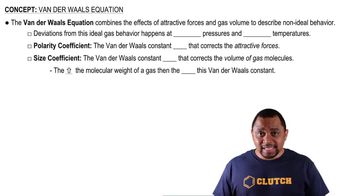
Van der Waals Equation

The Van der Waals equation is an adjustment of the ideal gas law that accounts for the volume occupied by gas molecules and the attractive forces between them. It is expressed as (P + a(n/V)²)(V - nb) = nRT, where P is pressure, V is volume, n is the number of moles, R is the ideal gas constant, and a and b are constants specific to each gas. This equation is particularly useful for real gases under high pressure and low temperature conditions.
Video consigliato:
Percorso guidato
01:40
Van der Waals Equation

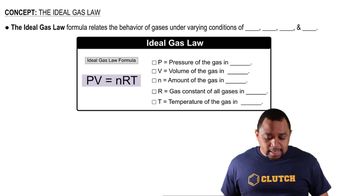
Ideal Gas Law

The Ideal Gas Law is a fundamental equation in chemistry that relates the pressure, volume, temperature, and number of moles of a gas. It is expressed as PV = nRT, where P is pressure, V is volume, n is the number of moles, R is the ideal gas constant, and T is temperature in Kelvin. While it provides a good approximation for many gases, it does not account for intermolecular forces or the volume of gas particles, which is where the Van der Waals equation becomes relevant.
Video consigliato:
Percorso guidato
01:15
Ideal Gas Law Formula

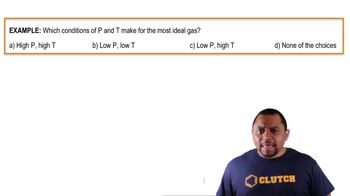
Gas Properties and Conditions

Understanding the properties of gases, including pressure, volume, temperature, and the number of moles, is crucial for solving gas-related problems. Pressure is the force exerted by gas molecules colliding with the walls of their container, while volume is the space the gas occupies. Temperature affects the kinetic energy of gas molecules, influencing their behavior. These properties are interrelated and can be manipulated using equations like the Ideal Gas Law and Van der Waals equation to predict gas behavior under various conditions.
Video consigliato:
Percorso guidato
02:13
Ideal Gas Conditions Example