Ch.13 - Properties of Solutions
Brown - Chemistry: The Central Science 14th Edition
Brown14th EditionChemistry: The Central ScienceISBN: 9780134414232Non è quello che usi tu?Cambia libro di testo
Capitolo 13, Problema 64

The vapor pressure of pure water at 60 °C is 149 torr. The vapor pressure of water over a solution at 60 °C containing equal numbers of moles of water and ethylene glycol (a nonvolatile solute) is 67 torr. Is the solution ideal according to Raoult's law?

Guida verificata passo dopo passo
1
Identify the components of the solution: water (solvent) and ethylene glycol (nonvolatile solute).
Recall Raoult's Law: The vapor pressure of a solvent over a solution (P_solution) is equal to the mole fraction of the solvent (X_solvent) times the vapor pressure of the pure solvent (P_pure).
Calculate the mole fraction of water in the solution. Since there are equal moles of water and ethylene glycol, the mole fraction of water (X_water) is 0.5.
Apply Raoult's Law: P_solution = X_water * P_pure. Substitute the known values: P_solution = 0.5 * 149 torr.
Compare the calculated vapor pressure from Raoult's Law with the given vapor pressure of the solution (67 torr) to determine if the solution behaves ideally.

Risposta video verificata per un problema simile:

Questa soluzione video è stata consigliata dai nostri tutor come utile per risolvere questo problema.
Durata del video:
1m

Concetti chiave

Ecco i concetti essenziali che devi comprendere per rispondere correttamente alla domanda.

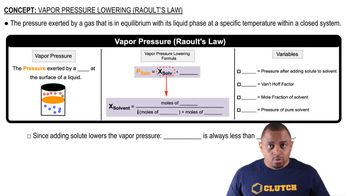
Raoult's Law

Raoult's Law states that the vapor pressure of a solvent in a solution is directly proportional to the mole fraction of the solvent present. For an ideal solution, the presence of a nonvolatile solute lowers the vapor pressure of the solvent compared to its pure state. This law helps predict how solutes affect the vapor pressure of solvents, which is crucial for understanding the behavior of solutions.
Video consigliato:
Percorso guidato
02:40
Raoult's Law and Vapor Pressure

Vapor Pressure

Vapor pressure is the pressure exerted by a vapor in equilibrium with its liquid or solid phase at a given temperature. It reflects the tendency of particles to escape from the liquid phase into the vapor phase. In the context of solutions, the vapor pressure of the solvent decreases when a nonvolatile solute is added, which is a key aspect of Raoult's Law.
Video consigliato:
Percorso guidato
02:40
Raoult's Law and Vapor Pressure

Ideal Solutions vs. Non-Ideal Solutions

An ideal solution is one that follows Raoult's Law perfectly, meaning the interactions between different molecules are similar to those between like molecules. Non-ideal solutions, on the other hand, exhibit deviations from Raoult's Law due to differences in molecular interactions. The extent of these deviations can indicate whether a solution behaves ideally or not, which is essential for analyzing the given scenario.
Video consigliato:
Percorso guidato
01:39
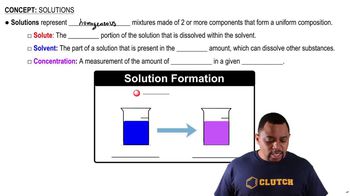
Solution Components