Ch.13 - Properties of Solutions
Brown - Chemistry: The Central Science 14th Edition
Brown14th EditionChemistry: The Central ScienceISBN: 9780134414232Non è quello che usi tu?Cambia libro di testo
Capitolo 13, Problema 10b

This portion of a phase diagram shows the vapor–pressure curves of a volatile solvent and of a solution of that solvent containing a nonvolatile solute. (b) What are the normal boiling points of the solvent and the solution? [Section 13.5]

Guida verificata passo dopo passo
1
Identify the phase diagram provided in the problem, focusing on the vapor-pressure curves for both the pure solvent and the solution.
Recall that the normal boiling point of a substance is the temperature at which its vapor pressure equals 1 atm (or 760 mmHg).
Locate the point on the vapor-pressure curve of the pure solvent where the pressure is 1 atm. The corresponding temperature is the normal boiling point of the solvent.
Similarly, locate the point on the vapor-pressure curve of the solution where the pressure is 1 atm. The corresponding temperature is the normal boiling point of the solution.
Note that the presence of a nonvolatile solute typically lowers the vapor pressure of the solution, resulting in a higher boiling point compared to the pure solvent. This phenomenon is known as boiling point elevation.

Risposta video verificata per un problema simile:

Questa soluzione video è stata consigliata dai nostri tutor come utile per risolvere questo problema.
Durata del video:
1m

Concetti chiave

Ecco i concetti essenziali che devi comprendere per rispondere correttamente alla domanda.

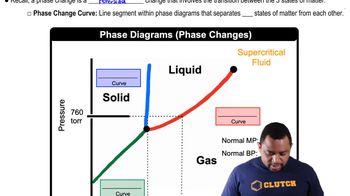
Phase Diagram

A phase diagram is a graphical representation that shows the phases of a substance at various temperatures and pressures. It illustrates the conditions under which distinct phases, such as solid, liquid, and gas, coexist. Understanding phase diagrams is crucial for interpreting the behavior of substances, particularly in relation to boiling points and vapor pressures.
Video consigliato:
Percorso guidato
03:22
Phase Changes in Diagrams

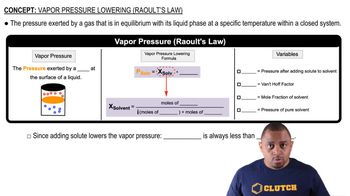
Vapor Pressure

Vapor pressure is the pressure exerted by a vapor in equilibrium with its liquid or solid form at a given temperature. It indicates how readily a substance will evaporate and is a key factor in determining boiling points. The normal boiling point of a liquid is defined as the temperature at which its vapor pressure equals atmospheric pressure, typically 1 atm.
Video consigliato:
Percorso guidato
02:40
Raoult's Law and Vapor Pressure

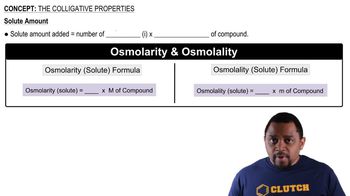
Colligative Properties

Colligative properties are properties of solutions that depend on the number of solute particles in a given amount of solvent, rather than the identity of the solute. These properties include boiling point elevation and freezing point depression. When a nonvolatile solute is added to a solvent, the boiling point of the solution increases compared to that of the pure solvent, which is essential for determining the boiling points in the given question.
Video consigliato:
Percorso guidato
01:26
Colligative Properties