
Ch.14 - Chemical Kinetics
Brown - Chemistry: The Central Science 14th Edition
Brown14th EditionChemistry: The Central ScienceISBN: 9780134414232Non è quello che usi tu?Cambia libro di testo
Capitolo 14, Problema 53

Calculate the fraction of atoms in a sample of argon gas at 400 K that has an energy of 10.0 kJ or greater.

Guida verificata passo dopo passo
1
Identify the relevant concept: The problem involves calculating the fraction of atoms with a certain energy in a gas, which is related to the Maxwell-Boltzmann distribution.
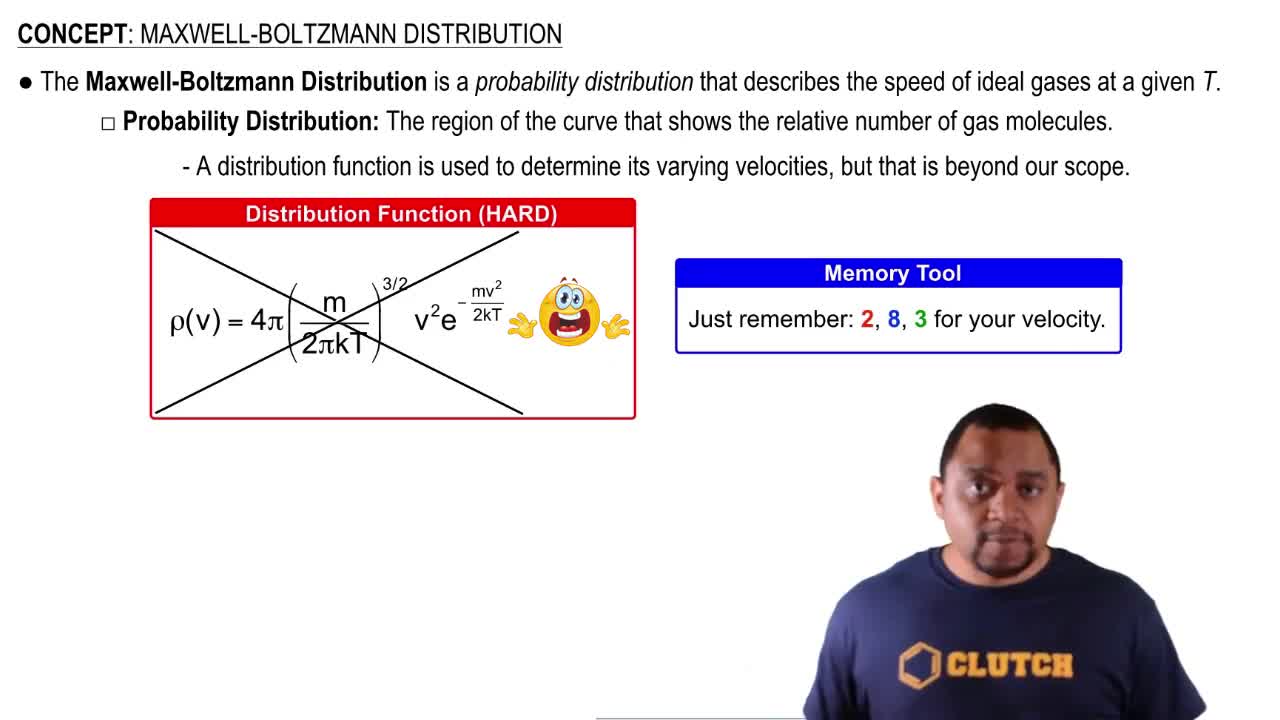
Use the Maxwell-Boltzmann distribution formula: \( f(E) = \frac{2}{\sqrt{\pi}} \left( \frac{E}{kT} \right)^{1/2} e^{-E/kT} \), where \( E \) is the energy, \( k \) is the Boltzmann constant, and \( T \) is the temperature in Kelvin.
Convert the given energy from kJ to J: Since 1 kJ = 1000 J, convert 10.0 kJ to Joules.
Calculate the exponent in the Maxwell-Boltzmann distribution: \( -E/kT \), where \( k = 1.38 \times 10^{-23} \text{ J/K} \) and \( T = 400 \text{ K} \).
Integrate the Maxwell-Boltzmann distribution from 10.0 kJ to infinity to find the fraction of atoms with energy greater than or equal to 10.0 kJ.

Risposta video verificata per un problema simile:

Questa soluzione video è stata consigliata dai nostri tutor come utile per risolvere questo problema.
Durata del video:
2m

Concetti chiave

Ecco i concetti essenziali che devi comprendere per rispondere correttamente alla domanda.

Maxwell-Boltzmann Distribution

The Maxwell-Boltzmann distribution describes the distribution of speeds (or energies) of particles in a gas at a given temperature. It shows that at higher temperatures, a greater fraction of particles have higher energies. This concept is essential for understanding how many argon atoms will have energies above a certain threshold, such as 10.0 kJ, at 400 K.
Video consigliato:
Percorso guidato
00:54
Maxwell-Boltzmann Distribution

Kinetic Energy and Temperature Relationship

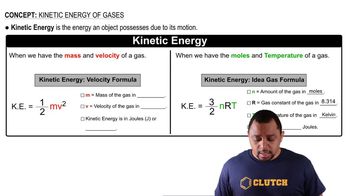
The kinetic energy of gas particles is directly related to the temperature of the gas, as described by the equation KE = (3/2)kT for monatomic gases, where k is the Boltzmann constant and T is the temperature in Kelvin. This relationship helps in calculating the average energy of argon atoms at 400 K and determining the fraction that meets or exceeds the specified energy level.
Video consigliato:
Percorso guidato
02:27
Kinetic Energy Formulas

Boltzmann Factor

The Boltzmann factor, given by e^(-E/kT), quantifies the probability of a particle having energy E at temperature T. It is crucial for calculating the fraction of argon atoms with energies equal to or greater than 10.0 kJ. By applying this factor, one can derive the proportion of atoms that possess sufficient energy to exceed the given threshold.
Video consigliato:
Percorso guidato
00:54
Maxwell-Boltzmann Distribution