

Ch.14 - Chemical Kinetics
Brown - Chemistry: The Central Science 14th Edition
Brown14th EditionChemistry: The Central ScienceISBN: 9780134414232Non è quello che usi tu?Cambia libro di testo
Capitolo 14, Problema 23a,b

For each of the following gas-phase reactions, indicate how the rate of disappearance of each reactant is related to the rate of appearance of each product:
(a) H2O2(g) → H2(g) + O2(g)
(b) 2 N2O(g) → 2 N2(g) + O2(g)

Guida verificata passo dopo passo
1
Identify the balanced chemical equation: \(2 \text{N}_2\text{O}(g) \rightarrow 2 \text{N}_2(g) + \text{O}_2(g)\).
Understand that the rate of disappearance of a reactant is related to the rate of appearance of a product by the stoichiometry of the reaction.
For the reaction \(2 \text{N}_2\text{O}(g) \rightarrow 2 \text{N}_2(g) + \text{O}_2(g)\), note that 2 moles of \(\text{N}_2\text{O}\) produce 2 moles of \(\text{N}_2\) and 1 mole of \(\text{O}_2\).
Express the rate of disappearance of \(\text{N}_2\text{O}\) as \(-\frac{1}{2} \frac{d[\text{N}_2\text{O}]}{dt}\).
Relate this to the rate of appearance of \(\text{N}_2\) and \(\text{O}_2\) as \(\frac{1}{2} \frac{d[\text{N}_2]}{dt}\) and \(\frac{d[\text{O}_2]}{dt}\), respectively.

Risposta video verificata per un problema simile:

Questa soluzione video è stata consigliata dai nostri tutor come utile per risolvere questo problema.
Durata del video:
2m

Concetti chiave

Ecco i concetti essenziali che devi comprendere per rispondere correttamente alla domanda.

Stoichiometry

Stoichiometry is the quantitative relationship between reactants and products in a chemical reaction. It is based on the balanced chemical equation, which indicates the proportions in which substances react and are produced. In the given reaction, the coefficients (2 for N2O and N2, and 1 for O2) dictate how the rates of disappearance and appearance of substances are related.
Video consigliato:
Percorso guidato
01:16
Stoichiometry Concept

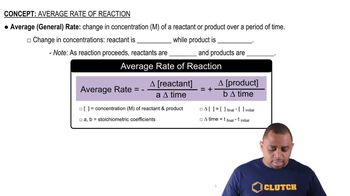
Rate of Reaction

The rate of reaction refers to the speed at which reactants are converted into products. It can be expressed in terms of the change in concentration of a reactant or product over time. For the reaction provided, the rate of disappearance of N2O is directly related to the rates of appearance of N2 and O2, as dictated by the stoichiometric coefficients.
Video consigliato:
Percorso guidato
02:03
Average Rate of Reaction

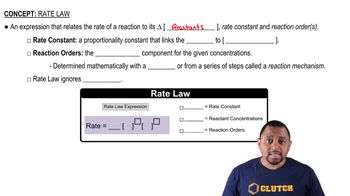
Rate Law

The rate law is an equation that relates the rate of a reaction to the concentration of its reactants, often expressed in the form rate = k[A]^m[B]^n, where k is the rate constant and m and n are the orders of the reaction with respect to each reactant. While the question focuses on stoichiometric relationships, understanding the rate law helps in comprehending how changes in concentration affect the rates of disappearance and appearance in a reaction.
Video consigliato:
Percorso guidato
01:52
Rate Law Fundamentals
Pratica correlata
Domanda del libro di testo

The rate of disappearance of HCl was measured for the following reaction: CH3OH1aq2 + HCl1aq2¡CH3Cl1aq2 + H2O1l2 The following data were collected: Time (min) 3HCl 4 1M2 0.0 1.85 54.0 1.58 107.0 1.36 215.0 1.02 430.0 0.580 (d) Graph [HCl] versus time and determine the instantaneous rates in M>min and M>s at t = 75.0 min and t = 250 min.

871
views
Domanda del libro di testo

The rate of disappearance of HCl was measured for the following reaction: CH3OH1aq2 + HCl1aq2¡CH3Cl1aq2 + H2O1l2 The following data were collected: Time (min) 3HCl 4 1M2 0.0 1.85 54.0 1.58 107.0 1.36 215.0 1.02 430.0 0.580 (b) Calculate the average rate of reaction for the entire time for the data from t = 0.0 min to t = 430.0 min.

790
views
Domanda del libro di testo

For each of the following gas-phase reactions, indicate how the rate of disappearance of each reactant is related to the rate of appearance of each product:

(d) C2H5NH2(g) → C2H4(g) + NH3(g)

110
views
Domanda del libro di testo

For each of the following gas-phase reactions, write the rate expression in terms of the appearance of each product and disappearance of each reactant:

(a) 2 H2O(g) → 2 H2(g) + O2(g)

(b) 2 SO2(g) + O2(g) → 2 SO3(g)

(c) 2 NO(g) + 2 H2(g) → N2(g) + 2 H2O(g)

(d) N2(g) + 2 H2(g) → N2H4(g)

108
views
Domanda del libro di testo

The rate of disappearance of HCl was measured for the following reaction: CH3OH1aq2 + HCl1aq2¡CH3Cl1aq2 + H2O1l2 The following data were collected: Time (min) 3HCl 4 1M2 0.0 1.85 54.0 1.58 107.0 1.36 215.0 1.02 430.0 0.580 (c) Which is greater, the average rate between t = 54.0 and t = 215.0 min, or between t = 107.0 and t = 430.0 min?

363
views
Domanda del libro di testo

For each of the following gas-phase reactions, indicate how the rate of disappearance of each reactant is related to the rate of appearance of each product: (c) N21g2 + 3 H21g2¡2 NH31g2

2056
views