Ch.14 - Chemical Kinetics
Brown - Chemistry: The Central Science 14th Edition
Brown14th EditionChemistry: The Central ScienceISBN: 9780134414232Non è quello che usi tu?Cambia libro di testo
Capitolo 14, Problema 107d

The following mechanism has been proposed for the reaction of NO with H2 to form N2O and H2O:
NO(g) + NO(g) → N2O2(g)
N2O2(g) + H2(g) → N2O(g) + H2O(g)
(d) The observed rate law is rate = k[NO]2[H2]. If the proposed mechanism is correct, what can we conclude about the relative speeds of the first and second reactions?

Guida verificata passo dopo passo
1
Identify the overall reaction from the given mechanism: 2NO(g) + H2(g) -> N2O(g) + H2O(g).
Examine the proposed mechanism: Step 1: 2NO(g) -> N2O2(g), Step 2: N2O2(g) + H2(g) -> N2O(g) + H2O(g).
Analyze the rate law: rate = k[NO]^2[H2]. This suggests that the rate-determining step involves two NO molecules and one H2 molecule.
Compare the rate law with the mechanism: The rate law matches the stoichiometry of the first step, indicating that the first step is the slow, rate-determining step.
Conclude that the first reaction (formation of N2O2) is slower than the second reaction (formation of N2O and H2O), as the rate law is determined by the first step.

Risposta video verificata per un problema simile:

Questa soluzione video è stata consigliata dai nostri tutor come utile per risolvere questo problema.
Durata del video:
1m

Concetti chiave

Ecco i concetti essenziali che devi comprendere per rispondere correttamente alla domanda.

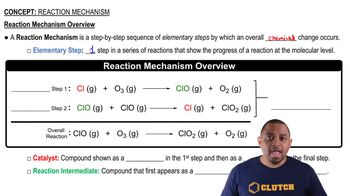
Reaction Mechanism

A reaction mechanism is a step-by-step description of the pathway through which reactants are converted into products. It outlines individual elementary steps, each with its own rate, and helps in understanding how the overall reaction occurs. In this case, the proposed mechanism involves two steps leading to the formation of N2O and H2O from NO and H2.
Video consigliato:
Percorso guidato
03:06
Reaction Mechanism Overview

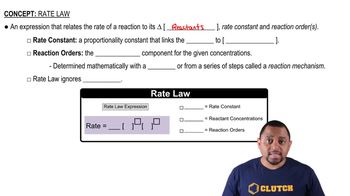
Rate Law

The rate law expresses the relationship between the rate of a chemical reaction and the concentration of its reactants. It is determined experimentally and can provide insights into the mechanism of the reaction. The given rate law, rate = k[NO]^4[H2]^2, indicates that the rate depends on the concentrations of NO and H2, suggesting that the first step is likely the rate-determining step.
Video consigliato:
Percorso guidato
01:52
Rate Law Fundamentals

Rate-Determining Step

The rate-determining step is the slowest step in a reaction mechanism that controls the overall rate of the reaction. It is crucial for understanding the kinetics of the reaction. In this scenario, if the observed rate law corresponds to the concentrations of reactants in the first step, it implies that this step is slower than the second step, thus determining the overall reaction rate.
Video consigliato:
Percorso guidato
01:15
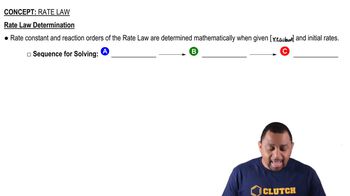
Rate Law Determination