Ch.14 - Chemical Kinetics
Brown - Chemistry: The Central Science 14th Edition
Brown14th EditionChemistry: The Central ScienceISBN: 9780134414232Non è quello che usi tu?Cambia libro di testo
Capitolo 14, Problema 22a

The rate of disappearance of HCl was measured for the following reaction: CH3OH1aq2 + HCl1aq2¡CH3Cl1aq2 + H2O1l2 The following data were collected: Time (min) 3HCl 4 1M2 0.0 1.85 54.0 1.58 107.0 1.36 215.0 1.02 430.0 0.580 (a) Calculate the average rate of reaction, in M>s, for the time interval between each measurement.

Guida verificata passo dopo passo
1
Identify the concentration of HCl at different time intervals. For example, at time 0.0 minutes, the concentration of HCl is 1.85 M, and at 54.0 minutes, it is 1.58 M.
Calculate the change in concentration of HCl (\(\Delta [HCl]\)) for each time interval by subtracting the final concentration from the initial concentration. For instance, between 0.0 and 54.0 minutes, \(\Delta [HCl] = 1.58 \text{ M} - 1.85 \text{ M}\).
Determine the change in time (\(\Delta t\)) for each interval by subtracting the initial time from the final time. For the first interval, \(\Delta t = 54.0 \text{ min} - 0.0 \text{ min}\).
Calculate the average rate of reaction for each interval using the formula: \(\text{Average Rate} = \frac{\Delta [HCl]}{\Delta t}\). Convert the time from minutes to seconds by multiplying by 60, as the rate should be expressed in M/s.
Repeat the calculations for each time interval to find the average rate of reaction for each.

Risposta video verificata per un problema simile:

Questa soluzione video è stata consigliata dai nostri tutor come utile per risolvere questo problema.
Durata del video:
11m

Concetti chiave

Ecco i concetti essenziali che devi comprendere per rispondere correttamente alla domanda.

Reaction Rate

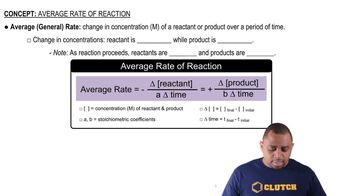
The reaction rate is a measure of how quickly reactants are converted into products in a chemical reaction. It is typically expressed as the change in concentration of a reactant or product per unit time, often in units of molarity per second (M/s). Understanding how to calculate the average rate of reaction over specific time intervals is crucial for analyzing kinetic data.
Video consigliato:
Percorso guidato
02:03
Average Rate of Reaction

Average Rate Calculation

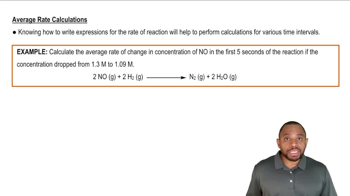
The average rate of a reaction over a time interval can be calculated by taking the change in concentration of a reactant or product and dividing it by the time interval. For example, if the concentration of HCl decreases from 1.85 M to 1.58 M over a certain time, the average rate can be calculated as the difference in concentration divided by the time elapsed. This method provides a straightforward way to quantify the speed of the reaction.
Video consigliato:
Percorso guidato
02:42
Average Rate Calculation Example

Concentration Units

Concentration is a measure of the amount of a substance in a given volume of solution, commonly expressed in molarity (M), which is moles of solute per liter of solution. In the context of reaction rates, understanding how to interpret and manipulate these units is essential for accurate calculations. Changes in concentration over time directly relate to the kinetics of the reaction being studied.
Video consigliato:
Pratica correlata
Domanda del libro di testo

The rate of disappearance of HCl was measured for the following reaction: CH3OH1aq2 + HCl1aq2¡CH3Cl1aq2 + H2O1l2 The following data were collected: Time (min) 3HCl 4 1M2 0.0 1.85 54.0 1.58 107.0 1.36 215.0 1.02 430.0 0.580 (d) Graph [HCl] versus time and determine the instantaneous rates in M>min and M>s at t = 75.0 min and t = 250 min.

871
views
Domanda del libro di testo

The rate of disappearance of HCl was measured for the following reaction: CH3OH1aq2 + HCl1aq2¡CH3Cl1aq2 + H2O1l2 The following data were collected: Time (min) 3HCl 4 1M2 0.0 1.85 54.0 1.58 107.0 1.36 215.0 1.02 430.0 0.580 (b) Calculate the average rate of reaction for the entire time for the data from t = 0.0 min to t = 430.0 min.

790
views
Domanda del libro di testo

The rate of disappearance of HCl was measured for the following reaction: CH3OH1aq2 + HCl1aq2¡CH3Cl1aq2 + H2O1l2 The following data were collected: Time (min) 3HCl 4 1M2 0.0 1.85 54.0 1.58 107.0 1.36 215.0 1.02 430.0 0.580 (c) Which is greater, the average rate between t = 54.0 and t = 215.0 min, or between t = 107.0 and t = 430.0 min?

363
views
Domanda del libro di testo

The isomerization of methyl isonitrile (CH3NC) to acetonitrile (CH3CN) was studied in the gas phase at 215°C, and the following data were obtained:

Time (s) [CH3NC] (M)

0 0.0165

2000 0.0110

5000 0.00591

8000 0.00314

12,000 0.00137

15,000 0.00074 

(d) Graph [CH3NC] versus time and determine the instantaneous rates in M/s at t = 5000 s and t = 8000 s.

755
views
Domanda del libro di testo

The isomerization of methyl isonitrile (CH3NC) to acetonitrile (CH3CN) was studied in the gas phase at 215°C, and the following data were obtained:

Time (s) [CH3NC] (M)

0 0.0165

2000 0.0110

5000 0.00591

8000 0.00314

12,000 0.00137

15,000 0.00074

(a) Calculate the average rate of reaction, in M/s, for the time interval between each measurement. (c) Which is greater, the average rate between t = 2000 and t = 12,000 s, or between t = 8000 and t = 15,000 s?

2
views
Domanda del libro di testo

The isomerization of methyl isonitrile (CH3NC) to acetonitrile (CH3CN) was studied in the gas phase at 215°C, and the following data were obtained:

Time (s) [CH3NC] (M)

0 0.0165

2000 0.0110

5000 0.00591

8000 0.00314

12,000 0.00137

15,000 0.00074 

(b) Calculate the average rate of reaction over the entire time of the data from t = 0 to t = 15,000 s.

562
views