Ch.16 - Acid-Base Equilibria
Brown - Chemistry: The Central Science 14th Edition
Brown14th EditionChemistry: The Central ScienceISBN: 9780134414232Non è quello che usi tu?Cambia libro di testo
Capitolo 16, Problema 109b

Butyric acid is responsible for the foul smell of rancid butter. The pKa of butyric acid is 4.84. (b) Calculate the pH of a 0.050 M solution of butyric acid.

Guida verificata passo dopo passo
1
Identify that butyric acid is a weak acid and will partially dissociate in water.
Write the dissociation equation for butyric acid: \( \text{HC}_4\text{H}_7\text{O}_2 \rightleftharpoons \text{H}^+ + \text{C}_4\text{H}_7\text{O}_2^- \).
Use the given \( \text{pK}_a \) value to find the \( K_a \) using the formula \( K_a = 10^{-\text{pK}_a} \).
Set up an ICE (Initial, Change, Equilibrium) table to determine the concentrations of the species at equilibrium.
Use the expression for \( K_a \), \( K_a = \frac{[\text{H}^+][\text{C}_4\text{H}_7\text{O}_2^-]}{[\text{HC}_4\text{H}_7\text{O}_2]} \), to solve for \([\text{H}^+]\) and then calculate the pH using \( \text{pH} = -\log[\text{H}^+] \).

Risposta video verificata per un problema simile:

Questa soluzione video è stata consigliata dai nostri tutor come utile per risolvere questo problema.
Durata del video:
9m

Concetti chiave

Ecco i concetti essenziali che devi comprendere per rispondere correttamente alla domanda.

pKa and Acid-Base Equilibrium

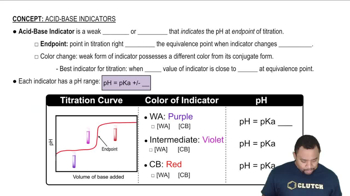
The pKa value of an acid indicates its strength and the degree to which it dissociates in solution. A lower pKa value corresponds to a stronger acid, meaning it more readily donates protons (H+). In this case, butyric acid has a pKa of 4.84, which helps determine its behavior in a solution and the resulting pH when dissolved.
Video consigliato:
Percorso guidato
04:30
Acid-Base Indicators

Henderson-Hasselbalch Equation

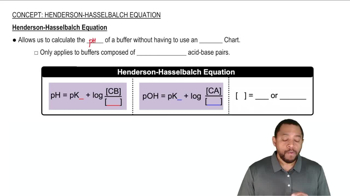
The Henderson-Hasselbalch equation relates the pH of a solution to the pKa of an acid and the concentration of its conjugate base. It is expressed as pH = pKa + log([A-]/[HA]). This equation is particularly useful for calculating the pH of weak acid solutions, such as butyric acid, by considering the ratio of the concentrations of the dissociated and undissociated forms.
Video consigliato:
Percorso guidato
02:40
Henderson-Hasselbalch Equation

Weak Acids and Their Dissociation

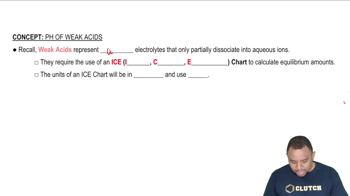
Weak acids, like butyric acid, do not completely dissociate in solution. Instead, they establish an equilibrium between the undissociated acid (HA) and its ions (A- and H+). The concentration of the acid and its dissociation constant (Ka) are crucial for calculating the pH, as they determine how much of the acid remains undissociated versus how much has dissociated into ions.
Video consigliato:
Percorso guidato
00:44
ICE Charts of Weak Acids