Ch.17 - Additional Aspects of Aqueous Equilibria
Brown - Chemistry: The Central Science 14th Edition
Brown14th EditionChemistry: The Central ScienceISBN: 9780134414232Non è quello che usi tu?Cambia libro di testo
Capitolo 17, Problema 112

A sample of 7.5 L of NH3 gas at 22 _x001F_C and 735 torr is bubbled into a 0.50-L solution of 0.40 M HCl. Assuming that all the NH3 dissolves and that the volume of the solution remains 0.50 L, calculate the pH of the resulting solution.

Guida verificata passo dopo passo
1
Step 1: Convert the temperature from Celsius to Kelvin by adding 273.15 to the Celsius temperature. This will be used in the ideal gas law calculation.
Step 2: Use the ideal gas law, PV = nRT, to calculate the number of moles of NH3 gas. Convert the pressure from torr to atm by dividing by 760, and use the volume in liters, the temperature in Kelvin, and R = 0.0821 L·atm/mol·K.
Step 3: Calculate the initial moles of HCl in the solution using the concentration (0.40 M) and the volume of the solution (0.50 L).
Step 4: Determine the limiting reactant by comparing the moles of NH3 and HCl. NH3 reacts with HCl in a 1:1 molar ratio to form NH4Cl.
Step 5: Calculate the concentration of NH4+ in the solution after the reaction. Use this concentration to find the pH by considering the hydrolysis of NH4+ and using the expression for the equilibrium constant, Kb, of NH3.

Concetti chiave

Ecco i concetti essenziali che devi comprendere per rispondere correttamente alla domanda.

Ideal Gas Law

The Ideal Gas Law relates the pressure, volume, temperature, and number of moles of a gas through the equation PV = nRT. In this question, it is essential to calculate the number of moles of NH3 gas present in the sample before it reacts with HCl. Understanding this relationship allows for the conversion of gas conditions into moles, which is crucial for subsequent calculations.
Video consigliato:
Percorso guidato
01:15
Ideal Gas Law Formula

Acid-Base Neutralization

Acid-base neutralization is a chemical reaction where an acid reacts with a base to produce water and a salt. In this scenario, NH3 acts as a weak base and HCl as a strong acid. The stoichiometry of the reaction will determine the amounts of NH3 and HCl that react, which is necessary to find the resulting concentrations of the products and the pH of the solution.
Video consigliato:
Percorso guidato
05:04
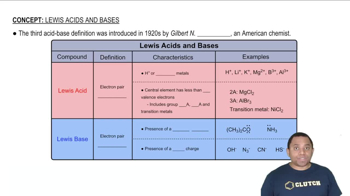
Lewis Acids and Bases

pH Calculation

pH is a measure of the acidity or basicity of a solution, calculated using the formula pH = -log[H+]. After determining the concentrations of the remaining acid or base in the solution post-reaction, the pH can be calculated. Understanding how to derive the concentration of hydrogen ions from the dissociation of acids and bases is critical for accurately determining the pH of the resulting solution.
Video consigliato:
Percorso guidato
02:15
pH Calculation Example