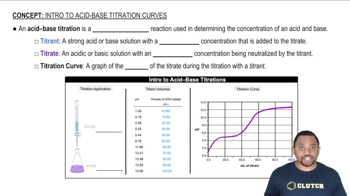
A 35.0-mL sample of 0.150 M acetic acid 1CH3COOH2 is titrated with 0.150 M NaOH solution. Calculate the pH after the following volumes of base have been added: (b) 17.5 mL.
Ch.17 - Additional Aspects of Aqueous Equilibria
Brown14th EditionChemistry: The Central ScienceISBN: 9780134414232Non è quello che usi tu?Cambia libro di testo
Tutti i libri di testo
Brown 14th Edition
Ch.17 - Additional Aspects of Aqueous Equilibria
Problema 46b,c
Brown 14th Edition
Ch.17 - Additional Aspects of Aqueous Equilibria
Problema 46b,cCapitolo 17, Problema 46b,c
Consider the titration of 30.0 mL of 0.050 M NH3 with 0.025 M HCl. Calculate the pH after the following volumes of titrant have been added: (b) 20.0 mL (c) 59.0 mL.
Guida verificata passo dopo passo1
Calculate the initial moles of NH_3 using the formula: \( \text{moles} = \text{concentration} \times \text{volume} \).
Calculate the moles of HCl added using the formula: \( \text{moles} = \text{concentration} \times \text{volume} \).
Determine the limiting reactant by comparing the moles of NH_3 and HCl.
Calculate the moles of NH_3 and NH_4^+ remaining after the reaction.
Use the Henderson-Hasselbalch equation: \( \text{pH} = \text{pK}_a + \log \left( \frac{[\text{base}]}{[\text{acid}]} \right) \) to find the pH, where \( \text{pK}_a \) is related to the \( K_b \) of NH_3.

Risposta video verificata per un problema simile:
Questa soluzione video è stata consigliata dai nostri tutor come utile per risolvere questo problema.
Durata del video:
9mConcetti chiave
Ecco i concetti essenziali che devi comprendere per rispondere correttamente alla domanda.
Titration
Titration is a quantitative analytical technique used to determine the concentration of a solute in a solution. It involves the gradual addition of a titrant (a solution of known concentration) to a solution of the analyte (the solution of unknown concentration) until the reaction reaches its endpoint, which is often indicated by a color change or a pH change.
Video consigliato:
Percorso guidato
Acid-Base Titration
Buffer Solutions
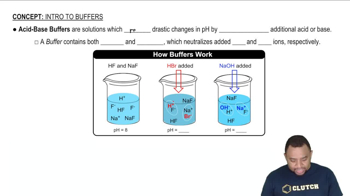
Buffer solutions are mixtures that can resist changes in pH upon the addition of small amounts of acid or base. In the context of the titration of ammonia (NH3), which is a weak base, the solution can act as a buffer when it contains both the weak base and its conjugate acid (NH4+), allowing for a more stable pH during the titration process.
Video consigliato:
Percorso guidato
Buffer Solutions
pH Calculation
The pH of a solution is a measure of its acidity or basicity, calculated as the negative logarithm of the hydrogen ion concentration. In titration problems, pH can be determined using the concentrations of the acid and base involved, the volume of titrant added, and the resulting equilibrium concentrations of the species present in the solution after the reaction has occurred.
Video consigliato:
Percorso guidato
pH Calculation Example
Pratica correlata
Domanda del libro di testo
944
views
Domanda del libro di testo
Calculate the pH at the equivalence point for titrating 0.200 M solutions of each of the following bases with 0.200 M HBr: (b) hydroxylamine 1NH2OH2.
1413
views
Domanda del libro di testo
A 20.0-mL sample of 0.150 M KOH is titrated with 0.125 M HClO4 solution. Calculate the pH after the following volumes of acid have been added: (d) 25.0 mL. (e) 30.0 mL.
Domanda del libro di testo
Consider the titration of 30.0 mL of 0.050 M NH3 with 0.025 M HCl. Calculate the pH after the following volumes of titrant have been added: (e) 61.0 mL (f) 65.0 mL.
1955
views
Domanda del libro di testo
Calculate the pH at the equivalence point for titrating 0.200 M solutions of each of the following bases with 0.200 M HBr: (a) sodium hydroxide (NaOH).