Ch.17 - Additional Aspects of Aqueous Equilibria
Brown - Chemistry: The Central Science 14th Edition
Brown14th EditionChemistry: The Central ScienceISBN: 9780134414232Non è quello che usi tu?Cambia libro di testo
Capitolo 17, Problema 37a,c

Predict whether the equivalence point of each of the following titrations is below, above, or at pH 7: (a) NaHCO3 titrated with NaOH (c) KOH titrated with HBr.

Guida verificata passo dopo passo
1
Identify the nature of the acid and base involved in each titration. For (a) NaHCO3 titrated with NaOH, NaHCO3 is a weak acid (bicarbonate ion) and NaOH is a strong base. For (c) KOH titrated with HBr, KOH is a strong base and HBr is a strong acid.
Understand the concept of equivalence point: It is the point in a titration where the amount of titrant added is enough to completely neutralize the analyte solution. The pH at the equivalence point depends on the strength of the acid and base involved.
For (a) NaHCO3 titrated with NaOH: Since NaHCO3 is a weak acid and NaOH is a strong base, the equivalence point will be above pH 7. This is because the conjugate base of the weak acid (carbonate ion) will hydrolyze to form a basic solution.
For (c) KOH titrated with HBr: Both KOH and HBr are strong, so the equivalence point will be at pH 7. This is because the neutralization of a strong acid with a strong base results in a neutral solution.
Summarize the results: (a) The equivalence point is above pH 7 due to the weak acid and strong base. (c) The equivalence point is at pH 7 due to the strong acid and strong base.

Risposta video verificata per un problema simile:

Questa soluzione video è stata consigliata dai nostri tutor come utile per risolvere questo problema.
Durata del video:
1m

Concetti chiave

Ecco i concetti essenziali che devi comprendere per rispondere correttamente alla domanda.

Acid-Base Titration

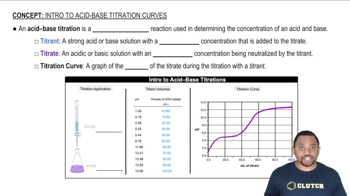
An acid-base titration is a quantitative analytical method used to determine the concentration of an acid or base in a solution. During the titration, a solution of known concentration (the titrant) is added to a solution of unknown concentration until the reaction reaches the equivalence point, where the amount of acid equals the amount of base. The pH at this point can vary depending on the nature of the acid and base involved.
Video consigliato:
Percorso guidato
03:04
Acid-Base Titration

Equivalence Point and pH

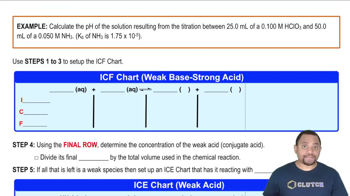
The equivalence point in a titration is the stage at which the amount of titrant added is stoichiometrically equivalent to the amount of substance in the sample solution. The pH at the equivalence point is influenced by the strength of the acid and base being titrated. Strong acid-strong base titrations typically have an equivalence point at pH 7, while weak acid-strong base or strong acid-weak base titrations can result in equivalence points that are below or above pH 7, respectively.
Video consigliato:
Percorso guidato
07:28
pH at the Equivalence Point Example

Buffer Solutions

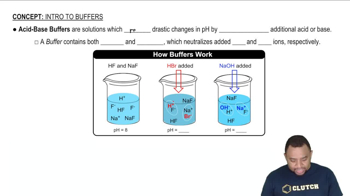
Buffer solutions are mixtures that can resist changes in pH upon the addition of small amounts of acid or base. In the case of NaHCO3 (sodium bicarbonate), it acts as a weak acid and can form a buffer system with its conjugate base, Na2CO3. This buffering capacity affects the pH during titration, particularly around the equivalence point, leading to a pH that may be above or below 7 depending on the titrant used.
Video consigliato:
Percorso guidato
03:02
Buffer Solutions