
Alcohol-based fuels for automobiles lead to the production of formaldehyde (CH2O) in exhaust gases. Formaldehyde undergoes photodissociation, which contributes to photo- chemical smog: CH2O + hn ¡ CHO + H The maximum wavelength of light that can cause this reac- tion is 335 nm. (d) Write out the formaldehyde photodis- sociation reaction, showing Lewis-dot structures.
Ch.18 - Chemistry of the Environment
Brown14th EditionChemistry: The Central ScienceISBN: 9780134414232Non è quello che usi tu?Cambia libro di testo
Capitolo 18, Problema 33b
Alcohol-based fuels for automobiles lead to the production of formaldehyde (CH2O) in exhaust gases. Formaldehyde undergoes photodissociation, which contributes to photo- chemical smog: CH2O + hn ¡ CHO + H The maximum wavelength of light that can cause this reaction is 335 nm. (b) What is the maximum strength of a bond, in kJ/mol, that can be broken by absorption of a photon of 335-nm light?
Guida verificata passo dopo passo1
Step 1: First, we need to calculate the energy of a photon of light with a wavelength of 335 nm. We can use the equation E = hc/λ, where E is the energy, h is Planck's constant (6.626 x 10^-34 J*s), c is the speed of light (3.00 x 10^8 m/s), and λ is the wavelength in meters. Remember to convert the wavelength from nm to m by multiplying by 1 x 10^-9.
Step 2: The energy obtained in step 1 will be in Joules. However, the question asks for the energy in kJ/mol. To convert the energy from Joules to kJ/mol, we need to use Avogadro's number (6.022 x 10^23 mol^-1). Multiply the energy obtained in step 1 by Avogadro's number and divide by 1000 to convert from Joules to kJ.
Step 3: The energy calculated in step 2 is the maximum energy that can be absorbed by a molecule of formaldehyde to break a bond. This energy corresponds to the maximum strength of a bond that can be broken by absorption of a photon of 335-nm light.

Risposta video verificata per un problema simile:
Questa soluzione video è stata consigliata dai nostri tutor come utile per risolvere questo problema.
Durata del video:
6mConcetti chiave
Ecco i concetti essenziali che devi comprendere per rispondere correttamente alla domanda.
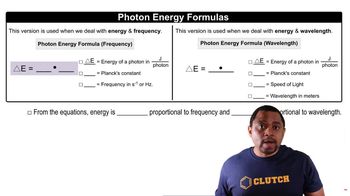
Photon Energy
The energy of a photon is directly related to its wavelength, described by the equation E = hc/λ, where E is energy, h is Planck's constant, c is the speed of light, and λ is the wavelength. For a photon with a wavelength of 335 nm, this relationship allows us to calculate the energy absorbed when the photon is absorbed by a molecule, which can lead to bond dissociation.
Video consigliato:
Percorso guidato
Photon Energy Formulas
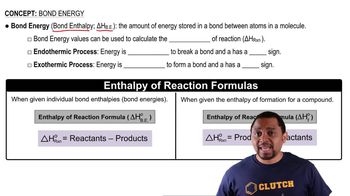
Bond Dissociation Energy
Bond dissociation energy is the amount of energy required to break a specific bond in a molecule, resulting in the formation of separate atoms or radicals. It is typically expressed in kJ/mol and is a critical factor in understanding how much energy is needed to initiate chemical reactions, such as the photodissociation of formaldehyde.
Video consigliato:
Percorso guidato
Bond Energy
Photodissociation
Photodissociation is the process by which a chemical bond is broken due to the absorption of light, resulting in the formation of reactive species. In the context of formaldehyde, the absorption of a photon can provide enough energy to break the C-H bond, leading to the production of carbonyl (CHO) and hydrogen (H) radicals, which are significant in atmospheric chemistry and smog formation.
Pratica correlata
Domanda del libro di testo
317
views
Domanda del libro di testo
(b) If a limestone sculpture were treated to form a surface layer of calcium sulfate, would this help to slow down the effects of acid rain? Explain.
339
views
Domanda del libro di testo
An important reaction in the formation of photochemical smog is the photodissociation of NO : NO2 + hv → NO(g) + O(g) The maximum wavelength of light that can cause this reac- tion is 420 nm. (a) In what part of the electromagnetic spec- trum is light with this wavelength found?
855
views
Domanda del libro di testo
An important reaction in the formation of photochemical smog is the photodissociation of NO : NO2 + hv → NO(g) + O(g) The maximum wavelength of light that can cause this reaction is 420 nm. (b) What is the maximum strength of a bond, in kJ/mol, that can be broken by absorption of a photon of 420-nm light?
