Ch.18 - Chemistry of the Environment
Brown - Chemistry: The Central Science 14th Edition
Brown14th EditionChemistry: The Central ScienceISBN: 9780134414232Non è quello che usi tu?Cambia libro di testo
Capitolo 18, Problema 24

Which of the following reactions in the stratosphere cause an increase in temperature there? (a) O(g) + O2(g) → O3+(g) (b) O3*(g) + M(g) → O3(g) + M*(g) (c) O2(g) + hv → 2 O(g) (d) O(g) + N2(g) → NO(g) + N(g) (e) All of the above

Guida verificata passo dopo passo
1
Identify the reactions that involve the absorption of energy, as these are likely to cause an increase in temperature.
Consider reaction (c): \(\text{O}_2(g) + h\nu \rightarrow 2 \text{O}(g)\). This reaction involves the absorption of ultraviolet light (hv), which provides energy to break the O-O bond in \(\text{O}_2\), leading to an increase in temperature.
Evaluate the other reactions to determine if they involve energy absorption or release. Reactions that release energy (exothermic) can also increase temperature.
Reaction (a) involves the formation of ozone, which is an exothermic process, potentially increasing temperature.
Conclude that reactions involving energy absorption or exothermic processes contribute to temperature increase in the stratosphere.

Risposta video verificata per un problema simile:

Questa soluzione video è stata consigliata dai nostri tutor come utile per risolvere questo problema.
Durata del video:
5m

Concetti chiave

Ecco i concetti essenziali che devi comprendere per rispondere correttamente alla domanda.

Stratospheric Chemistry

Stratospheric chemistry involves the study of chemical reactions that occur in the stratosphere, particularly those involving ozone (O3) and other atmospheric gases. The reactions can influence the concentration of ozone, which plays a crucial role in absorbing ultraviolet (UV) radiation from the sun, thereby affecting temperature and climate patterns.
Video consigliato:
Percorso guidato
00:58
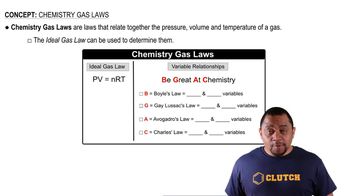
Chemistry Gas Laws

Photodissociation

Photodissociation is the process by which a chemical compound is broken down by photons, typically ultraviolet light. In the context of the stratosphere, the reaction O2(g) + hv → 2 O(g) illustrates how UV radiation can lead to the formation of reactive oxygen atoms, which can subsequently participate in other reactions that may affect temperature.

Ozone Formation and Depletion

Ozone formation and depletion are critical processes in the stratosphere that influence temperature. Reactions that produce ozone, such as O(g) + O2(g) → O3(g), can lead to warming as ozone absorbs UV radiation. Conversely, reactions that deplete ozone can lead to cooling effects, making it essential to understand these dynamics when analyzing temperature changes in the stratosphere.
Video consigliato:
Percorso guidato
00:46
Formation Equations Example 1