Ch.2 - Atoms, Molecules, and Ions
Brown - Chemistry: The Central Science 14th Edition
Brown14th EditionChemistry: The Central ScienceISBN: 9780134414232Non è quello che usi tu?Cambia libro di testo
Capitolo 2, Problema 70e

Give the names and charges of the cation and anion in each of the following compounds: (e) PbCO3.

Guida verificata passo dopo passo
1
Identify the chemical formula: PbCO_3.
Determine the cation in the compound: Pb (lead).
Determine the anion in the compound: CO_3 (carbonate).
Identify the charge of the carbonate ion: CO_3^{2-}.
Determine the charge of the lead cation by balancing the charges: Pb^{2+}.

Risposta video verificata per un problema simile:

Questa soluzione video è stata consigliata dai nostri tutor come utile per risolvere questo problema.
Durata del video:
3m

Concetti chiave

Ecco i concetti essenziali che devi comprendere per rispondere correttamente alla domanda.

Ionic Compounds

Ionic compounds are formed when cations (positively charged ions) and anions (negatively charged ions) bond together through electrostatic forces. In these compounds, the total positive charge from the cations must balance the total negative charge from the anions, resulting in a neutral overall charge for the compound.
Video consigliato:
Percorso guidato
02:11
Ionic Compounds Naming

Common Ions

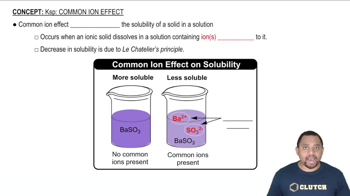
Common ions are specific ions that frequently occur in various compounds. For example, lead (Pb) can form a cation with a charge of +2 (Pb²⁺), while carbonate (CO3) is a common anion with a charge of -2 (CO3²⁻). Recognizing these common ions is essential for identifying the components of ionic compounds.
Video consigliato:
Percorso guidato
02:53
Common Ion Effect

Charge Balance

Charge balance is a fundamental principle in chemistry that states the total positive charge must equal the total negative charge in a neutral compound. When determining the cation and anion in a compound like PbCO3, it is crucial to ensure that the charges of the ions combine to yield a neutral compound, guiding the identification of the correct ions.
Video consigliato: